



Partial payment processing is the ability for a business to accept a payment that covers only part of the total amount due on a transaction or invoice. Stripe reports that businesses offering this option see about 20% faster invoice settlement times, which directly improves cash flow. For retail merchants managing large purchases, layaway programs, or customers with budget constraints, understanding partial payments is not optional. It is a competitive necessity. This guide covers how partial payment processing works, the key distinctions between partial authorization and split tender, and how to implement it without creating reconciliation headaches.
What is partial payment processing and how does it work?
Partial payment processing is a broad term that covers two distinct situations in retail: partial authorization and split tender. Knowing the difference is the first thing any merchant needs to get right.
Partial authorization is reactive. It happens when a card issuer approves less than the full transaction amount. For example, a customer tries to pay $200 on a debit card with only $150 available. The issuer approves $150 and returns a partial approval code. According to CorePOS documentation, merchants must detect this partial approval in the authorization response fields and treat it as an intermediate state, not a completed sale. The POS system must then prompt the cashier and customer for the remaining $50 through another payment method.

Split tender is planned and merchant-led. The customer intentionally pays with multiple payment types, such as a gift card plus a credit card. Oracle NetSuite POS handles this by reducing the amount due with each tender applied, guiding the cashier through the sequence until the full balance is satisfied. The receipt prints only after the total is covered.
The two scenarios require different POS handling, but they share one rule: the sale must stay open until the full amount is collected.
How ecommerce platforms handle split payments
In online retail, sequential payment processing keeps an order in a pending state until all payment steps are authorized. Oracle’s retail digital commerce platform describes this workflow explicitly. If a customer applies a store credit and then a credit card, the system processes each step one at a time. A successful first payment persists even if the second payment fails. This design prevents authentication overlaps and keeps the customer experience clean.
- The order stays in a pending state between payment steps.
- Each payment method is processed and confirmed before the next is requested.
- A failed second payment does not void the first approved payment.
- The order completes only when the full amount is authorized.
Pro Tip: If your ecommerce platform does not support sequential partial payment processing natively, check whether your payment gateway offers a split payment API before building a custom workaround.
What are the benefits of accepting partial payments?
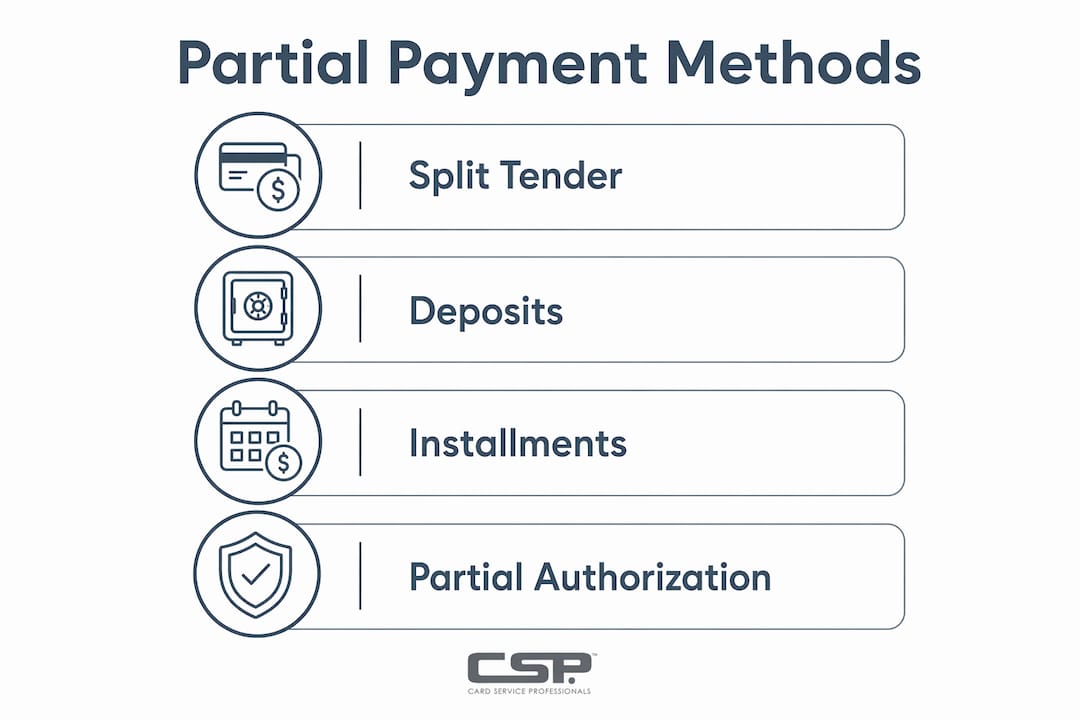
Accepting partial payments gives merchants a direct cash flow advantage. Partial payments reduce outstanding balances incrementally while invoices remain open until fully paid. That means money arrives sooner rather than waiting for a customer to gather the full amount.
The benefits extend beyond cash flow. For high-ticket retail items like furniture, appliances, or custom orders, requiring full payment upfront can kill a sale. Offering a deposit option or an installment schedule removes that barrier. The customer commits to the purchase, the merchant captures partial funds immediately, and both sides have a documented agreement.
“Partial payments reduce outstanding balances incrementally while invoices stay open until fully paid, giving merchants a steady stream of incoming funds rather than a single delayed lump sum.”
Industries that benefit most from partial payment options include:
- Furniture and home goods retailers taking deposits on custom or backordered items.
- Jewelry stores offering layaway or installment plans on high-value pieces.
- Auto parts and service shops collecting partial payment before ordering specialty parts.
- Wholesale and B2B suppliers invoicing with net terms and accepting partial remittances.
- Event and rental businesses requiring a deposit to hold inventory or a date.
Risk mitigation is another underrated benefit. When a customer cannot pay in full, accepting a partial payment is better than walking away with nothing. It also creates a documented payment history that supports collections if the balance goes unpaid.
What partial payment options can retailers offer?
Retailers have several practical partial payment options to choose from, and the right mix depends on the business model and customer base.
1. Split tender at the point of sale
Split tender is the most common partial payment method in physical retail. A customer pays part of the balance with a gift card and the remainder with a credit card. The cashier enters the gift card amount first, the system deducts it from the total, and then processes the remaining balance on the credit card. Oracle NetSuite POS automates this sequence, but any modern POS system should support it natively.
2. Deposits and balance-due invoices
For custom orders or high-value purchases, merchants collect a deposit upfront and invoice the remainder for a later date. Partial payments can be planned as a 50% upfront and 50% on delivery arrangement, or any split the merchant and customer agree on. The key is documenting the terms in the invoice so both parties have a clear record.
3. Installment payment plans
Installment plans break a total into fixed payments over time. This works well for retailers selling big-ticket items without a third-party buy-now-pay-later provider. The merchant manages the schedule internally, charges each installment on the agreed date, and keeps the invoice open until the final payment clears.
| Payment Option | Best For | Key Requirement |
|---|---|---|
| Split tender | In-store, multi-method checkout | POS system with multi-tender support |
| Deposit plus balance | Custom orders, high-value goods | Invoice with documented payment terms |
| Installment plan | Big-ticket retail, B2B invoicing | Recurring billing capability |
| Partial invoice payment | B2B, wholesale, net-term accounts | Accounting software with open invoice tracking |
Pro Tip: When setting up deposit invoices, always specify the exact balance due date and the consequences of non-payment in writing. A verbal agreement is not enough when a $2,000 balance is outstanding.
For merchants using retail payment solutions that integrate with accounting software, each partial payment should post as a separate line item against the original invoice. This keeps your books clean and makes reconciliation straightforward at month end.
What challenges come with partial payment processing?
The biggest operational mistake merchants make is treating a partial approval as a completed sale. Many POS systems end a sale immediately after any approval response, which causes errors when the approval covers only part of the total. The correct approach keeps the sale open, tracks the approved partial amount as one tender line, and prompts for the remaining balance.
Common challenges merchants face include:
- Incorrect sale closure: Closing a transaction after a partial approval leaves the remaining balance uncollected and creates a reconciliation gap.
- Cashier confusion: Without clear POS prompts, cashiers may not recognize a partial approval and assume the transaction is complete.
- Reversal complexity: If a customer cancels after a partial approval, only the approved partial amount is reversed. The cashier must understand this to avoid attempting a full void.
- Reporting gaps: Systems that do not show each tender separately make it hard to reconcile daily totals or investigate disputes.
- Customer confusion: Customers may not understand why they are being asked for a second payment method after their card was “approved.”
Aligning tender lines with the Amount Due and decrementing the balance with each tender applied is the technical standard that prevents most of these errors. Merchants evaluating a new POS system should ask vendors directly how the system handles partial approvals before signing a contract.
Pro Tip: Train cashiers specifically on the partial approval scenario. Show them what the screen looks like when a card is approved for less than the full amount. A five-minute training session prevents costly errors at the register.
Partial payment implementation must also support receipts, reporting, clearing, reversal, and dispute processes that show each partial tender separately for full transparency. If your current system bundles tenders into a single line, that is a gap worth addressing.
Key Takeaways
Partial payment processing works best when merchants distinguish between partial authorization and split tender, configure their POS to keep sales open after partial approvals, and document all payment terms clearly on invoices.
| Point | Details |
|---|---|
| Two distinct scenarios | Partial authorization is issuer-driven; split tender is a planned, merchant-led process requiring different POS handling. |
| Keep sales open | Never close a transaction after a partial approval. The sale must stay open until the full balance is collected. |
| Cash flow benefit | Businesses offering partial payment options report about 20% faster invoice settlement, per Stripe. |
| Document payment terms | Planned partial payments like deposits should be written into invoices and contracts to protect both parties. |
| Train your staff | Cashiers need specific training on partial approval screens to avoid errors and customer confusion at checkout. |
What I have learned from watching merchants get this wrong
Most merchants I talk to assume their POS handles partial payments correctly out of the box. That assumption costs them money. The gap between “the card was approved” and “the full amount was collected” is exactly where errors happen, and most of those errors go undetected until a monthly reconciliation turns into a two-hour investigation.
The distinction between partial authorization and split tender is not just a technical footnote. It changes how you train staff, how you configure your system, and how you handle reversals. A cashier who does not know the difference will close a $300 transaction after a $200 partial approval and hand the customer a receipt for a sale that was never fully paid.
Clear communication with customers matters just as much as the technical setup. When a customer’s card is approved for less than the total, they often feel embarrassed or confused. A well-trained cashier who calmly explains what happened and guides the customer to a second payment method turns a potentially awkward moment into a smooth checkout. That experience is what brings customers back.
The payment technology side is improving. Modern POS platforms and payment gateways are getting better at surfacing partial approval states clearly. But the merchant still needs to choose systems that support this workflow and integrate cleanly with accounting software. A partial payment that does not post correctly to your books is almost as bad as not collecting it at all.
— Jerry
How Card Service Professionals supports partial payment workflows
Retail merchants need payment systems that handle partial approvals, split tender, and installment plans without creating reconciliation problems. Card Service Professionals works with several of the leading merchant service providers in the U.S. to match retailers with the right POS equipment and processing solutions for their specific transaction needs.

Whether you are running a single storefront or managing multiple locations, Card Service Professionals offers competitive rates, cash discount programs, and full-service payment solutions that include multi-tender checkout support. The team helps merchants evaluate POS systems for partial payment capability before they commit. If you are ready to set up processing that handles every payment scenario correctly, the merchant sign-up application is the place to start.
FAQ
What is partial payment processing?
Partial payment processing is the ability for a business to accept a payment that covers only part of the total amount owed on a transaction or invoice. The sale or invoice stays open until the remaining balance is collected.
How does partial authorization differ from split tender?
Partial authorization happens when a card issuer approves less than the requested amount. Split tender is a planned process where a customer intentionally pays with multiple payment methods to cover the full total.
What happens if a customer cancels after a partial approval?
Only the approved partial amount is reversed. The merchant cannot void the full transaction amount because only a portion was authorized by the card issuer.
What partial payment options work best for retail merchants?
Split tender at the POS, deposit plus balance invoicing, and installment plans are the three most practical options for U.S. retailers. The right choice depends on average transaction size and whether sales are in-store or online.
How do partial payments improve cash flow?
Partial payments reduce outstanding invoice balances incrementally rather than waiting for a single full payment. Stripe reports that businesses using partial payment options settle invoices about 20% faster than those requiring full payment upfront.
Recommended
- Credit Card Processing Explained for U.S. Retailers – Card Service Professionals
- Types of Business Payment Solutions for U.S. Retailers – Card Service Professionals
- Pay by Phone Explained for U.S. Retail Merchants – Card Service Professionals
- What Is a Payment Processor? A Guide for Retailers – Card Service Professionals
