



Pin debit is a debit card transaction authenticated by a personal identification number, routing purchases through dedicated electronic funds transfer (EFT) networks such as STAR, NYCE, Pulse, and Accel rather than through Visa or Mastercard’s signature debit rails. These networks typically deliver lower interchange fees and faster settlement than signature debit, making pin debit one of the most underused cost controls available to U.S. retail merchants. The Durbin Amendment further shapes how these fees apply, depending on the size of the card-issuing bank. Understanding pin debit gives merchants a direct lever on processing costs without changing what customers pay.
What is pin debit and how does it differ from signature debit?
Pin debit is defined as a point-of-sale debit transaction where the cardholder enters a 4-to-6 digit PIN on a secure terminal to authorize payment. That PIN entry routes the transaction through EFT debit networks, not through the credit card networks that handle signature-based debit. The distinction matters because the routing path determines the fee structure, settlement speed, and fraud liability rules that apply to every transaction.
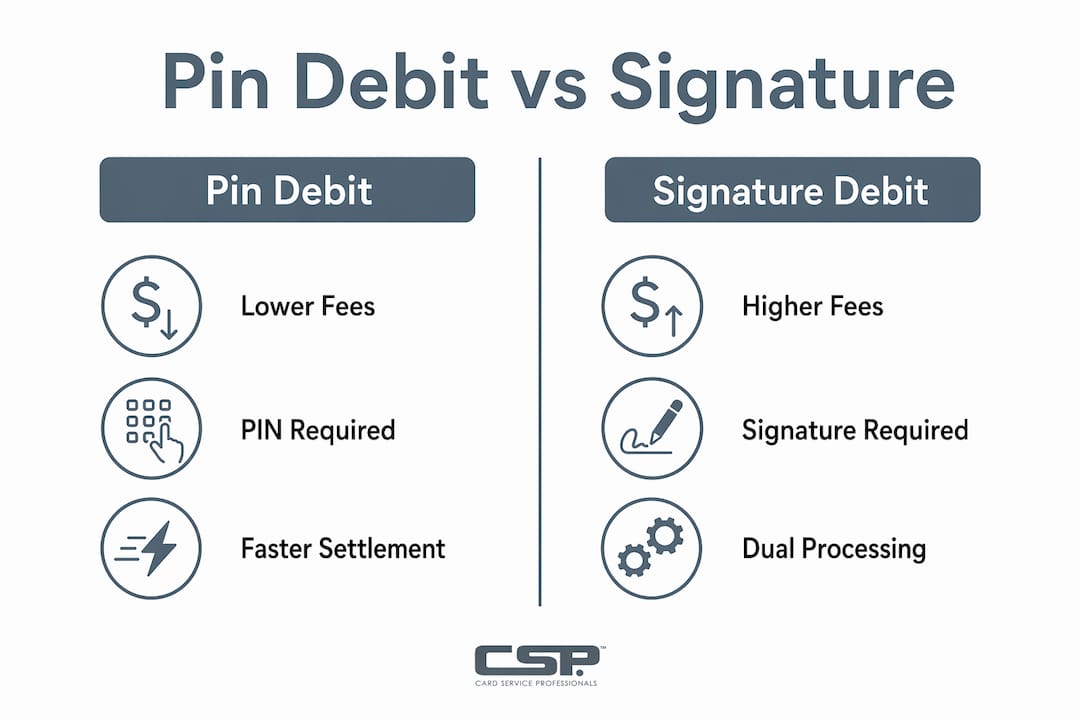
Signature debit uses dual-message processing. Authorization happens first, and clearing settles separately, typically 48–72 hours later. Pin debit uses single-message processing, combining authorization and clearing into one step. Settlement usually arrives within 24 hours. For a retail merchant managing cash flow, that difference is meaningful.
The fee structures also diverge in a counterintuitive way. Pin debit typically carries a lower percentage-based fee but a higher flat transaction fee per sale. Signature debit tends to carry a higher percentage fee with a lower flat fee. That structure makes pin debit the cheaper option on larger purchases, while signature debit can cost less on very small tickets.
How does pin debit work from authorization to settlement?
The pin debit transaction process moves fast. From card swipe or tap to authorization, the entire sequence typically completes in under 5 seconds. That speed comes from the single-message architecture used by EFT networks.
Here is the sequence a pin debit transaction follows:
- The customer inserts, swipes, or taps their debit card at a PIN pad-enabled terminal.
- The terminal prompts the customer to enter their PIN on the keypad.
- The terminal encrypts the PIN and sends the transaction data to the merchant’s payment processor.
- The processor routes the request through an EFT network such as STAR, NYCE, Pulse, or Accel.
- The network contacts the cardholder’s bank, which verifies the PIN and checks available funds.
- The bank sends an approval or decline back through the same network path.
- Authorization and clearing complete in a single message, and funds settle to the merchant account, usually within 24 hours.
Signature debit skips the PIN step entirely. The customer signs or taps without entering a code, and the transaction routes through Visa or Mastercard. That dual-message path adds settlement time and, in most cases, higher percentage-based fees.
Pro Tip: Confirm that your terminal is configured to prompt for PIN entry on every debit card swipe. A terminal that skips the PIN prompt defaults all debit transactions to signature debit, which costs more on mid-size and larger purchases.
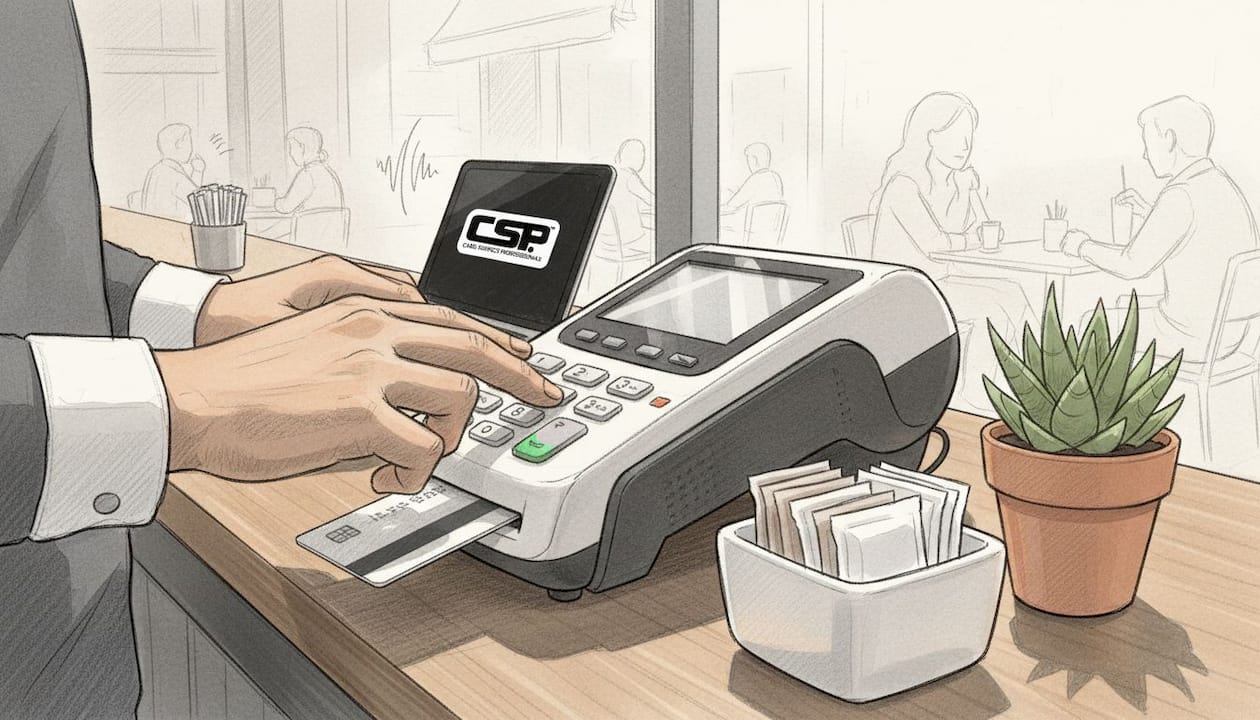
The terminal hardware matters here. Not every card reader includes a PIN pad. Merchants who process debit cards without a PIN pad-enabled device cannot access EFT network routing at all, regardless of their processor’s capabilities.
Pin debit vs. signature debit: cost comparison for retail merchants
The cost difference between pin debit and signature debit depends on transaction size, the issuing bank’s regulatory status, and how your processor routes transactions.
How the Durbin Amendment affects your fees
The Durbin Amendment caps interchange fees on debit cards issued by banks with assets over $10 billion. These are called regulated issuers. Cards from smaller banks and credit unions fall outside the cap and are considered unregulated. The fee difference between regulated and unregulated cards can be significant, and merchants often see both types in a single day’s transactions.
For regulated debit cards, the interchange cap applies to both pin and signature debit. For unregulated cards, the issuing bank sets its own rates, and those rates vary widely. Merchants on interchange-plus pricing see these differences directly on their processing statements.
Where pin debit saves money
The cost-effectiveness threshold for pin debit sits around $10–$15 per transaction. Below that amount, the flat fee on pin debit can outweigh the percentage savings. Above it, pin debit consistently costs less than signature debit on regulated cards.
Key cost factors to weigh:
- Percentage fee: Pin debit runs lower than signature debit on most regulated cards.
- Flat transaction fee: Pin debit charges a higher per-transaction flat fee, which matters most on small tickets.
- Settlement timing: Pin debit settles in roughly 24 hours versus 48–72 hours for signature debit, improving daily cash flow.
- Routing control: Merchants with processors that support routing optimization can direct transactions to the lowest-cost EFT network available.
Debit routing optimization is one of the easiest operational cost savings available to small businesses accepting debit cards. Most merchants never review their routing mix, which means they leave money on the table every month.
Does pin debit reduce fraud and chargeback risk?
Pin debit’s PIN authentication acts as a second verification layer that signature debit does not provide. A customer who enters the correct PIN proves physical possession of the card and knowledge of the secret code. That combination makes fraudulent disputes significantly harder to sustain.
“PIN debit’s authentication requirement reduces chargeback risk and makes fraudulent disputes harder for bad actors to sustain against merchants. When a PIN is entered correctly, the issuing bank bears greater responsibility for the transaction, shifting liability away from the merchant.”
For retail merchants, lower chargeback risk translates directly into fewer dispute fees, less administrative time, and a cleaner processing history. Processors and acquiring banks assess merchant risk partly based on chargeback ratios, so keeping that ratio low protects your account standing.
Benefits of pin debit’s security structure for merchants:
- Reduced chargeback exposure: PIN authentication shifts liability toward the issuing bank when a valid PIN was entered.
- Stronger fraud defense: A fraudster who steals a card number but not the PIN cannot complete a pin debit transaction at a physical terminal.
- Faster dispute resolution: Transactions with confirmed PIN entry are easier to defend in chargeback proceedings.
- Greater merchant confidence: Merchants accepting higher-value purchases benefit most from the added authentication layer.
The trade-off is customer convenience. Some shoppers prefer tapping or signing over entering a PIN, particularly for small purchases. Merchants should weigh that friction against the security and cost benefits, especially for their typical transaction size.
How to optimize your payment processing with pin debit
Most merchants accept whatever routing their terminal defaults to without reviewing whether it serves their cost interests. That default is almost always signature debit, because terminals without PIN pad configuration route all debit transactions through Visa or Mastercard automatically.
Review your processing statements
Your monthly processing statement shows where each transaction routed. Pin debit transactions appear under network names like STAR, NYCE, Pulse, or Accel. Signature debit transactions appear under Visa or Mastercard fee categories. If you see few or no EFT network entries, your terminal is likely defaulting to signature debit on every card swipe.
Practical steps to improve your pin debit routing:
- Verify that your terminal includes a physical PIN pad or an attached PIN entry device.
- Ask your payment processor whether your current setup supports EFT network routing.
- Request a statement review to identify your current routing mix between pin and signature debit.
- Ask whether your processor supports least-cost routing, which automatically selects the cheapest available network for each transaction.
- Check for payment processing red flags such as unexplained fee increases that may signal poor routing configuration.
Pro Tip: If your average transaction size is above $15, pushing more volume through pin debit routing will almost certainly reduce your monthly processing costs. Run the math on your last three statements using your actual interchange rates.
Match routing to transaction size
Pin debit is the better choice for purchases above the $10–$15 threshold. For very small tickets, signature debit’s lower flat fee may actually cost less. Merchants with a wide range of transaction sizes benefit from processors that support dynamic routing, selecting pin or signature debit based on which network delivers the lower fee for each specific transaction amount.
Understanding how your merchant account interacts with EFT networks is the starting point for any routing optimization effort. Without that knowledge, you cannot make informed decisions about terminal configuration or processor selection.
Key Takeaways
Pin debit is the most direct cost-control tool available to U.S. retail merchants accepting debit cards, and most merchants are not using it to its full potential.
| Point | Details |
|---|---|
| Pin debit definition | A debit transaction authenticated by a 4-to-6 digit PIN, routed through EFT networks like STAR, NYCE, Pulse, and Accel. |
| Settlement speed | Single-message processing settles pin debit within 24 hours, versus 48–72 hours for signature debit. |
| Cost threshold | Pin debit is typically cheaper than signature debit on purchases above $10–$15 due to its lower percentage fee. |
| Fraud protection | PIN authentication shifts chargeback liability toward the issuing bank, reducing merchant dispute exposure. |
| Optimization step | Review your processing statement for EFT network entries and confirm your terminal prompts for PIN on every debit swipe. |
Why merchants keep ignoring pin debit (and why that’s a mistake)
I have reviewed processing statements for merchants across retail categories, and the pattern is consistent. The debit routing section is almost always dominated by Visa and Mastercard signature fees. When I ask merchants about it, most have never thought about it. A few assume their processor handles it automatically. Almost none have ever asked their provider to configure EFT routing.
The misconception I hear most often is that pin debit is just a customer preference, not a merchant decision. That framing is wrong. Merchants control terminal configuration. Merchants choose processors. Merchants can request routing optimization. Every one of those decisions affects whether a debit card swipe costs you more or less money.
The debit routing optimization opportunity is real, and it is not complicated to act on. You do not need to change your bank, your processor, or your pricing model. You need to check your terminal settings and read your statement. That is it.
What I find most frustrating is that this is not a new issue. The Durbin Amendment created the regulatory framework for routing choice over a decade ago. The networks exist. The tools exist. Merchants just are not using them. If your processor has never raised this topic with you, that is worth noting. A good payment partner proactively identifies where you are overpaying.
— Jerry
Card Service Professionals can help you get more from pin debit
Card Service Professionals works with U.S. retail merchants to configure payment processing setups that actually reflect how debit transactions should route.

If your terminal is defaulting to signature debit on every swipe, you are likely overpaying on a significant portion of your debit volume. Card Service Professionals offers payment processing solutions with PIN pad-enabled terminal options and statement reviews that identify exactly where your routing mix is costing you money. Merchants can also explore the full range of business payment solutions available through Card Service Professionals, including cash discount programs and competitive interchange rates. Ready to see what optimized debit routing looks like for your store? Start your application and get a clear picture of what you could save.
FAQ
What is the pin debit definition in simple terms?
Pin debit is a debit card payment where the customer enters a PIN to authorize the purchase, routing the transaction through EFT networks like STAR, NYCE, Pulse, or Accel instead of Visa or Mastercard.
How does pin debit work at the point of sale?
The customer swipes or inserts their debit card, enters their PIN on a keypad, and the terminal routes the transaction through an EFT network using single-message processing. Authorization and settlement complete in a single step, typically within 24 hours.
What are the main advantages of pin debit for merchants?
Pin debit typically offers lower percentage-based interchange fees on purchases above $10–$15, faster settlement, and reduced chargeback risk because PIN authentication shifts liability toward the issuing bank.
How does the Durbin Amendment affect pin debit costs?
The Durbin Amendment caps interchange fees on debit cards from banks with assets over $10 billion. Those caps apply to both pin and signature debit on regulated cards, but unregulated cards from smaller banks carry rates set by the issuer, which can be higher.
Why is my terminal not processing pin debit transactions?
Terminals without a PIN pad or without proper EFT routing configuration default all debit transactions to signature debit. Confirming your terminal supports PIN entry and asking your processor to enable EFT routing resolves this issue.
Recommended
- What Is a Card Brand Fee? A Guide for U.S. Retailers – Card Service Professionals
- Retail Payment Processing Cost Audit Guide for Merchants – Card Service Professionals
- Credit Card Processing Explained for U.S. Retailers – Card Service Professionals
- Card Present vs Card Not Present: A Merchant’s Guide – Card Service Professionals
