



A merchant account is a specialized bank account that holds funds from card transactions before depositing them into your regular business checking account. Without one, your business cannot accept credit or debit card payments directly. For small to mid-sized U.S. retail merchants, understanding how merchant accounts work, what they cost, and how to get one is the foundation of any payment strategy. This article covers the merchant account definition, the application process, fee structures, and modern alternatives so you can make confident decisions about your payment setup.
How does a merchant account work in retail payment processing?
A merchant account acts as a temporary holding account between your customer’s card issuer and your business bank account. Funds typically settle within 1–3 business days after a transaction processes. That gap exists because several parties must verify, clear, and transfer the money before it reaches you.
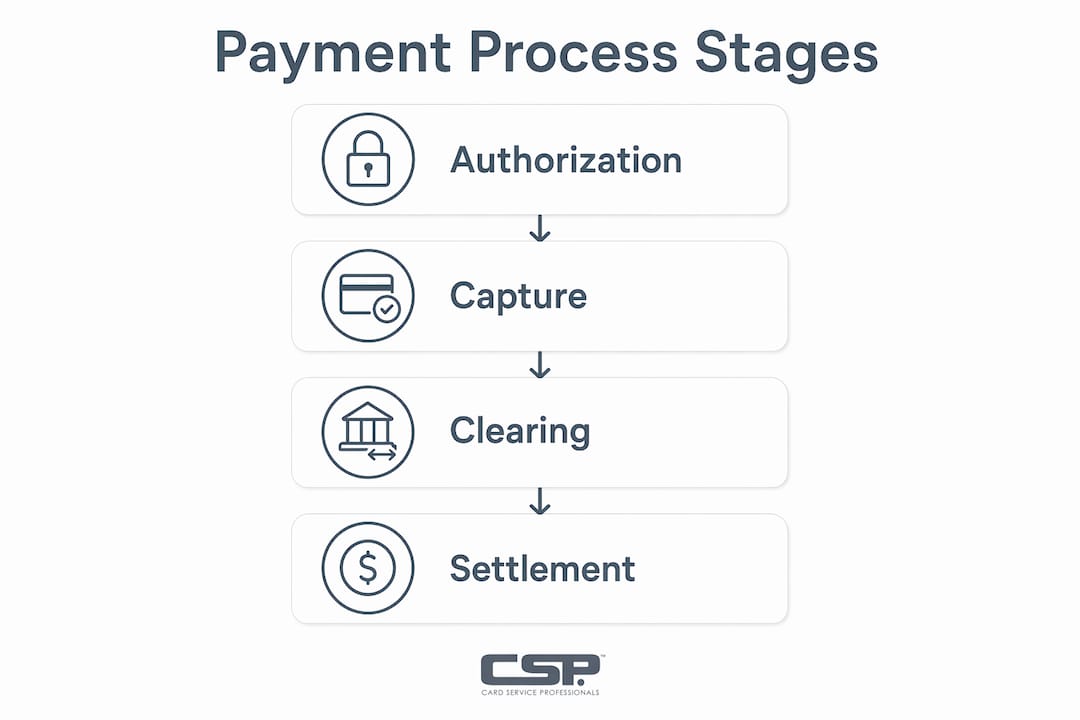
The payment flow moves through four stages: authorization, capture, clearing, and settlement.

| Stage | What Happens |
|---|---|
| Authorization | The card network checks the customer’s available funds and approves or declines the transaction. |
| Capture | The approved amount is flagged for collection, usually at the end of the business day. |
| Clearing | The acquiring bank and card network exchange transaction data and calculate amounts owed. |
| Settlement | Funds move from the issuing bank to your merchant account, then to your business bank account. |
Your acquiring bank sponsors your merchant account and takes on financial responsibility for your transactions. The payment processor handles the technical routing between the card networks, the issuing bank, and your account. Merchant accounts also manage authorization, fraud screening, chargebacks, and compliance, which a standard business checking account cannot do.
Chargebacks are a critical part of this system. When a customer disputes a charge, the funds are pulled back from your merchant account while the dispute is investigated. Merchants with high chargeback rates face higher fees or account termination.
Pro Tip: Set up automated chargeback alerts through your payment processor. Catching disputes early gives you time to respond with transaction evidence before the deadline.
What does the merchant account application process look like?
Getting a merchant account requires more documentation than opening a standard business bank account. The application process requires business registration documents, government-issued ID, bank statements, processing history, and often a website review.
Here is the typical step-by-step process:
- Gather your documents. Collect your EIN, business license, voided check, three to six months of bank statements, and any existing processing history.
- Complete the application. Fill out the acquiring bank or processor’s merchant application, which includes your business type, average transaction size, and estimated monthly volume.
- Submit to underwriting. The underwriter reviews your credit history, business financials, and risk profile. This stage can take anywhere from one day to six weeks depending on your business type.
- Personal guarantee review. Most providers require a personal guarantee, especially for new businesses or those with limited credit history.
- Approval and setup. Once approved, you receive your merchant ID, configure your point-of-sale equipment, and begin processing.
High-risk business categories, such as firearms retailers, CBD shops, or businesses with high chargeback histories, face rejection rates of 40–60% for dedicated merchant accounts. That is a significant barrier, and it pushes many merchants toward payment aggregators as a faster alternative.
Pro Tip: Pull your personal credit report before applying. Underwriters check it, and a score below 600 can trigger automatic rejection at many acquiring banks.
The key difference between a traditional merchant account and a payment aggregator is underwriting depth. Traditional accounts go through full underwriting. Aggregators onboard you in minutes by placing you under their master account, which trades speed for control.
What are the common fees associated with merchant accounts?
Merchant account fees are the most misunderstood part of payment processing. Most merchants focus on the transaction rate and miss the full picture. Typical fees include transaction fees of 1.0%–2.0%, monthly account fees of $0–$30, terminal rental of $20–$45 per month, chargeback fees of $15–$35 per incident, and setup fees of $0–$300.
Here is how traditional merchant accounts compare to payment aggregators on cost:
| Fee Type | Traditional Merchant Account | Payment Aggregator |
|---|---|---|
| Transaction fee | 1.0%–2.0% (interchange-plus or tiered) | Flat 1.6%–1.9% per transaction |
| Monthly account fee | $0–$30 | $0 |
| Terminal rental | $20–$45/month | Varies or purchase outright |
| Chargeback fee | $15–$35 per incident | $15–$25 per incident |
| Setup fee | $0–$300 | $0 |
The flat rate from aggregators looks attractive, but it costs more per transaction for high-volume merchants. A retailer processing $50,000 per month at 1.9% pays $950 in transaction fees. The same volume on an interchange-plus model through a traditional account might cost $700–$800 depending on card mix. That difference compounds fast over a year.
Several factors drive cost variability:
- Transaction volume. Higher volume gives you negotiating power with traditional providers.
- Average ticket size. Larger average transactions favor percentage-based pricing from aggregators less than flat-rate models.
- Business risk profile. High-risk categories pay more across all fee types.
- Card mix. Rewards cards and corporate cards carry higher interchange rates than standard debit cards.
Review your processing cost audit at least once a year. Providers adjust rates, and what was competitive two years ago may not be today.
What are the main alternatives to traditional merchant accounts?
Two alternatives stand out for U.S. retailers: payment aggregators and pay-by-bank methods.
Payment aggregators operate under a master merchant account and onboard sub-merchants with minimal friction, often in minutes to hours. That speed comes with trade-offs. Aggregators have more authority to place holds on your funds if their risk systems flag unusual activity. A sudden hold on your account during a busy sales period can be devastating for a small retailer.
Key trade-offs with payment aggregators:
- Pros: Fast setup, no monthly fees, no long-term contracts, simple flat-rate pricing.
- Cons: Less control over funds, higher risk of account holds, limited ability to negotiate rates, no dedicated underwriting relationship.
Pay-by-bank is a newer option that sends a payment request directly to the customer’s banking app for approval, bypassing card networks entirely. This method cuts fees significantly on large-ticket or recurring transactions because it avoids interchange fees. A furniture retailer processing a $2,000 sale saves meaningfully compared to running that charge on a rewards credit card.
Merchants processing over $100,000 per month typically favor dedicated merchant accounts for the pricing control and stability they provide. Smaller retailers or those just starting out often find aggregators or pay-by-bank methods a practical entry point.
Pro Tip: If you take recurring payments or large single transactions, ask your processor about pay-by-bank options. The fee savings on a $500+ transaction can exceed what you’d save from months of rate negotiation.
How to choose the right payment solution for your retail business
The right payment solution depends on your volume, risk profile, and how much control you need over your cash flow.
Use these factors to guide your decision:
- Monthly processing volume. Under $10,000 per month, a payment aggregator is usually the most practical choice. Over $50,000 per month, a dedicated merchant account with negotiated rates almost always costs less.
- Contract terms. Traditional merchant accounts often include one to three-year contracts with early termination fees. Read the contract before signing and watch for auto-renewal clauses.
- Technology integration. Confirm the processor integrates with your POS system, e-commerce platform, or inventory software before committing.
- Customer service. Payment problems happen at the worst times. Choose a provider with 24/7 support and a dedicated account rep if your volume justifies it.
- Compliance and security. All merchant accounts must comply with PCI DSS standards. Confirm your provider handles PCI compliance support or you will pay for it separately.
Watch for payment processing red flags like vague fee schedules, non-negotiable rate increases, and contracts that bury early termination penalties in fine print. Transparency from your provider is not optional. It is a baseline requirement.
Card Service Professionals works with several leading U.S. merchant service providers and can match your retail business to the right account type based on your actual volume and risk profile.
Key Takeaways
A dedicated merchant account gives high-volume U.S. retailers more pricing control, stability, and fraud protection than payment aggregators, making it the stronger choice once monthly processing exceeds $50,000.
| Point | Details |
|---|---|
| Merchant account definition | A specialized holding account that processes card payments before funds reach your business bank account. |
| Settlement timeline | Funds from card transactions typically settle within 1–3 business days through the acquiring bank. |
| Fee structure | Costs include transaction fees, monthly fees, terminal rental, chargeback fees, and setup fees. |
| Application requirements | You need business registration, bank statements, ID, and processing history to complete underwriting. |
| Choosing a solution | Match your choice to monthly volume: aggregators suit lower volumes, dedicated accounts suit higher volumes. |
What I’ve learned after years of watching merchants overpay
Most retail merchants I talk to have no idea what they actually pay per transaction once you add up every fee line. They know the headline rate. They don’t know the monthly fee, the terminal rental, the PCI non-compliance fee they forgot to address, and the chargeback fee from that one dispute six months ago. The real cost is almost always higher than the number on the sales sheet.
The other thing I see constantly is merchants staying with a provider out of inertia. They signed a three-year contract, the contract expired, and they never renegotiated. Providers count on that. Your leverage is highest right before renewal, and most merchants never use it.
Pay-by-bank is worth taking seriously if you sell high-ticket items. I’ve seen retailers save more on a single large transaction than they saved from an entire year of rate negotiation on smaller purchases. It’s not a replacement for card processing, but it’s a real tool for the right transaction types.
The merchants who manage their payment costs best treat it like any other operating expense. They audit it, they negotiate it, and they stay informed about alternatives. The types of payment solutions available to U.S. retailers have expanded significantly, and the merchants who know their options always end up in a better position than those who don’t.
— Jerry
Card Service Professionals can simplify your merchant account setup
Getting the right merchant account takes more than filling out an application. It takes knowing which providers fit your business type, volume, and risk profile before you apply.

Card Service Professionals is a U.S.-based independent sales agent working with several of the country’s leading merchant service providers. Whether you need a dedicated merchant account, a cash discount program, or a full credit card processing solution with modern POS equipment, the team matches you to the right fit at competitive rates. There are no generic packages. You get a solution built around your actual processing needs. Visit Card Service Professionals to start your application today.
FAQ
What is a merchant account in simple terms?
A merchant account is a specialized bank account that temporarily holds funds from card transactions before transferring them to your business checking account. It is required for any business that wants to accept credit or debit card payments directly.
How long does it take to get a merchant account?
Standard merchant account underwriting takes anywhere from one day to six weeks, depending on your business type and risk profile. High-risk businesses typically face longer review times and higher rejection rates.
What fees should I expect with a merchant account?
Typical fees include transaction fees of 1.0%–2.0%, monthly account fees up to $30, terminal rental of $20–$45 per month, and chargeback fees of $15–$35 per incident. Setup fees range from $0 to $300 depending on the provider.
What is the difference between a merchant account and a payment aggregator?
A merchant account is a dedicated account underwritten specifically for your business, while a payment aggregator places you as a sub-merchant under its master account. Aggregators offer faster setup but less control and a higher risk of fund holds.
Can I accept card payments without a merchant account?
Yes. Payment aggregators and pay-by-bank methods let you accept electronic payments without a dedicated merchant account. These options work well for lower-volume retailers, though high-volume merchants typically save money with a dedicated account and negotiated rates.
Recommended
- What Is Merchant Services? A Guide for U.S. Retailers – Card Service Professionals
- Credit Card Processing Explained for U.S. Retailers – Card Service Professionals
- Partial Payment Processing Explained for U.S. Retailers – Card Service Professionals
- Types of Business Payment Solutions for U.S. Retailers – Card Service Professionals
