



Credit card processing is the technology and service that moves payment data securely between your customer, your bank, and the card networks so funds land in your account. Every time a customer swipes, taps, or enters a card number, a chain of events fires across Visa, Mastercard, issuing banks, and payment processors like Stripe or Square. Understanding how that chain works, what it costs, and how to control those costs is the single most practical thing a retail merchant can do to protect margin.
How does credit card processing work, step by step?
Credit card processing follows a defined sequence: authorization, authentication, clearing, and settlement. Each phase involves different players and different risks. Knowing the sequence helps you spot where delays or declines originate.
The four core phases:
-
Authorization. Your customer presents a card. Your point-of-sale terminal or payment gateway sends the transaction details to your processor, which forwards them to the card network (Visa or Mastercard), which contacts the issuing bank. The issuing bank checks for available funds and fraud signals, then returns an approval or decline code within seconds.
-
Authentication and fraud checks. Before approval, the issuing bank runs the transaction through fraud models. For card-present sales, the chip or contactless tap provides cryptographic proof the physical card is present. For online sales, tools like 3D Secure add a second layer of verification.
-
Clearing. After the sale closes, your processor batches the day’s approved transactions and submits them to the card networks. The networks route each transaction to the correct issuing bank for final confirmation.
-
Settlement. The issuing bank transfers funds through the card network to your acquiring bank. Settlement typically completes in 1–3 business days. That timing gap is why your bank balance does not reflect sales instantly.
Payment gateways encrypt and transmit payment data between the customer, merchant, and banks, authorizing transactions within seconds while maintaining PCI DSS compliance. For online retailers, the gateway is the invisible engine running every transaction. For brick-and-mortar stores, the POS terminal plays the same role.
Pro Tip: Batch and close your terminal at the same time every day. Transactions left open past 24 hours can downgrade to higher interchange categories, which means higher fees.

What fee types make up credit card processing costs?
Credit card processing fees are layered, not flat. Most merchants see one blended rate on their statement and assume that is the whole story. It is not.
Interchange fees: the largest layer
Interchange represents 70%–80% of total processing costs for most merchants. Visa and Mastercard set these rates, and no processor can change them. Rates vary by card type, transaction method, and merchant category. A rewards card costs more to accept than a basic debit card. A keyed-in transaction costs more than a chip read.
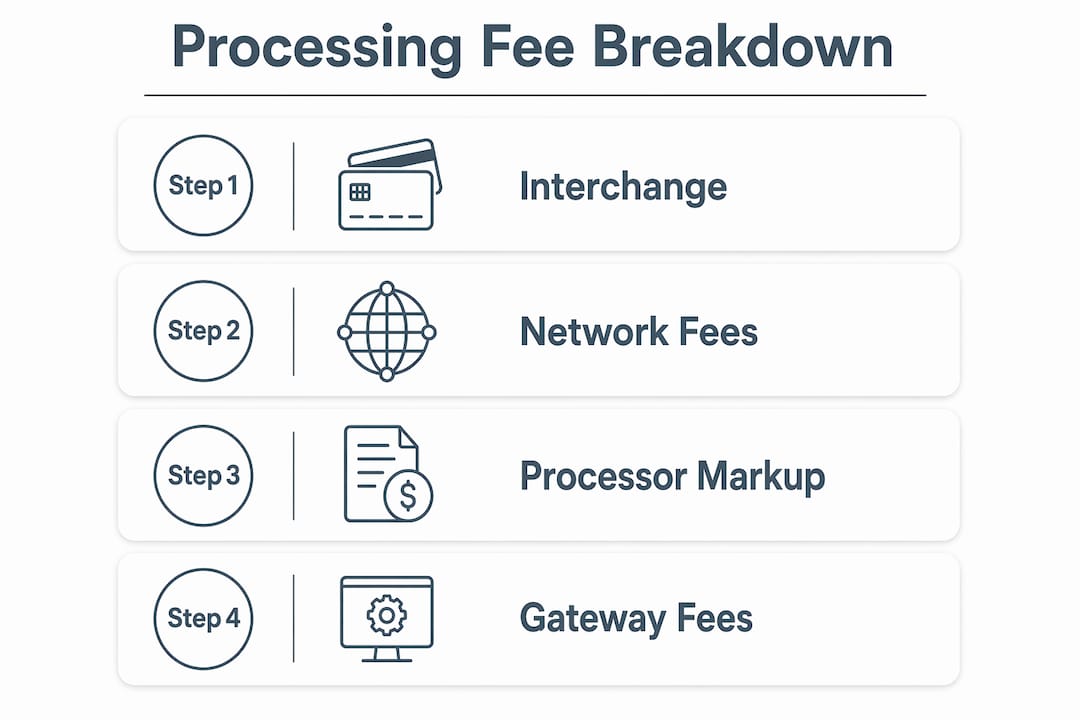
Network (scheme) fees
Card networks charge their own fees on top of interchange. Visa and Mastercard update network fees semiannually, and April 2026 updates alone are estimated to add roughly $3 billion annually in costs for U.S. merchants. These fees are small per transaction but add up fast at volume.
Processor markup
This is the one layer you can negotiate. Your processor adds a markup over interchange and network fees. The structure of that markup depends on your pricing model (covered in the next section).
Gateway and ancillary fees
Standalone payment gateways like Authorize.Net charge $25 or more per month plus $0.10 or more per transaction, on top of your processing rate. Some processors bundle gateway access into their pricing. Others do not. Always ask.
| Fee Type | Who Sets It | Negotiable? | Typical Range |
|---|---|---|---|
| Interchange | Visa / Mastercard | No | 0.05%–2.40% + flat fee |
| Network fees | Visa / Mastercard | No | 0.01%–0.15% per transaction |
| Processor markup | Your processor | Yes | 0.20%–0.50% + $0.08–$0.13 |
| Gateway fee | Gateway provider | Sometimes | $25+/month + $0.10+/transaction |
| Monthly/statement fees | Your processor | Sometimes | $10–$30/month |
Pro Tip: Ask every processor for an itemized fee schedule, not just a headline rate. If they cannot provide one, that is a red flag.
Which credit card processing model is right for your business?
Pricing model selection is where merchants leave the most money on the table. The right model depends on your monthly volume, average ticket size, and card mix.
Flat-rate pricing
Flat-rate pricing charges one fixed percentage on every transaction regardless of card type. Square charges 2.6% plus $0.10 for in-person swipes. Stripe charges 2.9% plus $0.30 for online transactions. This model is simple and predictable, which makes it a good fit for new merchants or very low-volume sellers. The tradeoff is that you overpay when your customers use basic debit cards, because the processor keeps the spread between your flat rate and the actual interchange cost.
Interchange-plus pricing
Interchange-plus pricing passes interchange and network fees through at cost and adds a fixed markup, typically 0.20%–0.50% plus $0.08–$0.13 per transaction. You see exactly what the networks charge and exactly what your processor earns. This model rewards higher-volume merchants because the processor margin is transparent and negotiable. Transparent pricing models like interchange-plus better serve higher-volume merchants by clarifying pass-through costs and processor margins.
Zero-fee (no-fee) processing
Zero-fee credit card processing shifts processing costs from the merchant to the customer through surcharges or dual pricing (cash versus card price). This model is legal in all 50 states, though some states restrict how surcharges are disclosed or capped. Merchants receive the full sale price. Customers cover the fee. Debit card transactions and some monthly fees typically remain the merchant’s responsibility. For merchants with thin margins, this model can eliminate a significant cost line.
Key considerations by model:
- Flat-rate: Best for under $10,000/month in card volume; simple but expensive at scale
- Interchange-plus: Best for merchants processing $10,000+/month; transparent and negotiable
- Zero-fee / cash discount: Best for margin-sensitive businesses; requires customer disclosure and network compliance
- Tiered pricing: Avoid this model. Processors control which tier each transaction falls into, which almost always benefits the processor, not you.
How can merchants reduce credit card processing fees?
Reducing processing costs does not require switching processors every year. It requires understanding what drives your fees and targeting the parts you can control.
-
Audit your transaction mix. Card type and transaction method heavily influence interchange fees. A transaction mix heavy in rewards cards or keyed-in entries costs significantly more than one dominated by chip-read debit cards. Pull a 90-day statement and categorize your transactions by card type. That data tells you where the cost is concentrated.
-
Negotiate processor markup and gateway fees. Negotiation targets the controllable components: processor markup, gateway fees, and monthly costs. Interchange is fixed. Everything above it is not. If your volume has grown since you signed your original agreement, use that as leverage.
-
Evaluate gateway integration carefully. Implementation choices such as incorporating a payment gateway versus direct POS integration affect both costs and your PCI DSS compliance burden. A bundled processor-gateway solution often reduces monthly fees and simplifies compliance. A standalone gateway gives you flexibility but adds cost layers.
-
Understand surcharge and cash discount rules in your state. Zero-fee programs are legal nationwide, but states like Connecticut and Massachusetts have specific restrictions. Before launching a surcharge program, confirm your state’s rules and your card network’s disclosure requirements.
-
Match your processor to your business type. A high-ticket furniture retailer has different needs than a coffee shop. Volume, average ticket, card mix, and chargeback risk all influence which processor and pricing model fits best. Review the types of ecommerce payment fees if you sell online, since online transactions carry different interchange categories than in-person sales.
Pro Tip: Request a fee review every 12 months. Processors rarely volunteer rate reductions, but most will negotiate when asked, especially if your volume has increased.
Key takeaways
Credit card processing costs are layered, and the only fees you can negotiate are the processor markup and gateway fees sitting above the fixed interchange base.
| Point | Details |
|---|---|
| Interchange dominates costs | Interchange represents 70%–80% of total processing costs and is set by card networks, not processors. |
| Settlement takes 1–3 days | Funds move from the issuing bank to your account within 1–3 business days after clearing. |
| Pricing model matters | Interchange-plus pricing is more transparent and cost-effective for merchants processing over $10,000/month. |
| Zero-fee is legal nationwide | Surcharge and cash discount programs shift fees to customers and are permitted in all 50 states with proper disclosure. |
| Gateway fees add up | Standalone gateways like Authorize.Net charge $25+/month plus per-transaction fees on top of processing rates. |
What i’ve learned after years of watching merchants overpay
Most merchants I work with have never read their processing statement line by line. They see a blended rate, compare it to a competitor’s blended rate, and think they are making an informed decision. They are not.
The real cost of accepting payments is not one number. It is interchange plus network fees plus processor markup plus gateway fees plus monthly minimums. A processor offering a 2.1% flat rate can cost more than one charging 1.8% interchange-plus, depending on your card mix. I have seen this play out dozens of times.
The merchants who control their processing costs best share one habit: they treat their processing statement like a utility bill they intend to audit. They know which card types their customers use most. They know what their processor earns per transaction. They ask for itemized breakdowns and they negotiate annually.
The second thing I have noticed is that many merchants avoid zero-fee programs because they worry about customer pushback. In practice, most customers accept a small card surcharge without complaint, especially when it is disclosed clearly at the point of sale. For a business running on 3%–5% margins, eliminating processing fees can be the difference between a profitable month and a break-even one.
My honest recommendation: start with your statement, identify your top three fee drivers, and negotiate from there. If your processor refuses to provide an itemized breakdown, that tells you everything you need to know about whether they are the right partner.
— Jerry
How Cardserviceprofessionals can lower your processing costs
Cardserviceprofessionals works with some of the leading merchant service providers in the world, which means you get competitive rates without doing the research yourself.

Whether you need interchange-plus pricing, a cash discount program, or a full POS setup, Cardserviceprofessionals matches your business to the right solution. The team reviews your current statement, identifies where you are overpaying, and presents options with transparent, itemized pricing. There are no hidden markups and no pressure to sign before you understand what you are getting. Visit Cardserviceprofessionals to see how the service works, or go straight to the merchant application to get started. You can also review what sets CSP apart from standard merchant service providers before you commit.
FAQ
What is credit card processing in simple terms?
Credit card processing is the system that moves payment data between your customer’s bank and your bank so you receive funds when a card is used. It involves authorization, clearing, and settlement across card networks like Visa and Mastercard.
How long does credit card settlement take?
Settlement typically takes 1–3 business days after the transaction is authorized and cleared. The exact timing depends on your processor and acquiring bank.
What is the difference between interchange-plus and flat-rate pricing?
Flat-rate pricing charges one fixed percentage on every transaction regardless of card type. Interchange-plus passes the actual interchange cost through to you and adds a fixed processor markup, making it more transparent and typically cheaper for higher-volume merchants.
Is zero-fee credit card processing legitimate?
Zero-fee processing is legal in all 50 states. It shifts processing costs to customers via surcharges or dual pricing. Merchants must follow card network disclosure rules and check state-specific restrictions before launching a program.
What fees can merchants actually negotiate?
Merchants can negotiate processor markup, gateway fees, and monthly account fees. Interchange and network fees are set by Visa and Mastercard and cannot be negotiated with any processor.
Recommended
- Card Service Professionals – Credit Card Processing Experts
- Sign Up Application – Card Service Professionals
- The CSP Advantage – Card Service Professionals
