



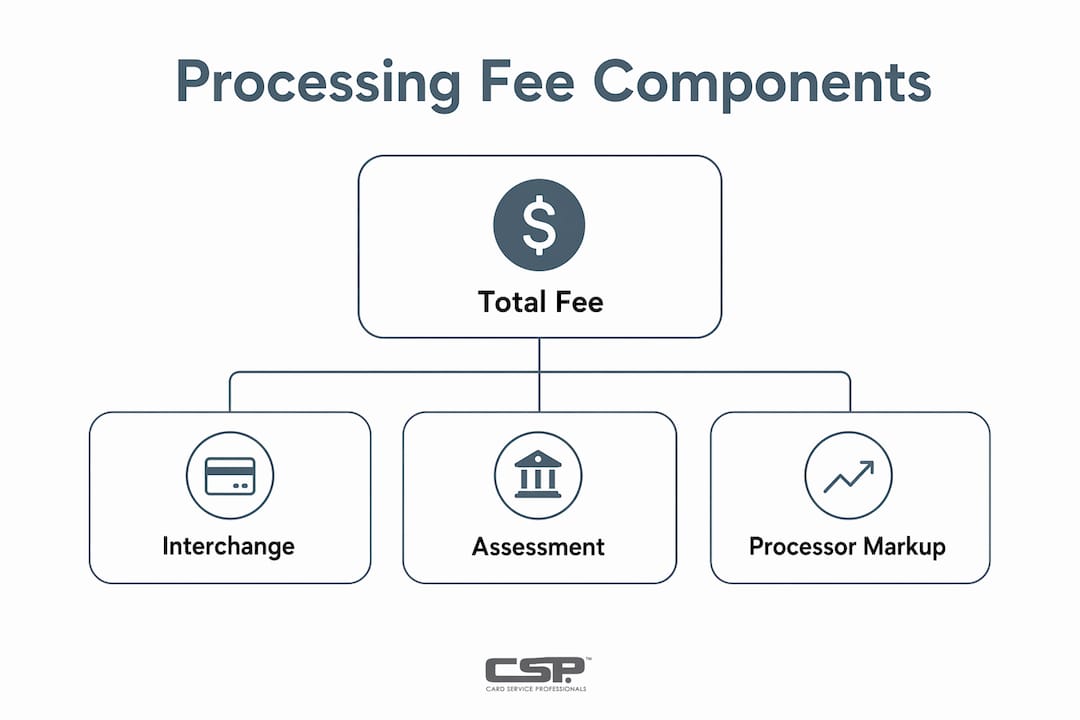
A processing fee is the total charge a merchant pays to accept a payment card transaction, covering costs split among the issuing bank, the card network, and the payment processor. Credit card processing fees typically range from 1.5% to 3.5% per transaction. On a $100 sale, that means fees commonly total $2.24, leaving $97.76 in the merchant’s pocket. Three parties collect a share: the card-issuing bank takes interchange, Visa or Mastercard collects an assessment, and your processor keeps a markup. Understanding all three components is the only way to know what you actually owe and what you can negotiate.
What is a processing fee, and what makes it up?
A processing fee is not a single charge. It bundles three distinct fees that flow to three different parties every time a customer swipes, taps, or dips a card.
Interchange fees go to the bank that issued the customer’s card. They are the largest slice of the total cost, ranging from 1.4% to 3.3% depending on card type, transaction method, and merchant category. Rewards cards carry higher interchange than basic debit cards. No processor can change this rate. It is set by Visa and Mastercard and is non-negotiable.

Assessment fees go directly to the card networks, Visa and Mastercard. These are fixed at roughly 0.13% to 0.16% per transaction. They are also non-negotiable. Together, interchange and assessments make up 70% to 90% of your total processing cost. That means the vast majority of what you pay is locked in before your processor ever enters the picture.
Processor markup is the only portion you can negotiate. This is the profit margin your payment processor adds on top of interchange and assessments. Markups vary from 0.1% to over 1% depending on your transaction volume, business type, and the pricing model you accepted when you signed up.
| Fee Type | Paid To | Negotiable? | Typical Range |
|---|---|---|---|
| Interchange | Card-issuing bank | No | 1.4%–3.3% |
| Assessment | Visa / Mastercard | No | 0.13%–0.16% |
| Processor markup | Your payment processor | Yes | 0.1%–1%+ |
Pro Tip: Ask your processor for an interchange-plus pricing statement. It shows each fee component separately, so you can see exactly what your processor charges versus what Visa or Mastercard requires.
How do processing fees affect your business costs?
Processing fees affect your bottom line on every single transaction. A merchant running $500,000 in annual card volume at a 2.5% effective rate pays $12,500 per year in fees. Shaving that rate by half a point saves $2,500 without changing a single product or price.
The effective rate is the clearest way to measure your true cost. Calculate it by dividing your total monthly fees by your total monthly card sales volume. An effective rate significantly above the sum of interchange plus assessments signals excess processor markup. That gap is money you may be able to recover through negotiation.
A common misconception trips up many merchants: confusing swipe fees with total processing fees. Swipe fees refer only to the interchange portion of the total cost. Treating them as the whole picture leads to incomplete cost analysis and weak negotiation. Knowing the difference lets you read your statement accurately and push back on the right line items.
Fees also shape pricing decisions. A merchant selling low-margin goods, such as a grocery store or gas station, feels a 2.9% fee far more sharply than a jewelry retailer with a 60% margin. Building your effective rate into your pricing model is not optional. It is a basic cost-of-goods calculation.
Pro Tip: Calculate your effective rate every month, not just at contract signing. Processors sometimes add fees gradually after the initial agreement, and a monthly check catches those changes early.
What are common hidden processing fees to watch for?
Hidden fees are the most expensive part of processing for merchants who do not read their statements carefully. Processors often bury extra charges in monthly billing that have little connection to actual transaction costs.
The most common examples of hidden processing fees include:
- Batch fees: Charged each time you close your daily batch of transactions. Processors pay a few cents per batch but often bill $0.10 to $0.25 each. On 300 batches per year, that adds up fast.
- Statement fees: A monthly charge simply for generating your billing statement. The actual cost to the processor is negligible.
- PCI compliance fees: Legitimate PCI DSS compliance has real costs, but many processors inflate this fee well beyond what compliance actually requires.
- Network access fees: Sometimes called network gateway fees, these are pass-through charges that processors mark up significantly.
- Annual fees and retrieval fees: Processors sometimes bundle extraneous fees like annual account fees or chargeback retrieval fees that carry very low actual cost but appear as significant line items on your statement.
Tiered pricing models make all of this worse. A tiered model splits transactions into qualified, mid-qualified, and non-qualified buckets. Tiered pricing obscures true costs by lumping fees together, making it nearly impossible to see what you actually pay in interchange versus markup. Most transactions end up in the mid-qualified or non-qualified tier, which carry the highest rates.
The clearest sign you overpay processing fees is an effective rate that runs more than 0.5% above the published interchange rate for your card mix. A second sign is a statement with more than five distinct fee line items beyond interchange and assessments. A third sign is a processor that cannot or will not provide an interchange-plus breakdown when you ask.
Pro Tip: Request a line-by-line statement audit from your current processor. If they refuse or cannot explain each charge, that is a red flag worth acting on.
How can merchants reduce their processing fees?
The single most effective way to reduce processing fees is to negotiate your processor markup. Interchange and assessment fees are fixed. The markup is not. High-volume merchants can negotiate markups as low as 0.1% to 0.3%, while smaller merchants often pay above 1%. Volume is your primary leverage point.
Here is a practical approach to reducing your fees:
- Calculate your effective rate before any negotiation. Know your current total cost as a percentage of sales. This is your baseline.
- Request interchange-plus pricing. This model passes interchange and assessments through at cost and adds a fixed processor markup. It is the most transparent structure available.
- Avoid flat-rate and tiered pricing models. Flat-rate pricing typically runs 2.6% to 2.9%, with hidden markups between 0.8% and 1.4% baked in. You pay for simplicity with higher overall costs.
- Audit your monthly statement for padded fees. Identify every charge beyond interchange and assessments and ask your processor to justify each one.
- Use your transaction profile as leverage. A merchant with high volume, low chargebacks, and card-present transactions is a low-risk account. Low-risk accounts command lower markups.
- Compare offers from multiple processors. Independent sales agents, like those at Card Service Professionals, work with several leading merchant service providers and can present competing rates without requiring you to negotiate each one separately.
Switching pricing models often delivers more savings than switching processors entirely. A merchant moving from a tiered model to interchange-plus frequently sees immediate cost reductions without changing any hardware or software.
Pro Tip: If you process more than $10,000 per month in card volume, you have enough leverage to negotiate. Do not accept the first rate you are offered.
Key Takeaways
Processing fees are made up of three components, and only one of them is negotiable. Merchants who understand this structure control their costs. Those who do not pay more than they should.
| Point | Details |
|---|---|
| Processing fee definition | A processing fee bundles interchange, assessment, and processor markup into one total charge per transaction. |
| Only markup is negotiable | Interchange and assessment fees are fixed by card networks; only the processor’s markup can be reduced. |
| Effective rate reveals overpayment | Divide total monthly fees by total card sales to find your effective rate and spot excess charges. |
| Hidden fees inflate costs | Batch fees, statement fees, and PCI fees often exceed actual costs and should be audited monthly. |
| Interchange-plus pricing wins | Interchange-plus pricing offers the clearest view of true costs and the best opportunity to reduce fees. |
What I have learned after years of watching merchants overpay
The most consistent mistake I see is merchants who negotiate hard on the wrong thing. They push back on interchange rates, which no processor can change, and accept the markup without question. That is backwards. The markup is the only number on your statement that reflects a business decision your processor made. Everything else is a pass-through.
The second pattern I see constantly is merchants who signed up for a flat-rate or tiered plan because it “seemed simple.” Simple pricing is not the same as low-cost pricing. Flat rates bundle a significant markup into a single percentage, and you never see it. Interchange-plus pricing feels more complex because it shows you more numbers. Those numbers are exactly what you need to see.
Reading a merchant statement line by line is not glamorous work. But merchants who do it consistently find fees that should not be there. I have seen statement fees, annual fees, and network access fees that added hundreds of dollars per year to accounts where the processor never mentioned them at signing.
My honest advice: treat your processing statement the same way you treat your lease or your supplier invoices. Review it every month. Question every new line item. Know your effective rate. And if your processor cannot explain a charge in plain language, that charge should not be on your statement.
— Jerry
How Card Service Professionals can lower your processing costs
Card Service Professionals works with several of the leading merchant service providers in the United States, which means we bring competitive rates to the table without requiring you to negotiate each provider separately.

Whether you need transparent credit card processing for a retail location, a cash discount program that eliminates processing fees entirely, or a full review of your current statement to find savings, Card Service Professionals has the tools and the relationships to help. Our team works with businesses across the U.S. to match merchants with the right pricing model for their transaction volume and card mix. If you are ready to take control of your payment costs, the sign-up application takes minutes to complete.
FAQ
What is the processing fee definition in simple terms?
A processing fee is the total cost a merchant pays to accept a card payment, made up of interchange fees, assessment fees, and a processor markup. It typically ranges from 1.5% to 3.5% per transaction.
What are examples of hidden processing fees?
Common hidden fees include batch fees, statement fees, PCI compliance fees, network access fees, and annual account fees. These charges often exceed their actual cost to the processor and can add hundreds of dollars per year to your bill.
How do I know if I overpay processing fees?
Calculate your effective rate by dividing total monthly fees by total card sales. If your effective rate runs significantly above the published interchange rate for your card mix, you are likely paying excess processor markup.
What is the difference between a swipe fee and a processing fee?
A swipe fee refers only to the interchange portion of the total cost, which goes to the card-issuing bank. A processing fee includes interchange, assessment fees, and the processor’s markup combined.
Can merchants negotiate their processing fees?
Merchants can only negotiate the processor markup portion of their fees. Interchange and assessment fees are set by card networks like Visa and Mastercard and are non-negotiable for all processors.
Recommended
- Credit Card Processing Explained for U.S. Retailers – Card Service Professionals
- What Is a Card Brand Fee? A Guide for U.S. Retailers – Card Service Professionals
- Retail Payment Processing Cost Audit Guide for Merchants – Card Service Professionals
- What Is a Payment Processor? A Guide for Retailers – Card Service Professionals
