



Payment processing for delivery services is the system that moves funds securely from a customer to a delivery business at the point of sale, whether online, in an app, or at the door. The industry term for this end-to-end system is merchant payment acceptance, and it covers everything from authorization to settlement. Credit and debit cards dominate digital payments, with over 70% of online shoppers relying on them. That figure means any delivery operation that skips card acceptance is already losing the majority of potential customers. Fast settlement is equally critical. Slow fund transfers create working capital gaps that can stall operations within weeks.
What are the most effective payment methods for delivery services?
The right payment mix for a delivery business depends on order volume, customer demographics, and whether transactions happen online, in an app, or at the door. Four categories cover most use cases.
Credit and debit cards remain the foundation of any payment strategy. They are widely accepted, familiar to customers, and supported by every major payment gateway. The tradeoff is interchange fees, which vary by card type and processor.
Digital wallets like Apple Pay and Google Pay are the fastest-growing option for mobile payment processing. Tokenization in digital wallets keeps raw card data off the merchant’s system entirely. That directly lowers your exposure to chargebacks and fraud disputes.
QR code payments at delivery convert a traditional cash-on-delivery handoff into a near-instant digital transaction. The customer scans a code on the driver’s phone or printed slip, pays through their banking app, and confirmation is instant without any hardware required. This method is particularly useful for last-mile operators who want to eliminate cash handling without investing in POS terminals for every driver.
ACH transfers and eChecks work well for recurring B2B delivery contracts. ACH payments are regulated and low-cost, but clearing typically takes one to three business days. They are not suited for same-day settlement needs.
| Payment Method | Best Use Case | Settlement Speed |
|---|---|---|
| Credit/debit card | All delivery types | 1–2 business days |
| Digital wallet | Mobile and app orders | 1–2 business days |
| QR code payment | At-door delivery | Near-instant confirmation |
| ACH/eCheck | Recurring B2B contracts | 1–3 business days |
Pro Tip: Set up Apple Pay and Google Pay alongside card acceptance from day one. Customers who use digital wallets complete checkout faster and abandon orders less often.
How do variable order amounts complicate delivery payment processing?
Variable order totals are the defining challenge of delivery payment infrastructure. A customer orders groceries online, but item availability changes by the time the driver picks up the order. The final charge differs from the authorized amount. Generic payment systems have no clean way to handle this.
Traditional card pre-authorizations create a specific problem here. Pre-auth holds can last up to 30 days if voided incorrectly. A customer who sees a frozen balance on their account for a month will complain, dispute the charge, or stop ordering entirely.
Two technologies solve this problem cleanly.
Variable Recurring Payments (VRP) allow a merchant to set a capped authorization at checkout and then adjust the final charge at fulfillment. VRP avoids repeated customer authentication while keeping the final amount within the approved ceiling. The customer authorizes once, and the system handles the rest.
Network tokenization goes further. It replaces raw card data with a secure token that the merchant can use for post-purchase adjustments. Network tokenization enables indefinite post-purchase charge adjustments without re-authentication or exposing sensitive card details. This is the right tool for adding a tip after delivery or correcting a quantity discrepancy.
- VRP works best for subscription-style or recurring delivery models with predictable order ranges.
- Network tokenization suits on-demand delivery where the final amount is confirmed only after the driver completes the run.
- Both methods reduce disputes because the customer is never surprised by an unexpected hold or double charge.
Pro Tip: Ask your payment processor specifically whether they support network tokenization. Many entry-level processors do not, and that gap will cost you in disputes as your order volume grows.
How to implement payment processing solutions for your delivery business
A structured rollout prevents the most common mistakes: choosing a processor that cannot handle delivery-specific workflows, or deploying mobile payment tools without training drivers.
-
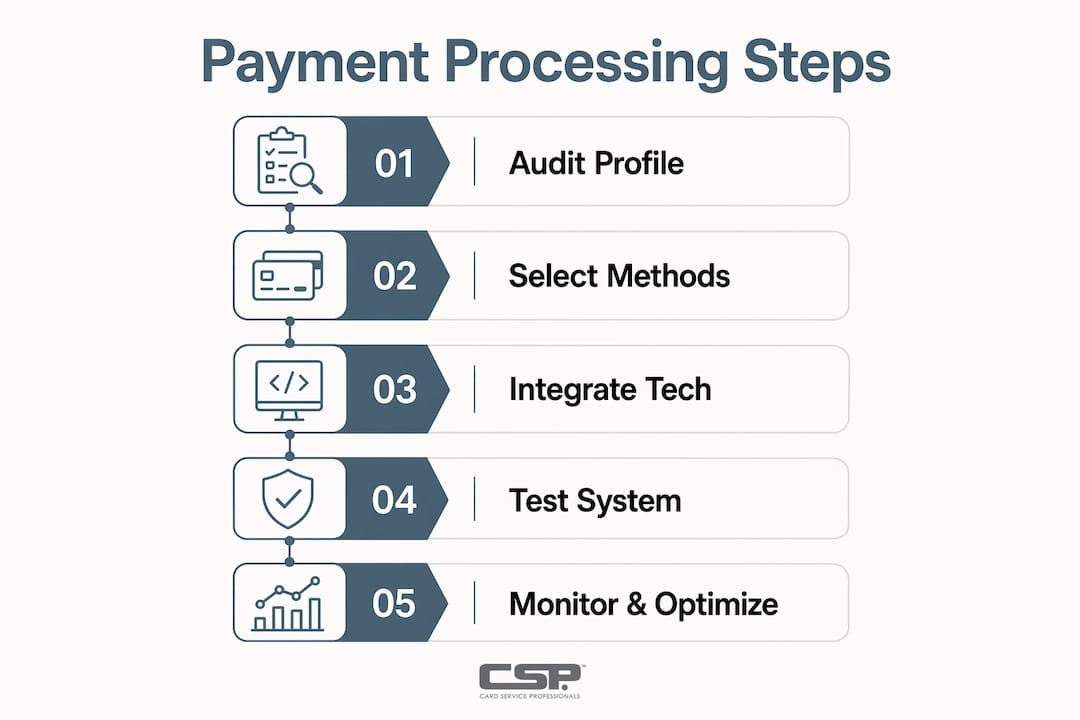
Audit your transaction profile. Calculate your average order value, monthly volume, and the percentage of orders that change between checkout and delivery. These numbers determine which processor tier and pricing model fits your operation.
-
Select a payment gateway compatible with delivery workflows. Look for gateways that support partial payment processing, dynamic authorization, and mobile SDK integration. A gateway built for retail point-of-sale will not handle variable basket amounts without custom workarounds.
-
Integrate payment options across every customer touchpoint. Online ordering pages, branded payment links, and in-app checkout should all route through the same processor. Fragmented payment flows create reconciliation headaches and inconsistent customer experiences.
-
Equip drivers for digital acceptance. Drivers need a clear, simple method to accept payment at the door. QR codes printed on delivery slips or displayed on a phone screen require no hardware investment. For higher-volume operations, a compact mobile card reader connected via Bluetooth handles tap-to-pay and chip cards.
-
Activate fraud and chargeback management tools. Delivery businesses face a specific fraud pattern: customers claim non-delivery to dispute a charge. Require digital proof of delivery, including a photo or GPS-confirmed drop-off, and link that record to the transaction in your payment system.
| Implementation Step | Key Action | Common Mistake to Avoid |
|---|---|---|
| Audit transaction profile | Calculate average order value and volume | Skipping this leads to wrong pricing tier |
| Select gateway | Confirm VRP and tokenization support | Choosing retail-only gateways |
| Driver training | Practice QR and mobile card acceptance | Assuming drivers will figure it out |
| Fraud tools | Link delivery proof to each transaction | Relying on customer trust alone |
Troubleshooting common payment challenges in delivery operations
Even well-configured payment systems run into friction. Knowing the most common failure points lets you fix them before they affect customers or cash flow.
Delayed pre-authorization release is the most frequent complaint. If a driver marks an order as undeliverable but the pre-auth is not voided immediately, the customer’s funds stay frozen. Build an automatic void trigger into your order management system so that any canceled delivery releases the hold within hours, not days.
Failed transactions at the door happen when a customer’s card declines after the order is already prepared. Pre-delivery payment confirmation, where the customer pays or confirms payment intent before the driver leaves the warehouse, eliminates this problem almost entirely. Customer verification workflows before dispatch lower failed deliveries and protect your margins.
Cash-on-delivery reconciliation creates daily accounting gaps when drivers collect cash but settlements are recorded digitally. The cleanest fix is to phase out cash entirely by offering QR code payment as the default at-door option. QR-based instant payments at delivery remove the need for cash handling and cut reconciliation time significantly.
Settlement delays affect working capital directly. Advanced payment-on-delivery platforms can settle funds within 1 working day. That speed matters when you are paying drivers daily and restocking inventory weekly.
Delivery businesses that rely on next-day settlement can fund daily operations without drawing on a credit line. Slow settlement is not just an inconvenience. It is a cash flow risk.
Key takeaways
Effective payment processing for delivery services requires matching your technology to the specific demands of variable orders, mobile acceptance, and fast settlement.
| Point | Details |
|---|---|
| Card and wallet acceptance | Accept credit, debit, and digital wallets to capture over 70% of digital payment preferences. |
| Variable order handling | Use VRP or network tokenization to manage changing totals without re-authenticating customers. |
| QR codes replace cash | QR payment at delivery eliminates cash handling and cuts reconciliation time for drivers. |
| Fast settlement matters | Choose processors that settle within 1 working day to protect daily operating cash flow. |
| Fraud prevention | Link digital proof of delivery to each transaction to reduce false non-delivery disputes. |
What I’ve learned about payment tech in last-mile delivery
The operators who struggle most with payment processing are not the ones using the wrong tools. They are the ones using generic tools and expecting delivery-specific results. A standard retail payment setup works fine at a checkout counter. At the door of a customer’s home, with a variable order total and a driver who needs to move to the next stop, it falls apart fast.
The shift I recommend most often is moving away from traditional pre-authorizations toward network tokenization. The 30-day hold risk alone is enough to damage customer relationships at scale. Once you tokenize, you can adjust the final charge cleanly, add a tip, or correct a quantity error without touching the customer again. That is the kind of payment experience that builds repeat orders.
I also think the industry underestimates how much QR code payments change driver operations. Removing cash from the equation is not just about security. It cuts the end-of-day reconciliation process from an hour to minutes. Drivers close out faster. Errors drop. And customers who pay digitally at the door are easier to track for loyalty programs and reorder campaigns.
The last thing I tell every delivery operator: audit your processing costs before you sign anything. Interchange fees, gateway fees, and monthly minimums add up differently at 500 orders per month versus 5,000. Card Service Professionals works with multiple leading merchant service providers across the U.S., which means the rate comparison happens before you commit, not after.
— Jerry
Payment solutions built for U.S. delivery operators
Delivery businesses have payment needs that off-the-shelf merchant accounts were not built to handle. Variable order totals, mobile acceptance at the door, and same-day settlement requirements all demand a setup that goes beyond basic card processing.
Card Service Professionals works with several of the leading merchant service providers in the United States, giving delivery operators access to competitive processing rates, cash discount programs, and the full range of electronic payment options. Whether you need a mobile card reader for drivers, a QR code payment workflow, or dynamic authorization for variable baskets, the right solution exists. Visit the sign-up application to get a customized quote or speak with a specialist about your specific delivery operation.
FAQ
What is payment processing for delivery services?
Payment processing for delivery services is the system that authorizes, routes, and settles customer payments for delivery transactions, whether online, in an app, or at the door. It covers card acceptance, digital wallets, QR payments, and settlement into the merchant’s account.
What are the best payment apps for delivery drivers?
The best mobile payment processing options for drivers combine QR code payment display with a compact Bluetooth card reader for tap-to-pay and chip cards. This setup requires no fixed hardware and handles both digital wallet and card payments at the door.
How do I handle variable order totals in delivery payment processing?
Variable Recurring Payments (VRP) and network tokenization are the two most effective tools. VRP sets a capped authorization at checkout and adjusts the final charge at fulfillment. Network tokenization allows post-delivery adjustments, like tips or quantity corrections, without re-authenticating the customer.
How fast can delivery businesses receive payment settlements?
Advanced payment-on-delivery platforms settle within 1 working day. Choosing a processor that supports next-day settlement is one of the most direct ways to protect daily operating cash flow.
How do I reduce chargebacks in delivery payment processing?
Link digital proof of delivery, such as a GPS-confirmed drop-off or a photo, to every transaction record. This documentation is the most effective defense against false non-delivery disputes and is recognized by card networks during the chargeback review process.
Recommended
- Accepting Payments for Service Businesses: 2026 Guide – Card Service Professionals
- Card Service Professionals – Credit Card Processing Experts
- Partial Payment Processing Explained for U.S. Retailers – Card Service Professionals
- Retail Payment Processing Cost Audit Guide for Merchants – Card Service Professionals
