



A payment aggregator is a model where multiple merchants share a single master merchant account, enabling near-instant onboarding without traditional underwriting. A dedicated merchant account, by contrast, is an individually underwritten account tied directly to your business through an acquiring bank. The aggregator vs merchant account decision shapes your cash flow, pricing, and operational risk every day you run your store. U.S. retail merchants who understand this distinction make smarter choices about which model fits their volume, risk profile, and growth plans.
What is the difference between an aggregator and a merchant account?
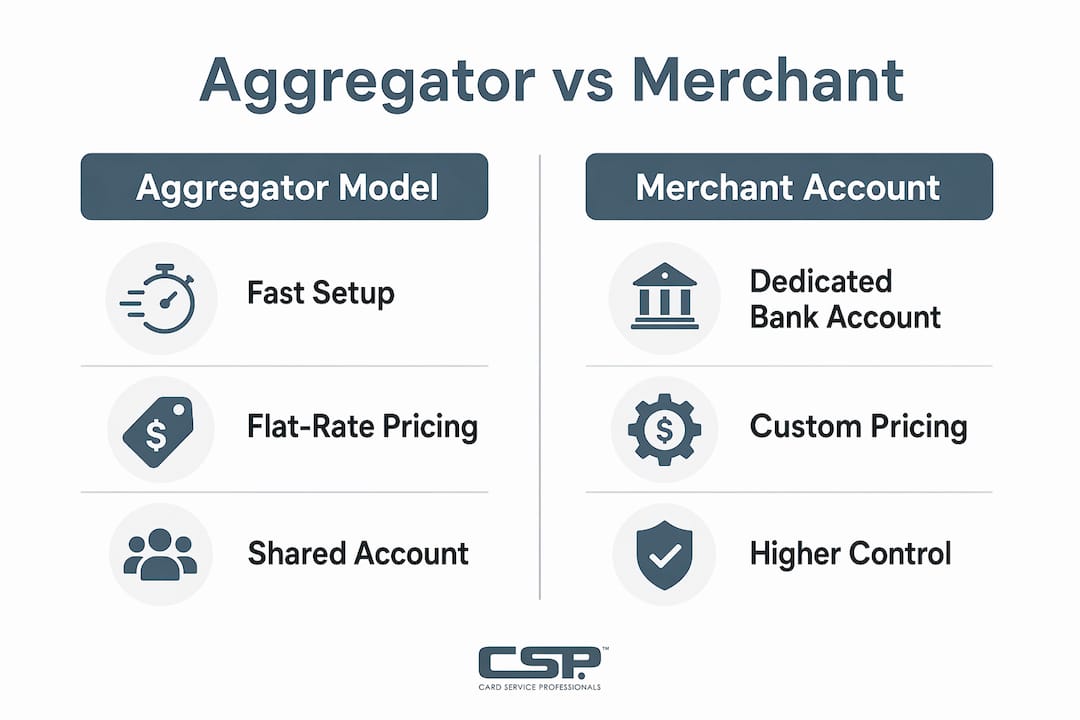
A payment aggregator onboards sub-merchants under its own master account, acting as the merchant of record with card networks like Visa and Mastercard. You sign up, pass a basic identity check, and start accepting cards within hours. There is no formal underwriting, no paper application, and no waiting for bank approval.
A dedicated merchant account works differently. Your business applies directly with an acquiring bank, which evaluates your industry, processing history, and chargeback record before issuing a unique Merchant Identification Number (MID). That MID ties every transaction directly to your business, not to a shared pool. The underwriting process takes days or weeks, but the result is a direct banking relationship you own.

The core trade-off is speed versus control. Aggregators win on setup time. Dedicated accounts win on stability, pricing flexibility, and long-term cost efficiency. Industry analysts note that merchants often misunderstand these as identical services when the operational differences are significant.
How does a payment aggregator work, and who benefits most?
Payment aggregators pool all their sub-merchants under one master account. Fast onboarding with minimal documentation means a new retailer can start processing the same day they sign up. No credit check, no business history review, no formal contract negotiation.
The pricing model is flat-rate. You pay a fixed percentage per transaction regardless of card type. That predictability is useful when you are just starting out and cannot forecast monthly volume. There are no monthly minimums, which protects you during slow seasons.
The downside is risk pooling. Because the aggregator is responsible for all sub-merchants collectively, its automated systems monitor the entire portfolio. A spike in chargebacks anywhere in that pool can trigger holds on your funds, even if your own account is clean.
Merchants best suited for aggregator solutions:
- New businesses with no processing history
- Retailers processing below $10,000 per month
- Standard-risk product categories like apparel, gifts, or home goods
- Seasonal sellers who need payment capability without long-term commitments
- Businesses testing a new sales channel before committing to a full setup
Pro Tip: If you are launching a pop-up shop or a new product line, an aggregator gets you processing fast. Plan your transition to a dedicated account before you hit $10,000 in monthly volume, not after.
What is a dedicated merchant account, and when should U.S. retailers choose it?
A dedicated merchant account gives your business its own direct relationship with an acquiring bank. The bank underwrites your application by reviewing your business type, average ticket size, chargeback history, and financial stability. That review takes time, but it produces a customized agreement built around your specific risk profile.
Pricing under a dedicated account uses the interchange-plus model. You pay the actual interchange rate set by Visa or Mastercard, plus a fixed markup negotiated with your processor. At higher volumes, this structure consistently costs less than flat-rate aggregator pricing. Merchants processing over $10,000–$25,000 monthly typically see meaningful savings by switching to a dedicated account.
Retailers who benefit most from dedicated merchant accounts:
- Businesses with monthly volume above $10,000
- High-average-ticket retailers like furniture, electronics, or jewelry stores
- Merchants in higher-risk categories requiring tailored underwriting
- Businesses with complex payment needs such as recurring billing or B2B invoicing
- Retailers who have experienced aggregator freezes and need stable fund access
Pro Tip: Negotiate your rolling reserve terms and chargeback thresholds before signing any merchant account contract. These terms are fixed at signing and are much harder to change later. Card Service Professionals can walk you through what to look for.
The onboarding timeline for a dedicated merchant account runs from a few days to two weeks. That delay is worth accepting if your volume and business profile justify the long-term savings and stability.
What are the key differences in risk management and fund stability?
Risk management is where aggregators and dedicated accounts diverge most sharply in practice. Aggregators use automated algorithms to monitor their entire sub-merchant portfolio. Algorithmic freezes triggered by volume spikes or chargeback anomalies can lock your funds without warning and without human review. Your account may be clean, but a problem elsewhere in the portfolio affects you.
Aggregator risk management is reactive by design. Businesses can face frozen accounts triggered by patterns entirely unrelated to their own transactions. When an algorithm flags the portfolio, every sub-merchant in that pool is exposed. That is not a flaw in the system. It is the system.
Dedicated merchant accounts handle risk differently. Your reserve terms, chargeback thresholds, and fund hold conditions are negotiated upfront in your contract. You know exactly what triggers a hold and how long it lasts. That predictability matters when you are managing payroll, inventory, and supplier payments.
| Risk factor | Aggregator model | Dedicated merchant account |
|---|---|---|
| Account freeze trigger | Automated, portfolio-wide | Contractually defined, account-specific |
| Reserve terms | Applied reactively, post-incident | Negotiated upfront at signing |
| Human review on disputes | Rare, algorithm-driven | Standard, with direct bank contact |
| Fund hold duration after termination | Months, often without notice | Defined in contract |
| Chargeback response | Automated account action | Managed dispute process |
Aggregators also commonly retain rolling reserves and pending balances for months after account termination, unlike dedicated accounts where these terms are set in writing before you process a single transaction. For a retailer managing tight cash flow, that distinction is critical.
How do pricing models compare as your volume grows?
Flat-rate pricing from aggregators charges a single percentage on every transaction, regardless of whether the customer pays with a debit card, a rewards Visa, or a corporate Mastercard. That simplicity is useful at low volumes. Flat fees become expensive once monthly processing exceeds roughly $10,000–$25,000. At that point, the spread between flat-rate and interchange-plus pricing adds up to real money.
Interchange-plus pricing passes the actual network cost through to you, then adds a transparent markup. A debit card transaction costs less than a premium rewards card, and you pay accordingly. That granularity rewards merchants who understand their card mix.
| Monthly volume | Aggregator flat-rate cost (est. 2.9%) | Interchange-plus cost (est. 2.1% blended) | Estimated monthly savings |
|---|---|---|---|
| $5,000 | $145 | $105 | $40 |
| $15,000 | $435 | $315 | $120 |
| $30,000 | $870 | $630 | $240 |
| $60,000 | $1,740 | $1,260 | $480 |
Note: These figures use illustrative blended rates for comparison. Your actual rates depend on card mix, industry, and negotiated terms.
Additional cost factors to weigh:
- Monthly fees on dedicated accounts typically run $10–$30 but are offset by lower per-transaction rates at volume
- Aggregators charge no monthly minimums, which protects low-volume months
- Hidden costs in aggregator contracts can include chargeback fees and currency conversion markups
- A payment processing cost audit reveals your true effective rate across both models
What practical steps should U.S. retailers take to choose the right model?
Start by calculating your average monthly processing volume over the past six months. If you are consistently below $10,000, an aggregator likely serves you well right now. If you are approaching or above that threshold, the math favors a dedicated account.
- Assess your risk profile. High-ticket items, subscription billing, and certain product categories face more scrutiny. Know your chargeback rate before you apply for anything.
- Map your cash flow needs. If a two-week fund hold would disrupt your operations, an aggregator’s reactive freeze policy is a real business risk.
- Compare total cost, not just rate. Use your actual monthly volume and card mix to model both pricing structures side by side.
- Plan your transition early. Do not wait for a freeze or a volume spike to force the decision. Transition to a dedicated account while your business is stable.
- Consider a hybrid setup. Combining both models strategically lets you run primary volume through a dedicated account while using an aggregator for new channels or overflow.
Pro Tip: Watch for payment processing red flags like unexplained reserve increases, vague chargeback policies, or contracts with no defined termination terms. These signal a processor relationship that will cost you more than money.
Retailers with complex needs, such as multiple locations, high average tickets, or mixed online and in-store sales, benefit most from consulting an independent agent before committing to either model. Card Service Professionals works with multiple leading U.S. processors and can match your business profile to the right structure without locking you into a single provider.
Key Takeaways
Retail merchants processing above $10,000 monthly consistently save money and reduce operational risk with a dedicated merchant account, while those below that threshold benefit from the speed and simplicity of an aggregator.
| Point | Details |
|---|---|
| Aggregator suits low-volume merchants | Retailers under $10,000 monthly gain speed and simplicity with minimal setup requirements. |
| Dedicated accounts offer pricing control | Interchange-plus pricing saves meaningful money at higher volumes compared to flat-rate aggregator fees. |
| Risk management differs fundamentally | Aggregator freezes are automated and portfolio-wide; dedicated account holds are contractually defined upfront. |
| Transition timing matters | Plan the move to a dedicated account before volume spikes, not after a freeze disrupts cash flow. |
| Hybrid setups add flexibility | Using both models strategically lets merchants optimize cost, risk, and channel coverage simultaneously. |
What I’ve learned after years of watching merchants choose wrong
Most retail merchants I talk to make this decision based on one factor: how fast they can start accepting cards. That instinct makes sense when you are launching. It becomes a liability the moment your volume climbs past $15,000 a month and you are paying flat-rate fees on every transaction.
The misconception I see most often is that aggregators are just “the easy version” of a merchant account. They are not. They are a fundamentally different risk structure. When an aggregator’s algorithm flags its portfolio, your funds are at risk even if you have done nothing wrong. I have spoken with retailers who lost access to $20,000 or more in pending funds during their busiest season because of an automated hold they had no warning about and no direct contact to resolve.
The merchants who handle this well are the ones who treat payment processing as a business infrastructure decision, not an afterthought. They audit their costs, know their chargeback rate, and plan transitions before they need them. The ones who struggle are the ones who stay on an aggregator too long because switching feels complicated.
My honest advice: if you are running a retail operation with real volume and real inventory, get a dedicated account. The underwriting process is not as painful as it sounds, and the stability is worth every day of setup time. If you are just starting out or testing a new channel, an aggregator is fine. Just set a volume trigger in your calendar to revisit the decision.
— Jerry
How Card Service Professionals helps U.S. retailers get payment processing right
Card Service Professionals works as an independent agent for several of the leading merchant service providers in the United States. That independence means the recommendation you get is based on your business profile, not on which provider pays the highest commission.

Whether you need a dedicated merchant account with interchange-plus pricing, a cash discount program that offsets processing costs, or guidance on transitioning away from an aggregator that has frozen your funds, Card Service Professionals has the relationships and experience to match you with the right solution. U.S. retail merchants can explore payment processing options or go directly to the sign-up application to get started. The right structure for your business exists. Finding it starts with a conversation.
FAQ
What is a payment aggregator in simple terms?
A payment aggregator is a company that lets multiple merchants process cards under one shared master account, enabling fast signup without individual bank underwriting. Merchants trade account ownership and pricing control for speed and simplicity.
When should a U.S. retailer switch from an aggregator to a merchant account?
Retailers consistently processing above $10,000–$25,000 per month typically save money and gain stability by moving to a dedicated merchant account with interchange-plus pricing. The switch also reduces exposure to automated fund holds.
Can aggregator funds be frozen without warning?
Yes. Aggregators use automated algorithms to manage portfolio-wide risk, and those systems can freeze funds or terminate accounts without prior notice or human review. Dedicated merchant accounts define hold conditions in the contract upfront.
What is interchange-plus pricing and why does it matter?
Interchange-plus pricing charges the actual network rate set by Visa or Mastercard plus a fixed processor markup, making costs transparent and lower at volume compared to flat-rate aggregator fees. It rewards merchants who understand their card mix.
Is it possible to use both an aggregator and a merchant account at the same time?
Yes. A hybrid setup lets merchants run primary volume through a dedicated account for cost efficiency while using an aggregator for new sales channels or overflow, combining the strengths of both models.
Recommended
- Merchant Account Explained for U.S. Retail Merchants – Card Service Professionals
- What Is Merchant Services? A Guide for U.S. Retailers – Card Service Professionals
- High Risk Merchant Account Explained for U.S. Retailers – Card Service Professionals
- Credit Card Processing Explained for U.S. Retailers – Card Service Professionals
