



A high-risk merchant account is a specialized payment processing account issued to businesses that acquiring banks and processors classify as having elevated exposure to chargebacks, fraud, or regulatory scrutiny. The industry term is “high-risk merchant account,” and it is a formal underwriting category, not an informal label. If you run a liquor store, a service business with recurring billing, or any operation in a regulated sector, understanding this classification is the first step toward securing stable payment processing. This article covers the high risk merchant account explained in full: what triggers the label, how underwriting works, what the account terms look like, and how to get approved and stay approved.
What makes a business a high-risk merchant?
Several measurable factors push a business into the high-risk category. Processors do not make this call arbitrarily. They apply consistent criteria tied to financial exposure and industry patterns.

Chargeback ratio is the most direct trigger. Chargeback rates above 1% of total transactions trigger high-risk classification under 2026 industry standards. Rates above 1.5% shrink your processor options significantly. A liquor retailer with a high volume of delivery orders or online sales faces this risk more acutely than a cash-heavy counter operation.
Industry vertical matters just as much. High-risk industries include liquor sales, adult entertainment, gambling, subscription services, firearms where legal, travel, nutraceuticals, and financial services. These sectors face elevated regulatory scrutiny and historically higher dispute rates. Processors assign Merchant Category Codes (MCCs) to every business, and certain MCC codes carry automatic high-risk flags regardless of your individual history.
Other factors that push a business into high-risk territory include:
- Card-not-present transactions: Online and phone orders carry higher fraud rates than in-person swipes.
- High average ticket size: A single large transaction creates more financial exposure per dispute.
- International sales: Cross-border transactions add currency, fraud, and regulatory complexity.
- Subscription or recurring billing models: Customers forget they signed up, then dispute charges.
- New business with no processing history: No track record means no data to offset perceived risk.
Pro Tip: Accurate MCC coding and consistent descriptors on receipts reduce misclassification risk and build processor trust. Mismatches between your declared business type and your transaction patterns raise red flags during routine monitoring.
How does underwriting work for high-risk accounts?
Underwriting for a high-risk merchant account is more thorough than for a standard account. Processors need to quantify their exposure before they agree to hold your funds and settle your transactions.
Underwriters evaluate eight dimensions to determine approval and set account terms: legal legitimacy, industry risk profile, chargeback history, financial stability, website compliance, transaction profile, fraud prevention tools, and reserve or account terms. Each dimension gets weighted based on your specific business model. A liquor retailer with three years of clean processing history and a low chargeback ratio will score very differently from a new online spirits subscription service.
The approval process typically requires the following documentation:
- Government-issued ID for all principals with ownership above a set threshold.
- Business license and relevant permits, including liquor licenses for alcohol retailers.
- Three to six months of bank statements showing financial stability.
- Three to six months of prior processing statements, if available.
- A completed application with accurate volume projections and average ticket size.
- Website review, confirming compliant refund policies, terms of service, and contact information.
- Voided business check for settlement account verification.
Transparency during the application is not optional. Concealing prior terminations or MATCH list history results in automatic rejection. Full disclosure, paired with a credible explanation of what changed, is the better path. Processors expect imperfect histories in high-risk sectors. They do not expect dishonesty.
Pro Tip: Volume projections matter more than most business owners realize. Underwriters compare your projected monthly volume against your bank statements. Overstating volume to appear more established backfires during the review. Match your projections to your actual financial picture.
How do high-risk accounts differ from standard accounts?
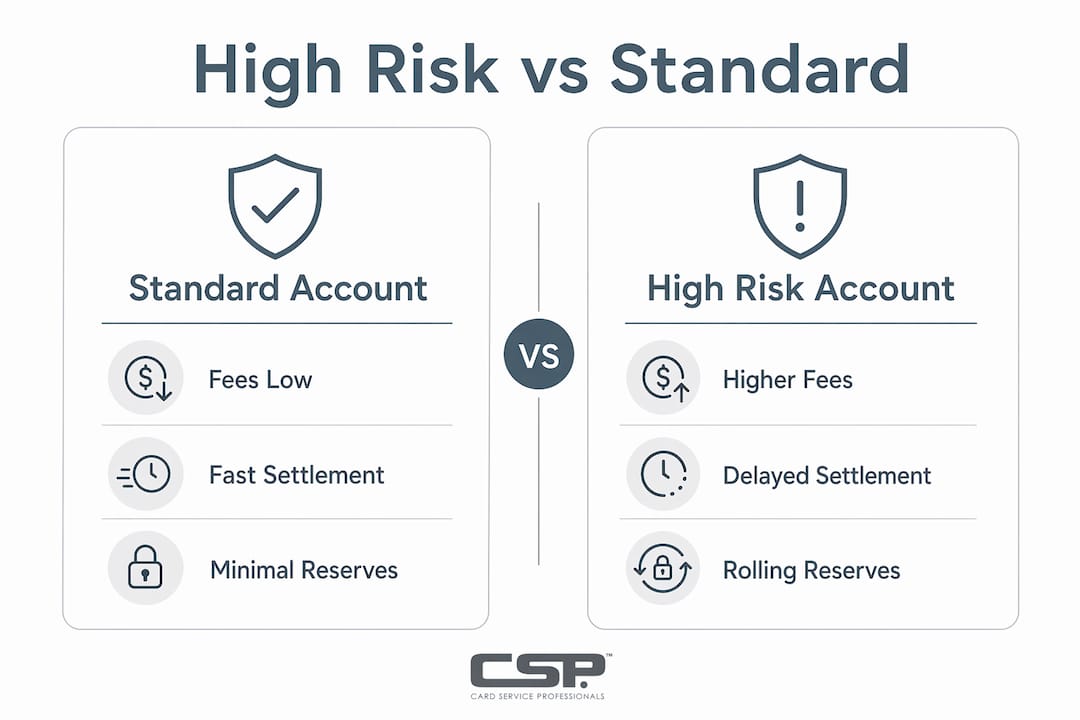
The structural differences between a high-risk merchant account and a standard account are real and affect your cash flow directly. Knowing them before you sign a contract prevents surprises.
| Feature | Standard merchant account | High-risk merchant account |
|---|---|---|
| Processing fees | 1.5%–2.5% typical | 2.5%–4.5%+ typical |
| Settlement period | 1–2 business days | 5–7 business days or more |
| Rolling reserve | None or minimal | 5%–15% held 90–365 days |
| Contract length | Month-to-month common | 1–3 year terms common |
| Early termination fee | Low or none | Often $500+ |
| Chargeback threshold | 1% before review | Monitored from day one |
Rolling reserves between 5% and 15% are standard for high-risk accounts, held for 90 to 365 days depending on your risk profile. That means a portion of every dollar you process sits inaccessible for months. Plan your cash flow accordingly before you sign.
Extended settlement periods of five to seven days or more are also common. For a liquor retailer managing tight inventory cycles, delayed fund access creates real operational pressure. Understanding merchant processing contract terms before signing protects you from being locked into terms that do not fit your business model.
Account monitoring is continuous. Processors watch chargeback ratios, transaction patterns, and descriptor consistency in real time. A sudden spike in disputes or a shift in average ticket size triggers a review and potentially a fund hold.
How to get and keep a high-risk merchant account
Getting approved is one challenge. Keeping the account in good standing is the ongoing work. Both require the same discipline: documentation, transparency, and active dispute management.
Before you apply:
- Confirm your website has a clear refund policy, terms of service, privacy policy, and working contact information. Processors check this before approval.
- Pull your own chargeback history and understand your ratio. If it is above 1%, address the root cause before applying.
- Check whether your business appears on the MATCH list. If it does, disclose it and explain the remediation steps you have taken.
- Gather at least three months of bank statements and prior processing statements if you have them.
After approval, keep your account healthy:
- Monitor chargeback reason codes monthly. Fraud-related dispute codes weigh more heavily in underwriting reviews than product complaint codes. Unauthorized transaction codes signal a fraud exposure problem that processors take seriously.
- Use fraud prevention tools. AVS, CVV verification, 3D Secure 2.0 (3DS2), and real-time transaction monitoring reduce dispute rates and demonstrate to your processor that you are managing risk actively.
- Keep your chargeback ratio below 1% consistently. Payment processors track chargeback trends over time, and a declining ratio can ease reserve requirements even if you started above threshold.
- Respond to every dispute within the required timeframe. Ignoring chargebacks is the fastest way to lose an account.
Pro Tip: Using payment aggregators like general-purpose platforms as a temporary fix in high-risk industries often ends with abrupt account freezes and fund holds. These platforms use automated risk monitoring and terminate high-risk merchants without warning. A dedicated high-risk account is more expensive upfront and far more stable long-term.
Selecting a processor with direct experience in your industry matters. A processor familiar with liquor retail understands your MCC, your typical dispute patterns, and your seasonal volume swings. That context shapes better terms and faster resolution when issues arise. Review the payment processing red flags that commonly trip up retail merchants before you commit to any processor.
Key Takeaways
A high-risk merchant account is a formal underwriting category with specific approval criteria, structural differences from standard accounts, and ongoing compliance requirements that directly affect your cash flow and processing stability.
| Point | Details |
|---|---|
| Chargeback ratio is the key trigger | Ratios above 1% classify your account as high risk; above 1.5% limits your processor options severely. |
| Eight underwriting dimensions determine approval | Processors assess legitimacy, industry, chargeback history, financials, website, transactions, fraud tools, and reserve terms. |
| Rolling reserves affect cash flow | Expect 5%–15% of revenue held for 90–365 days; plan your operating budget around this. |
| Transparency improves approval odds | Disclosing prior terminations or MATCH list history upfront is required; concealment causes automatic rejection. |
| Fraud tools reduce long-term costs | AVS, CVV, 3DS2, and real-time monitoring lower dispute rates and can ease reserve requirements over time. |
What I have learned about high-risk accounts after years in merchant services
The term “high-risk” makes business owners defensive, and I understand why. Nobody wants to hear that their business is in the same category as industries they may not associate with. Here is what I tell every retail owner who comes to me with that reaction: high-risk is a financial classification, not a moral judgment. It reflects statistical patterns in your industry, not the quality of your business.
What I have seen consistently is that the owners who struggle most with high-risk accounts are the ones who try to avoid the label rather than manage it. They sign up with a general-purpose aggregator, process for a few months, and then wake up to a frozen account and a 180-day fund hold. That is a cash flow crisis that a proper high-risk account would have prevented entirely.
The owners who do well treat the underwriting process like a job interview. They show up with complete documentation, honest disclosures, and a clear picture of their business model. They ask about reserve terms before signing, not after. They implement fraud tools from day one, not after their first chargeback spike.
Underwriting in 2026 has gotten more data-driven, not less. Processors track trends, not just snapshots. A business with a 1.2% chargeback ratio that has been declining for six months looks very different to an underwriter than one holding steady at 0.9% with no fraud controls in place. Trajectory matters. Build good habits early, document everything, and the account terms improve over time.
— Jerry
How Card Service Professionals helps U.S. retailers navigate high-risk processing
Retail business owners in high-risk sectors, including liquor sales and service industries, face a narrower field of qualified processors and less room for error during the application process. Card Service Professionals works as an independent sales agent for several of the leading merchant service providers in the United States, which means access to multiple underwriting relationships and the ability to match your specific risk profile to the right processor.
Card Service Professionals offers competitive payment solutions for high-risk retail businesses, including cash discount programs that offset processing costs, all electronic payment options, and point-of-sale equipment suited to liquor retail and service operations. The application process is straightforward, and the team guides you through documentation requirements and underwriting expectations before you submit. If you are ready to move forward, the sign-up application takes only a few minutes to start.
FAQ
What is a high-risk merchant account?
A high-risk merchant account is a payment processing account issued to businesses that banks and processors classify as having elevated exposure to chargebacks, fraud, or regulatory risk. Industries like liquor sales, subscription services, and travel are commonly classified this way.
What chargeback rate triggers high-risk status?
Chargeback rates above 1% of total transactions trigger high-risk classification under current industry standards. Rates above 1.5% significantly limit which processors will work with your business.
How long does it take to get approved for a high-risk merchant account?
Approval timelines vary by processor and the completeness of your application, but most high-risk accounts take 3–7 business days once all documentation is submitted. Complex histories or missing documents extend that timeline.
Can a high-risk merchant account become a standard account?
Yes. Processors review account terms periodically, and a consistent record of low chargebacks, clean transaction patterns, and active fraud prevention can lead to reclassification or improved terms over time. Declining chargeback ratios are the strongest signal that reserve requirements can be reduced.
Is a liquor store automatically classified as high risk?
Liquor retail is listed among high-risk industry verticals due to regulatory scrutiny and elevated dispute rates in the sector. Individual account terms still depend on your specific chargeback history, processing volume, and business model.
Recommended
- Merchant Account Explained for U.S. Retail Merchants – Card Service Professionals
- What Is Merchant Services? A Guide for U.S. Retailers – Card Service Professionals
- Credit Card Processing Explained for U.S. Retailers – Card Service Professionals
- Partial Payment Processing Explained for U.S. Retailers – Card Service Professionals
