



Accepting credit cards in retail is the single most direct way to stop losing sales to payment friction. Credit cards now account for 38% of U.S. consumer in-person payments, up from 24% in 2016. The average American consumer made 16 credit card payments per month in 2025. Retailers who do not accept Visa, Mastercard, or other major cards are turning away a growing share of their customer base before a single item is rung up. The question is no longer whether to accept cards. It is how to do it well.
What are the key benefits of accepting credit cards in retail?
Card acceptance, the industry term for merchant payment acceptance, delivers four measurable advantages: higher sales, faster cash flow, greater customer trust, and a wider customer base.
Higher average transaction values. Shoppers spend more when they pay by card than when they pay with cash. Physical limits on what someone carries in their wallet do not apply to a credit card. A customer browsing a boutique clothing store may walk in with $40 in cash but $2,000 in available credit. Removing that ceiling directly increases your average ticket size.
Faster, more predictable cash flow. Card settlements typically arrive in your bank account within one to two business days. Cash requires manual counting, deposit trips, and reconciliation time. Checks can take a week or more to clear. For a retail owner managing payroll and inventory, that speed difference is real money.
Stronger customer trust and perceived professionalism. Businesses that accept cards are viewed as more professional and deliver a better checkout experience. A customer who sees a “cash only” sign at the register often reads it as a red flag, not a quirk. That perception costs you sales and repeat visits.
Expanded customer base. Some shoppers carry no cash at all. Others prefer to earn rewards points on every purchase. By accepting cards, you capture these buyers instead of sending them to a competitor. The benefits of credit cards in retail compound over time as your loyal card-paying customers return more often and spend more per visit.
Key advantages at a glance:
- Larger average purchase amounts compared to cash transactions
- Deposits settled in one to two business days
- Reduced risk of theft compared to holding cash on-site
- Access to customers who exclusively use card or digital wallet payments
- Cleaner transaction records that simplify tax preparation and audits
How do declining cash payments influence retail payment strategies?
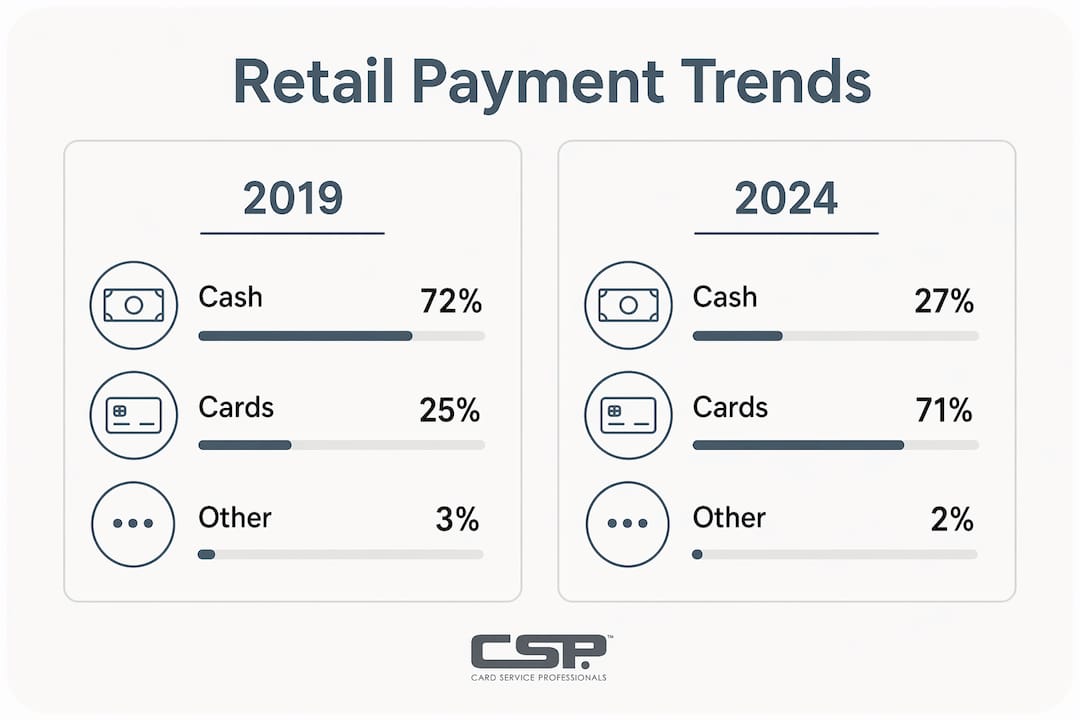
Cash is not dead, but its role at the register is shrinking fast. Cash usage at physical point-of-sale locations fell from 72% in 2019 to 52% in 2024 by transaction volume. That 20-point drop in five years is not a blip. It reflects a permanent behavioral shift across age groups and income levels.
The table below shows how the U.S. retail payment mix has shifted and what it means for your store strategy.
| Payment method | 2019 share (POS volume) | 2024 share (POS volume) | Trend |
|---|---|---|---|
| Cash | 72% | 52% | Declining |
| Credit and debit cards | Growing | 71% of in-store shopping | Dominant |
| Digital wallets (Apple Pay, Google Pay) | Emerging | Growing but secondary | Rising |
Cards remain the clear leader. Credit and debit cards accounted for 71% of in-store U.S. shopping in 2025, despite the rapid growth of digital wallets from Apple Pay and Google Pay. Digital wallets are important, but most of them run on the same Visa and Mastercard rails. Accepting cards means you already accept most wallet payments too.
Demographic pressure reinforces this trend. Younger shoppers, particularly those under 40, rarely carry cash. If your store serves a mixed age group, the share of cash-only customers will shrink every year. Building your retail payment options around card acceptance now positions you ahead of that curve rather than behind it.
What are the costs and operational considerations of accepting credit cards?
The true cost of accepting card payments for small retailers typically runs 2.5%–3.5% of revenue. That number surprises many owners who see a processor’s advertised rate and assume it covers everything. It does not.
The full fee stack includes:
- Interchange fees: Paid to the card-issuing bank. These vary by card type and transaction method.
- Scheme fees: Charged by Visa, Mastercard, Discover, and American Express for network access.
- Gateway fees: Charged by the payment gateway for routing transactions.
- PCI compliance fees: Annual or monthly fees for maintaining Payment Card Industry Data Security Standard compliance.
- Statement and service fees: Miscellaneous charges that vary by processor.
Understanding layered fees and careful monitoring of your monthly statement is the only way to keep costs in check. Most retailers overpay because they never audit their statements.
Card mix and transaction type matter
Higher credit card usage versus debit raises your effective processing cost because rewards cards carry higher interchange rates. A customer paying with a premium travel rewards card costs you more to process than one paying with a basic debit card. You cannot control which card a customer pulls out, but you can influence the outcome.
Encouraging debit card use and promoting tap-to-pay or chip transactions lowers your blended interchange cost. Keyed-in transactions, where a cashier manually types a card number, carry the highest rates and the highest fraud risk. Always use a chip or tap-enabled terminal.
Pro Tip: Request an interchange-plus pricing model from your processor instead of a flat bundled rate. With interchange-plus, you see exactly what each card type costs, which makes auditing and negotiating far easier.
Integration with your existing systems
Retailers’ acceptance decisions should factor in integration with POS, accounting, and inventory systems. A payment terminal that does not talk to your point-of-sale software creates manual reconciliation work every day. That labor cost is real, even if it does not show up on your processing statement. Choosing a processor whose hardware and software connect directly to platforms like QuickBooks, Shopify, or Square eliminates that friction. You can learn more about how these structures work in this credit card processing guide from Card Service Professionals.
How can retailers implement card acceptance for competitive advantage?
Seamless card acceptance reduces purchase abandonment, shortens checkout lines, and increases impulse buying. The checkout experience is the last impression you leave on a customer. A slow or clunky payment process erases goodwill built during the entire shopping visit.
Practical steps to build a fast, reliable payment setup:
- Choose a terminal with tap, chip, and swipe capability. Tap-to-pay transactions complete in under two seconds. That speed reduces line length and increases throughput during peak hours.
- Unify in-store, online, and mobile payments under one processor. Separate systems for your physical store and your e-commerce site create reconciliation headaches and inconsistent customer data.
- Use a mobile POS for pop-up events, markets, and line-busting. Solutions like a smartphone-connected card reader let you take payments anywhere in the store, not just at a fixed register.
- Train staff on the payment system before launch. A cashier who fumbles with a new terminal slows the line and frustrates customers just as much as a broken machine.
- Monitor transaction decline rates weekly. A spike in declines often signals a hardware issue or a processor problem that costs you sales silently.
Pro Tip: If you sell at farmers markets, trade shows, or pop-up locations, a mobile POS solution paired with your main retail processor keeps all your sales data in one place. Fragmented data means fragmented decisions.
Retail payment systems that integrate payments, accounting, and inventory deliver real operational efficiency. When a sale posts automatically to your inventory count and your accounting ledger, you eliminate a category of human error entirely. That accuracy compounds over a year into fewer stockouts, cleaner books, and faster tax filing. For retailers thinking about the full picture of card processing for small retailers, the operational gains are often as valuable as the sales lift.
Card acceptance costs can be optimized through card-present transactions, fee negotiation, and payment routing. Negotiating with your processor annually, not just at signup, is one of the highest-return activities a retail owner can do. Rates are not fixed. Volume growth gives you leverage.
Key Takeaways
Accepting credit cards in retail increases sales, improves cash flow, and builds customer trust by meeting the payment preferences of the majority of U.S. shoppers.
| Point | Details |
|---|---|
| Cards dominate U.S. retail | Credit and debit cards account for 71% of in-store U.S. shopping, making acceptance non-negotiable. |
| Cash use is falling fast | Cash dropped from 72% to 52% of POS volume between 2019 and 2024. Plan your payment mix accordingly. |
| True costs run 2.5%–3.5% | The full fee stack includes interchange, scheme, gateway, and compliance costs beyond the headline rate. |
| Card mix affects your fees | Rewards credit cards cost more to process than debit cards. Encourage tap and chip to lower blended costs. |
| Integration multiplies the benefit | Connecting payments to your POS and accounting system eliminates manual work and reduces errors daily. |
What I’ve learned from watching retailers get this wrong
After years of working with U.S. retail business owners on payment acceptance, the pattern I see most often is this: a retailer sets up card processing once, never looks at the statement again, and quietly overpays for years. The signup rate looked competitive. The monthly statement is a wall of line items nobody reads. That gap between what you agreed to and what you actually pay is where processors make their margin.
The second mistake I see is treating card acceptance as a checkbox rather than a system. A retailer buys a terminal, plugs it in, and considers the job done. But if that terminal is not integrated with the POS, every sale requires a manual entry somewhere. Over a year, that is hundreds of hours of labor and dozens of reconciliation errors.
The retailers who get the most out of card acceptance treat it as a living part of their business. They audit their statements quarterly. They ask their processor about better pricing when their volume grows. They upgrade their hardware when tap-to-pay becomes the norm, not three years after. They think about which cards their customers use and whether a cash discount program could shift behavior and lower their effective rate.
Card acceptance is not just operational. It is a revenue decision you make every day, whether you realize it or not. The retailers who treat it that way consistently outperform those who do not.
— Jerry
How Card Service Professionals can help your retail business
Card Service Professionals works with U.S. retail business owners to find the right processing solution at the right cost. As independent sales agents for several of the leading merchant service providers in the country, Card Service Professionals compares options across providers rather than pushing a single product.
Whether you need a full POS setup, a cash discount program that offsets processing fees, or a mobile solution for off-site selling, Card Service Professionals has options built for retail. Rates are competitive, and the team walks you through your statement so you understand exactly what you are paying and why. Visit Card Service Professionals to review your current processing costs or apply for a new account and start accepting payments on better terms.
FAQ
Why should a retail store accept credit cards?
Accepting credit cards removes payment friction, increases average transaction size, and captures customers who carry no cash. Credit and debit cards account for 71% of in-store U.S. shopping, making card acceptance a baseline requirement for most retail businesses.
What does it actually cost to accept credit cards in retail?
The true cost for small retailers typically runs 2.5%–3.5% of revenue when you include interchange, scheme fees, gateway charges, and PCI compliance costs. The advertised processor rate is only one part of the total fee stack.
How do credit cards compare to cash for retail sales?
Cards produce higher average transaction values because customers are not limited by what they carry in their wallet. Cash usage at U.S. point-of-sale locations fell from 72% in 2019 to 52% in 2024, so the gap between card and cash volume continues to widen.
What is the easiest way to reduce credit card processing fees?
Encouraging debit card use and tap-to-pay transactions lowers your blended interchange cost. Requesting interchange-plus pricing from your processor and auditing your monthly statement quarterly are the two most effective ongoing strategies.
Do digital wallets replace the need to accept credit cards?
No. Most digital wallets, including Apple Pay and Google Pay, run on Visa and Mastercard networks. Accepting cards means you already support the majority of wallet transactions without any additional setup.
Recommended
- Credit Card Processing Explained for U.S. Retailers – Card Service Professionals
- Why Small Retailers Need Card Processing in 2026 – Card Service Professionals
- Accepting Payments for Service Businesses: 2026 Guide – Card Service Professionals
- Liquor Store Payment Processing Explained for Owners – Card Service Professionals
