



Mobile payment is defined as any financial transaction completed using a smartphone, tablet, or wearable device to pay for goods or services. The industry term is “mobile commerce payment,” though “mobile payment” is the standard shorthand across retail and banking. Technologies like NFC (Near Field Communication), QR codes, and mobile wallets power these transactions, replacing cash and physical cards with faster, more secure digital alternatives. For retail business owners evaluating payment solutions for your store, understanding how these systems work is the first step toward smarter adoption.
What is mobile payment and how does it work in retail?
Mobile payments use three core technologies: NFC, QR codes, and mobile wallets. NFC, QR codes, and mobile wallets each enable a different interaction style. NFC lets customers tap their phone or watch against a terminal. QR codes let customers scan a displayed code with their camera. Mobile wallets like Apple Pay and Google Pay store card credentials digitally and transmit them securely at the point of sale.
The transaction flow follows a clear sequence:
- Customer initiates payment. The customer opens a mobile wallet or payment app and holds their device near the terminal or scans a QR code.
- Device transmits encrypted data. The phone sends a tokenized version of the card number, not the actual account details, to the payment terminal.
- Payment processor routes the request. The terminal forwards the token to the payment processor, which contacts the card network (Visa, Mastercard, etc.) and the issuing bank.
- Authorization is returned. The bank approves or declines the transaction in seconds. The customer receives confirmation on their screen.
- Settlement occurs. Funds move from the customer’s bank to your merchant account, typically within one to two business days.
From a hardware standpoint, you need an NFC-enabled terminal or a QR code display to accept most mobile payments. Software requirements include a payment gateway that supports tokenized transactions and, ideally, integration with your existing POS system.
Pro Tip: If your current terminal does not support NFC, a simple hardware upgrade often costs less than one month of cash-handling losses from manual errors and theft.

What are the types of mobile payment systems?
Mobile payment systems fall into four main categories: mobile wallets, mobile banking apps, carrier billing, and mobile POS systems. Each serves a different use case and customer base.
- Mobile wallets (Apple Pay, Google Pay, Samsung Pay) store payment credentials on the device and use NFC or QR codes for in-store transactions. These are the most common form of contactless payment in U.S. retail.
- Mobile banking apps allow customers to pay directly from their bank account using the bank’s own application. These are common for bill payments and larger purchases.
- Carrier billing charges purchases to a customer’s phone bill. This method is most relevant for digital goods and app purchases rather than physical retail.
- Mobile POS systems turn a smartphone or tablet into a card reader using a small hardware attachment or Bluetooth device. These are popular with food trucks, pop-up shops, and service businesses that need flexibility.
Beyond these four categories, two transaction types matter for retail strategy:
| Transaction type | Description | Best retail fit |
|---|---|---|
| Contactless in-store | NFC or QR tap at a terminal | Grocery, pharmacy, quick service |
| In-app payment | Customer pays inside a branded app | Restaurants, loyalty-driven retail |
| Peer-to-peer (P2P) | Customer sends funds to another person | Farmers markets, service providers |
| Consumer-to-business | Customer pays a business directly via app | Any retail with a loyalty program |
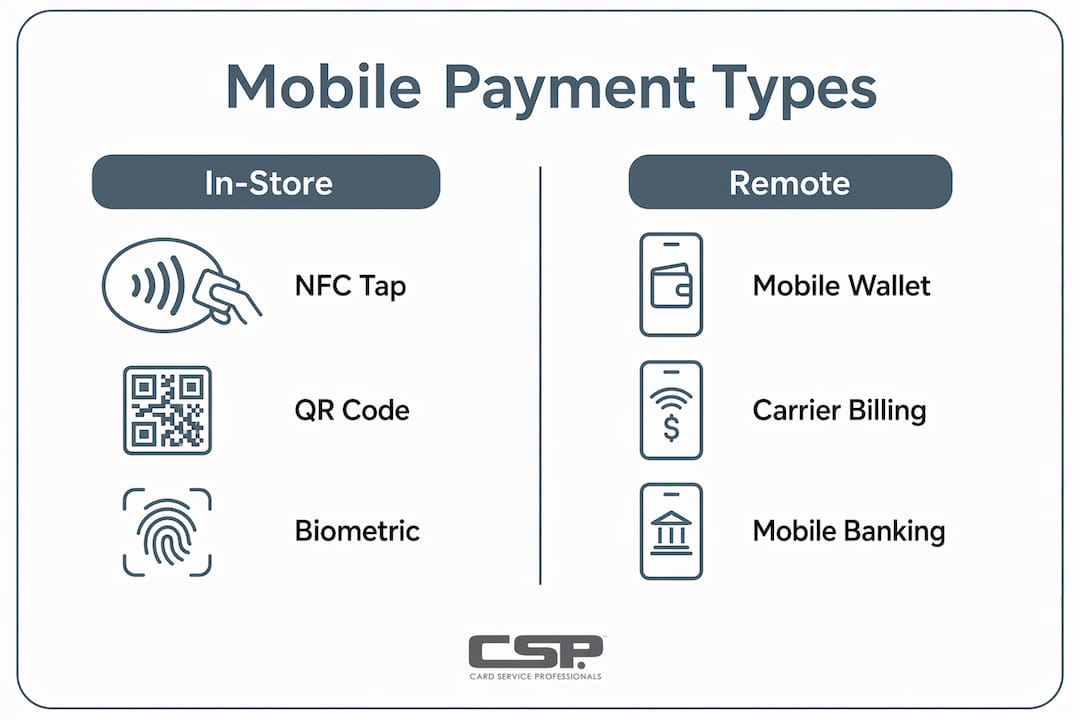
Biometric payments represent the newest category. These systems authenticate the transaction using a fingerprint, face scan, or iris recognition rather than a PIN or signature. Biometric authentication is becoming a baseline security standard in 2026, not a premium feature.
What are the benefits of mobile payments for retail businesses?
Mobile payments deliver measurable advantages over cash and traditional card transactions. Mobile payments have clear operational and customer experience advantages over both cash and standard card processing. The most direct benefit is speed. Tap-to-pay transactions complete in under two seconds, compared to 15–30 seconds for chip card dips. That difference compounds across hundreds of daily transactions and shortens checkout lines noticeably.
Key benefits for retail businesses include:
- Faster checkout. Faster transactions and less cash handling reduce queue times and free staff to focus on service rather than counting change.
- Reduced cash handling risk. Less physical cash on hand means lower exposure to theft, counting errors, and bank deposit fees.
- Stronger transaction security. Biometric authentication and tokenization reduce fraud liability. When a tokenized transaction is intercepted, the stolen data is useless without the original device.
- Consumer behavior data. Mobile payments enable businesses to gather consumer behavior data that informs inventory decisions and targeted promotions. A customer who pays through a loyalty-linked app tells you what they bought, when, and how often.
- Higher customer satisfaction. Customers who prefer digital payments expect to use them. Refusing mobile payments is a friction point that pushes buyers toward competitors who accept them.
Pro Tip: Connect your mobile payment system to your loyalty program from day one. Every tap becomes a data point. Over time, that data tells you which products drive repeat visits and which promotions actually convert.
The data advantage deserves more attention than it typically gets. Cash transactions are anonymous. Mobile payment transactions are not. That shift from anonymous to identified purchasing gives you a direct line to understanding your best customers.
What security considerations apply to mobile payments?
Security in mobile payments rests on three technical pillars: tokenization, encryption, and biometric authentication. Tokenization replaces sensitive card data with a digital identifier that is useless if intercepted. Encryption protects data in transit between the device, terminal, and payment processor. Biometric authentication confirms the customer’s identity before the transaction is authorized.
PCI DSS (Payment Card Industry Data Security Standard) compliance is mandatory for any business accepting card payments, including mobile. PCI DSS sets requirements for how payment data is stored, transmitted, and processed. Working with a processor that handles PCI compliance on your behalf reduces your liability and administrative burden significantly.
One factor that many retailers overlook is trust transfer. Trust transfer, the perceived security and reliability from merchants, significantly influences customer mobile payment adoption. Customers are more willing to pay digitally at businesses they already trust. Your store’s reputation, staff confidence with the technology, and clear communication about security all affect whether customers actually use the mobile payment option you offer.
Interoperability is another practical concern. Not every mobile wallet works with every terminal. Apple Pay requires NFC. Some QR-based systems need specific software integrations. Before committing to a terminal or processor, confirm which wallet types it supports. Gaps in acceptance frustrate customers and undermine the speed advantage mobile payments are supposed to deliver.
For guidance on avoiding common pitfalls, reviewing payment processing red flags before signing any processing agreement is worth your time.
How can retail businesses implement mobile payments successfully?
Successful mobile payment implementation follows a defined sequence. Skipping steps, especially staff training and customer communication, is the most common reason adoption stalls after launch.
- Audit your current setup. Identify whether your existing terminals support NFC. Check whether your POS software can integrate with mobile payment gateways. Know your gaps before you spend anything.
- Select the right payment technologies. Match your choice to your customer base. A coffee shop benefits most from NFC tap payments and a loyalty app. A farmers market vendor needs a mobile POS with QR code support.
- Train your staff thoroughly. Staff who are uncertain about the technology communicate that uncertainty to customers. Training should cover how to prompt customers, how to troubleshoot a declined tap, and how to handle refunds through the mobile system.
- Communicate acceptance to customers. Display NFC and wallet acceptance logos at the register and on your website. Customers who do not know you accept Apple Pay will not try it.
- Integrate with loyalty and inventory systems. The operational value of mobile payments multiplies when transaction data flows into your existing systems. Standalone payment acceptance is useful. Connected payment acceptance is transformative.
- Measure and adjust. Track checkout times, transaction volumes by payment type, and customer feedback. Use that data to refine your setup over three to six months after launch.
Mobile payment adoption requires retailers to address hardware, software, staff training, and consumer communication as a package, not as separate projects. Treating them separately leads to gaps that show up at the register when it matters most.
For businesses exploring phone-based payment options, the implementation steps are similar but include additional considerations for remote and card-not-present transactions.
Key Takeaways
Mobile payment adoption succeeds when retailers combine the right technology, clear security protocols, and consistent staff training to deliver fast, trusted transactions.
| Point | Details |
|---|---|
| Core technology | NFC, QR codes, and mobile wallets are the three primary mechanisms for in-store mobile payments. |
| Four system types | Mobile wallets, mobile banking apps, carrier billing, and mobile POS each serve different retail contexts. |
| Security foundation | Tokenization, encryption, and biometric authentication together protect transactions and reduce fraud liability. |
| Trust drives adoption | Merchant reputation and staff confidence influence whether customers actually use mobile payment options. |
| Data is the hidden benefit | Mobile transactions generate customer behavior data that cash and anonymous card payments cannot provide. |
Why trust matters more than technology in mobile payments
The retail industry tends to frame mobile payments as a technology problem. Get the right terminal, pick the right wallet, done. My experience working with retail merchants across the U.S. tells a different story.
The technology is largely solved. NFC terminals are reliable. Tokenization works. The real variable is trust, on both sides of the counter. Trust and security perceptions are as critical as the technology itself in keeping mobile payment users coming back. A customer who taps once and gets a confusing error message, or whose cashier looks uncertain about how to process the payment, does not tap again.
The retailers I have seen get the most out of mobile payments treat it as a customer experience project, not an IT project. They train staff until the process feels natural. They put acceptance logos where customers can see them before they reach the register. They connect payments to loyalty programs so every transaction builds a relationship.
The businesses that struggle are the ones that install the hardware and assume customers will figure out the rest. They will not. Your job is to make the path obvious and the experience frictionless. When you do that, mobile payments stop being a payment method and start being a competitive advantage.
— Jerry
How Card Service Professionals supports your mobile payment setup
Card Service Professionals works with retail businesses across the U.S. as an independent agent for several of the country’s leading merchant service providers. That independence means you get access to competitive rates, cash discount programs, and the full range of electronic payment options without being locked into a single provider’s ecosystem.
Whether you are setting up mobile payment acceptance for the first time or looking to cut processing costs on your existing setup, Card Service Professionals matches you with the right solution for your transaction volume and customer base. The team also provides current POS equipment that supports NFC, QR codes, and all major mobile wallets. Start by reviewing your merchant services options or go directly to the Card Service Professionals main page to connect with an advisor.
FAQ
What is mobile payment in simple terms?
Mobile payment is the process of paying for goods or services using a smartphone, tablet, or wearable device instead of cash or a physical card. It uses technologies like NFC and QR codes to complete the transaction at a terminal or online.
How does mobile payment work at a retail store?
The customer’s device sends a tokenized version of their payment credentials to the terminal via NFC or QR code. The terminal routes the token through the payment processor and card network for authorization, which completes in seconds.
Is mobile payment secure for retail businesses?
Mobile payments are generally more secure than cash or magnetic stripe cards. Tokenization, encryption, and biometric authentication work together to protect transaction data and reduce fraud exposure for both the business and the customer.
What are the main types of mobile payment systems?
The four main types are mobile wallets, mobile banking apps, carrier billing, and mobile POS systems. Mobile wallets like Apple Pay and Google Pay are the most widely used in U.S. retail settings.
Do I need special equipment to accept mobile payments?
Most mobile payments require an NFC-enabled terminal or a QR code display. Many modern POS terminals already support NFC. If yours does not, an upgrade is typically straightforward and cost-effective relative to the operational benefits.
Recommended
- Pay by Phone Explained for U.S. Retail Merchants – Card Service Professionals
- Types of Business Payment Solutions for U.S. Retailers – Card Service Professionals
- What Is a Payment Processor? A Guide for Retailers – Card Service Professionals
- What Is Merchant Services? A Guide for U.S. Retailers – Card Service Professionals
