



ACH payment acceptance is defined as the process of receiving bank-to-bank electronic transfers through the Automated Clearing House network, a federally regulated system that moves money directly between checking or savings accounts. For small business owners, this method cuts processing costs significantly compared to credit cards, making it one of the most practical tools for recurring billing, B2B invoices, and high-value transactions. Understanding how ACH works, what it costs, and how to set it up correctly gives your business a real competitive edge on cash flow and fees.
What is ACH payment acceptance for small businesses?
ACH payment acceptance for small businesses means using the Automated Clearing House network to collect payments directly from customer bank accounts. NACHA, the organization that governs ACH operating rules in the United States, sets the compliance standards every business must follow. These rules cover everything from how you collect customer authorization to how long you must retain those records.
The cost advantage is the main reason small businesses adopt ACH. ACH fees typically run $0.20 to $1.50 per transaction, or roughly 0.5% to 1.5% of the transaction value. Credit card processing fees commonly land between 2.5% and 3.5%. On a $5,000 invoice, that difference can mean $100 or more saved on a single payment.
ACH works best for recurring and B2B payments like subscriptions, payroll, vendor invoices, and service retainers. It is not designed for instant retail checkout, where card payments remain the faster and more familiar option. Knowing this distinction upfront saves you from setting up ACH for the wrong use cases.
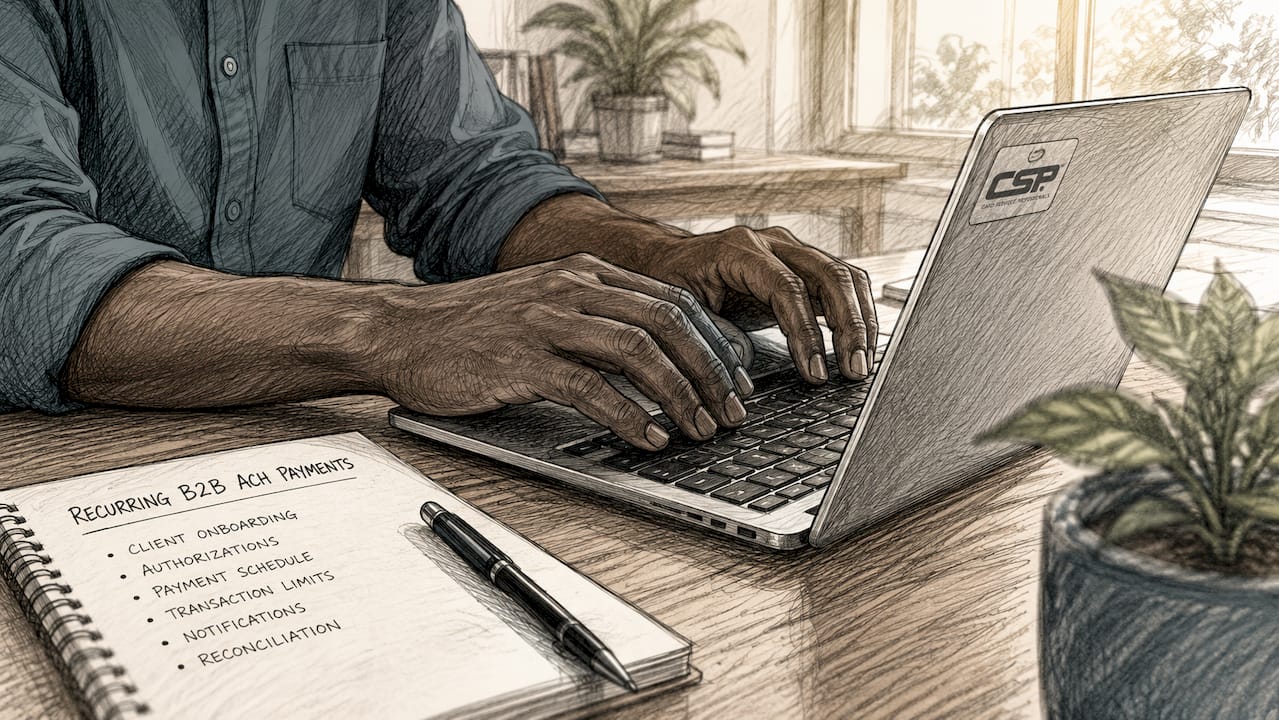
How do you set up ACH payment acceptance?
Getting started with ACH requires a few specific tools and accounts before you can process your first transaction.
What you need before your first ACH transaction
- A business bank account with ACH origination capabilities, either through your bank directly or via a third-party payment processor
- An ACH-enabled payment processor or platform that handles transaction submission, return management, and reporting
- Customer authorization mandates collected in writing or electronically, as required by NACHA operating rules
- An account verification method to confirm customer bank details before pulling funds
Account verification methods include micro-deposits, where two small amounts under $1.00 are sent to the customer’s account for them to confirm, and instant bank verification, which uses a secure login to the customer’s bank to confirm account details in real time. Instant verification is faster and reduces setup friction for your customers.
| Requirement | Purpose |
|---|---|
| Business bank account | Receives settled ACH funds |
| ACH-enabled processor | Submits transactions to the network |
| Customer authorization | Legal compliance under NACHA rules |
| Account verification | Confirms valid bank details before charging |
| Secure data storage | Protects customer banking information |
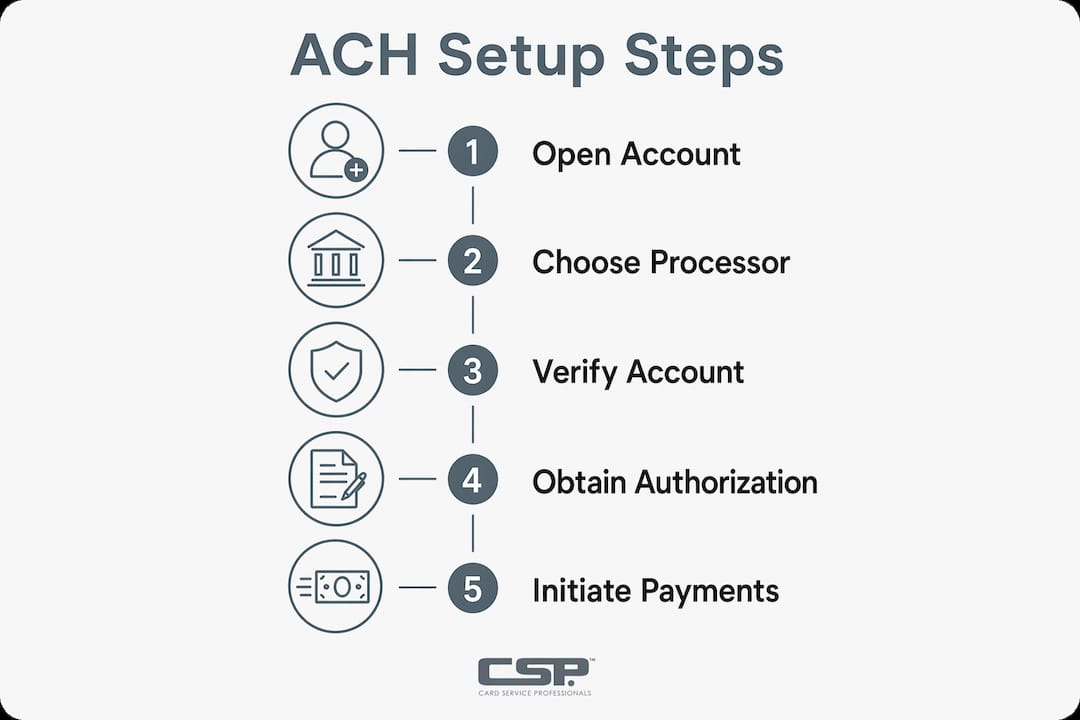
Pro Tip: Ask your bank whether it offers ACH origination directly. Some community banks and credit unions provide this at low cost, which can reduce your per-transaction fees compared to third-party processors.
How to accept ACH payments: a step-by-step process
Setting up ACH payment acceptance follows a clear sequence. Skipping steps, especially around authorization, creates compliance exposure and higher return rates.
-
Decide between ACH debit and ACH credit. ACH debit means you pull funds from your customer’s account. ACH credit means you push funds out, such as for refunds or payroll. Most small businesses collecting payments use ACH debit.
-
Choose a payment processor that supports ACH. Look for processors that offer ACH as part of their standard merchant services, not just as an add-on. Review their fee structure, return handling policies, and same-day ACH availability. Card Service Professionals works with several leading U.S. merchant service providers that include ACH options in their payment solutions.
-
Complete provider onboarding and compliance checks. Your processor will verify your business identity, bank account, and sometimes your industry type. This step mirrors the process for setting up a merchant account and typically takes one to three business days.
-
Integrate ACH into your invoicing or checkout workflow. Most processors provide API connections, hosted payment pages, or plugins for common invoicing software. Add ACH as a payment option on your invoices or payment portal so customers can select it at checkout.
-
Collect and document customer bank information and authorization. NACHA requires businesses to obtain formal written or electronic authorization before debiting a customer’s account. Your authorization form must clearly state the payment amount, frequency, and the customer’s right to revoke consent.
-
Submit transactions and track their status. Once submitted, ACH transactions enter a batch processing cycle. Standard ACH settlement takes 1–3 business days. Monitor your processor’s dashboard for return codes, which signal failed transactions.
-
Set up recurring payment schedules where applicable. For subscription billing or retainer clients, configure automatic debits on agreed dates. This removes manual work and gives you predictable cash flow.
What challenges come with accepting ACH payments?
ACH is reliable, but it is not without friction. Knowing the common problems in advance lets you build systems that handle them before they affect your cash flow.
Processing times and delays
ACH settlement runs 1–3 business days under standard processing. Weekends and federal holidays extend that window. If you submit a transaction on a Friday afternoon, funds may not arrive until Wednesday. Same-day ACH is available through many processors for an additional fee, which helps when timing is critical.
Return codes and payment failures
ACH returns most commonly occur within two business days. Return codes explain exactly why a transfer failed. Some codes, like R01 for insufficient funds, allow you to retry the transaction. Others, like R02 for a closed account, mean you need to contact the customer for updated bank details before attempting again. Build a clear retry policy into your billing process.
Customer disputes and compliance
Customers have up to 60 calendar days to dispute an unauthorized ACH debit under NACHA rules. That window is long enough to create real cash flow uncertainty if you do not have solid authorization documentation. Retain every signed authorization form and timestamp every electronic consent record.
The businesses that struggle most with ACH are the ones that treat authorization as a formality. A missing or vague authorization form is the single fastest way to lose a dispute and face a return charge. Document everything before you pull a single dollar.
Pro Tip: Automate retry logic for R01 returns. Most ACH processors allow you to configure automatic retry attempts after a set number of days. This recovers a meaningful share of failed payments without any manual follow-up.
Review your payment processing checklist to make sure ACH fits correctly into your broader payment operations before going live.
How does ACH fit into your overall payment strategy?
ACH is one tool in a broader set of small business payment methods. Combining it with credit card acceptance gives your customers more options and covers a wider range of transaction types.
ACH works best for high-value invoices, recurring subscriptions, B2B vendor payments, and payroll. Card payments work best for in-person retail, low-value transactions, and situations where customers expect instant confirmation. Wire transfers handle very large, one-time transfers but cost significantly more per transaction.
| Payment method | Typical cost | Settlement time | Best use case |
|---|---|---|---|
| ACH | 0.5%–1.5% or flat fee | 1–3 business days | Recurring billing, B2B, payroll |
| Credit card | 2.5%–3.5% | 1–2 business days | Retail, low-value, instant checkout |
| Wire transfer | $15–$50 flat | Same day | Large one-time transfers |
The right mix depends on your customer base. A landscaping company billing $3,000 monthly retainers saves real money routing those invoices through ACH. A coffee shop selling $6 drinks needs card acceptance, not ACH. Many service businesses run both methods in parallel, using ACH for recurring clients and cards for walk-in or one-time customers. See how types of payment solutions work together for U.S. retailers to build a complete payment strategy.
Key Takeaways
ACH payment acceptance gives small businesses a direct, low-cost way to collect bank-to-bank payments, but it requires proper authorization, account verification, and return management to work reliably.
| Point | Details |
|---|---|
| ACH costs less than cards | ACH fees run 0.5%–1.5% versus 2.5%–3.5% for credit card processing. |
| Authorization is mandatory | NACHA rules require written or electronic customer consent before every ACH debit. |
| Returns need a clear policy | Build retry logic for recoverable return codes and update bank details for closed accounts. |
| Settlement takes 1–3 days | Plan cash flow around standard ACH timing; use same-day ACH when speed matters. |
| ACH complements card payments | Use ACH for recurring and B2B invoices; keep cards for retail and instant transactions. |
ACH acceptance: what I’ve learned from working with small businesses
After years of helping small business owners set up payment processing, the pattern I see most often is this: owners hear about ACH, get excited about the lower fees, and then underestimate the compliance side. They skip the authorization form, or they use a vague template that does not specify the payment amount or frequency. Then a customer disputes a charge, and suddenly the savings from lower fees are wiped out by a return fee and a lost client.
The businesses that get ACH right treat the authorization process as seriously as a signed contract. They use clear, specific language. They store records digitally with timestamps. They test their retry logic before they go live with recurring billing. That level of preparation takes maybe two extra hours upfront and saves dozens of hours in disputes later.
My honest recommendation: start ACH with your most reliable, long-term clients first. Use it for your recurring invoices where you already have a strong relationship and clear payment terms. Once you have the process dialed in, expand it to new clients. Do not roll it out to your entire customer base on day one.
One more thing I tell every business owner: do not drop card acceptance when you add ACH. Some customers will never give you their bank account number, and that is their right. Offering both methods is not redundant. It is good business.
— Jerry
How Card Service Professionals can help you get started
Card Service Professionals works with several of the leading U.S. merchant service providers to give small businesses access to competitive ACH payment solutions alongside full card processing options.
Whether you need ACH-enabled invoicing, recurring billing setup, or a complete payment processing package with cash discount programs, Card Service Professionals connects you with the right provider at rates that fit your transaction volume. The sign-up process is straightforward, and the team walks you through compliance requirements, account verification, and integration from day one. Visit Card Service Professionals to compare your options and get expert guidance on building a payment setup that actually works for your business.
FAQ
What is ACH payment acceptance for a small business?
ACH payment acceptance means collecting payments directly from customer bank accounts through the Automated Clearing House network. It is governed by NACHA operating rules and is commonly used for recurring billing, B2B invoices, and payroll.
How much does ACH payment processing cost?
ACH processing typically costs $0.20 to $1.50 per transaction or 0.5% to 1.5% of the transaction value, which is significantly less than credit card fees of 2.5% to 3.5%.
How long does an ACH payment take to settle?
Standard ACH settlement takes 1–3 business days. Same-day ACH is available through many processors for an additional fee, provided transactions are submitted before the processor’s cutoff time.
Do I need customer authorization to accept ACH payments?
Yes. NACHA rules require written or electronic authorization from every customer before you debit their account. You must retain those authorization records and can face disputes for up to 60 calendar days after a transaction.
Can I use ACH and credit card payments at the same time?
Absolutely. Combining ACH with card acceptance covers more customer preferences. Use ACH for high-value recurring invoices and cards for retail or one-time transactions where customers expect instant processing.
Recommended
- Small Business Payment Processing Checklist for 2026 – Card Service Professionals
- Accepting Payments for Service Businesses: 2026 Guide – Card Service Professionals
- Accepting Payments on the Go: A Retail Merchant’s Guide – Card Service Professionals
- Card Service Professionals – Credit Card Processing Experts
