



Credit card processing fees are a measurable, negotiable overhead expense for retail merchants, not a fixed cost of doing business. The industry term for these charges is “merchant processing fees,” and they average around 2.36% per transaction in 2025. That number compounds fast. A Kentucky retailer processing $300,000 annually pays roughly $7,000 in fees before a single negotiation attempt. Treating credit card costs as unnecessary overhead, rather than accepting them as unavoidable, is the mindset shift that separates merchants who control their margins from those who don’t.
What components make up credit card processing costs as unnecessary overhead?
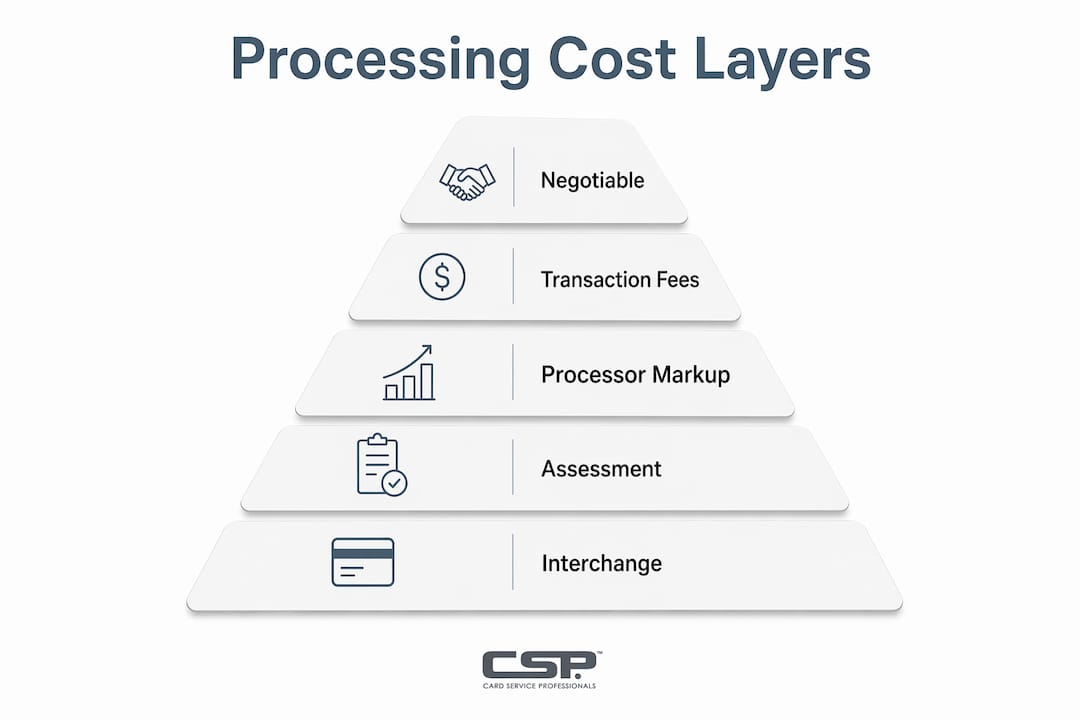
Credit card processing fees break into three distinct layers, and only one of those layers is negotiable. Understanding which is which determines how much overhead you can actually cut.
Interchange fees represent 70%–80% of your total processing cost. They go directly to the bank that issued your customer’s card, and no processor can change them. Network assessment fees, paid to Visa or Mastercard, make up a small additional slice and are equally fixed. The only layer you can negotiate is the processor markup, which is the fee your payment processor charges on top of everything else.

Beyond percentage fees, most processors charge a fixed per-transaction fee, typically between $0.10 and $0.30 per transaction. That fixed fee is where small-ticket retailers get hit hardest. A $0.10 fee on a $5 sale adds 2% to your cost before the percentage rate even applies. Retailers selling coffee, snacks, or low-cost goods feel this disproportionately.
Here is how the three fee layers compare:
| Fee Type | Who Receives It | Negotiable? | Typical Share of Total Cost |
|---|---|---|---|
| Interchange fee | Card-issuing bank | No | 70%–80% |
| Network assessment | Visa, Mastercard, etc. | No | 5%–10% |
| Processor markup | Your payment processor | Yes | 15%–25% |
Pro Tip: Calculate your effective rate by dividing total monthly fees by total monthly card sales. If your effective rate is consistently above 2.5%, your processor markup is almost certainly inflated.
Most merchants focus on the advertised rate and ignore the effective rate. The effective rate is the only number that tells you what you actually pay. Reviewing your payment processing statements monthly is the fastest way to spot markup creep before it compounds.
How do Kentucky’s surcharge laws affect merchant overhead?
Kentucky permits merchants to surcharge credit card transactions, which means you can legally pass processing costs to customers rather than absorbing them yourself. The cap is up to 3% or your actual processing cost, whichever is lower. That rule alone can eliminate a significant portion of your overhead.
The legal requirements are specific. Kentucky merchants must:
- Post clear signage at the store entrance and at the point of sale
- Label the surcharge on every receipt
- Apply surcharges only to credit card transactions, not debit cards or cash payments
- Notify the card networks before implementing a surcharge program
Surcharging applies strictly to credit cards. Debit card transactions, even when run as credit, cannot carry a surcharge under card network rules. This distinction matters because many customers carry debit cards and will naturally avoid the surcharge without any friction.
Pro Tip: Before launching a surcharge program, notify Visa and Mastercard directly through their online registration portals. Skipping this step violates network rules and can result in fines or loss of card acceptance privileges.
Surcharging shifts costs to customers but requires careful execution. Merchants who implement it transparently, with clear signage and staff training, report minimal customer pushback. Merchants who add it quietly without disclosure face complaints and potential penalties.
What pricing models reduce unnecessary credit card fees?
The pricing model your processor uses determines how much of your overhead is visible and how much is hidden. Three models dominate the market: flat-rate, interchange-plus, and tiered pricing.
Flat-rate pricing
Flat-rate pricing bundles all fees into one percentage, typically around 2.6%–2.9% plus a fixed fee per transaction. The appeal is simplicity. The problem is that flat-rate pricing charges the same rate on a premium rewards card as it does on a basic debit card, even though interchange fees differ significantly between those two card types. High-volume retailers end up subsidizing the processor’s profit on every low-interchange transaction.
Interchange-plus pricing
Interchange-plus pricing saves merchants money once monthly card volume exceeds $15,000–$25,000. The model passes the actual interchange rate through to the merchant and adds a fixed markup, such as 0.25% plus $0.10 per transaction. Every line item is visible. You see exactly what the bank charges and exactly what the processor charges. That transparency is the foundation of effective overhead management.
Tiered pricing
Tiered pricing groups transactions into “qualified,” “mid-qualified,” and “non-qualified” buckets. Processors set those definitions themselves, which means they can move transactions into higher-cost tiers with little explanation. This model is the least transparent and most likely to inflate your effective rate over time.
Pro Tip: If your processor quotes a tiered rate, ask them to show you what percentage of your transactions fall into each tier. If they can’t or won’t answer, that is a red flag worth acting on.
Bundled POS solutions often lock merchants into flat-rate or tiered pricing with no ability to negotiate. Independent retailers who select open payment systems gain the flexibility to switch to interchange-plus pricing and negotiate markups directly. That flexibility is worth more than any hardware discount a bundled provider offers.
Which strategies cut credit card overhead most effectively?
Reducing processing overhead does not require switching providers immediately. Several strategies produce results within your current contract.
-
Audit your statements monthly. Merchant audits and negotiations can recover thousands of dollars annually. Look for fees labeled “non-qualified surcharge,” “FANF,” or “network access fee” that appear without explanation.
-
Negotiate your processor markup directly. Call your processor and ask for a rate review. Processors routinely reduce markups for merchants who ask, especially those with consistent monthly volume. Most merchants never ask.
-
Promote debit card use. Debit card interchange rates are regulated under the Durbin Amendment and are significantly lower than credit card rates. A simple sign at the register noting “Debit saves you money” can shift your card mix meaningfully.
-
Set a minimum purchase amount. Card networks allow merchants to set a minimum purchase of up to $10 for credit card transactions. This protects you from the disproportionate cost of fixed fees on small-ticket sales.
-
Offer ACH payment options. For repeat customers or B2B transactions, ACH payment acceptance carries far lower fees than credit card processing. ACH fees typically run $0.20–$1.50 per transaction regardless of the sale amount.
-
Review your contract for hidden fees. Monthly minimums, PCI compliance fees, batch fees, and statement fees all add to your effective rate. Many are negotiable or can be waived entirely.
Pro Tip: Processors commonly offer teaser rates that don’t reflect the true fees applied to your specific card mix. Always calculate your effective rate before signing any new agreement.
How do you balance cost savings with customer experience?
Cost reduction strategies only work if customers keep buying. Surcharging and minimum purchase requirements can reduce overhead, but they require careful implementation to avoid damaging sales.
Transparency is the most effective tool for managing customer reaction. Merchants who post clear signage, train staff to explain the surcharge calmly, and offer a cash or debit alternative consistently report lower friction than those who add fees without explanation. Customers accept fees they understand. They resent fees that feel hidden.
Compliance protects you from a different kind of cost. Violating card network surcharge rules or Kentucky state law can result in fines, chargebacks, or loss of card acceptance privileges. The cost of non-compliance far exceeds the overhead you were trying to avoid. Review your surcharge program against current Visa and Mastercard guidelines at least once per year, since network rules change.
Gradual implementation reduces risk. Merchants who test surcharging on a subset of transactions, monitor sales data for two to three months, and adjust based on results make better decisions than those who roll out changes store-wide without a baseline. Watch your conversion rate and average ticket size as your primary indicators. If either drops significantly after implementing a surcharge, the cost savings may not justify the revenue loss.
Key Takeaways
Credit card processing fees are negotiable overhead expenses, and Kentucky merchants who treat them as fixed costs leave measurable money on the table every month.
| Point | Details |
|---|---|
| Fees average 2.36% per transaction | Total cost includes interchange, network fees, and a negotiable processor markup. |
| Only processor markup is negotiable | Interchange and network fees are fixed; focus negotiation efforts on the markup layer. |
| Kentucky allows surcharging up to 3% | Merchants must post signage and disclose surcharges on receipts to comply with state law. |
| Interchange-plus beats flat-rate above $15K/month | Transparent pricing models reduce effective rate for merchants with meaningful card volume. |
| Auditing statements recovers real money | Monthly reviews catch inflated fees and hidden charges before they compound annually. |
What I’ve learned about fees that most retailers never question
After working with merchants across Kentucky and the broader U.S., the pattern I see most often is not ignorance. It’s resignation. Retailers assume processing fees are like rent or utilities. They show up on the statement, you pay them, and that’s that.
That assumption is wrong, and it costs real money. I’ve seen merchants paying effective rates above 3.2% on card mixes that should cost them closer to 2.1%. The difference was entirely in the processor markup and a handful of junk fees that had never been questioned. One audit conversation changed their annual cost by several thousand dollars.
The flat-rate pricing trap is the one I find most frustrating. It’s marketed as simple and transparent, but simplicity for the merchant means profit for the processor on every low-interchange transaction. A basic Visa debit card might carry an interchange rate of 0.05% plus $0.21. Under flat-rate pricing at 2.6%, the processor pockets the difference. That’s not a fee. That’s a margin transfer.
My honest advice: treat your processing fees the way you treat your cost of goods. Review them regularly, negotiate them actively, and watch for red flags that signal a processor is taking more than they should. The merchants who do this consistently keep more of what they earn.
— Jerry
How Card Service Professionals helps Kentucky retailers control processing costs
Retail merchants who want to stop overpaying on processing fees need a partner who understands both the fee structure and the negotiation process.

Card Service Professionals works with U.S. retailers as independent agents for several of the country’s leading merchant service providers. That independence means the focus is on finding the right fit for your business, not pushing a single product. Services include credit card processing solutions with competitive rates, cash discount programs that can eliminate processing costs entirely, and full support for all electronic payment options. If you’re a Kentucky retailer ready to stop treating processing fees as a fixed cost, a rate analysis from Card Service Professionals is the right starting point.
FAQ
What is the average credit card processing fee for retailers?
U.S. retail merchants pay an average of around 2.36% per transaction, with total fees typically ranging from 1.5% to 3.5% depending on card type, pricing model, and processor markup.
Can Kentucky merchants legally surcharge credit card transactions?
Yes. Kentucky permits surcharges on credit card transactions up to 3% or actual processing cost, whichever is lower, with mandatory signage at entry and point of sale and disclosure on receipts.
What is the difference between interchange-plus and flat-rate pricing?
Interchange-plus pricing passes the actual interchange rate to the merchant and adds a fixed markup, making costs fully transparent. Flat-rate pricing bundles all fees into one rate, which often overcharges merchants on low-interchange transactions.
Which credit card fees are actually negotiable?
Only the processor markup is negotiable. Interchange fees, paid to card-issuing banks, and network assessment fees, paid to Visa or Mastercard, are set by the networks and cannot be changed by any processor.
How do I know if I’m overpaying on processing fees?
Calculate your effective rate by dividing total monthly processing fees by total monthly card sales. An effective rate consistently above 2.5% signals that your processor markup or hidden fees are inflating your overhead beyond the market norm.
Recommended
- Retail Payment Processing Cost Audit Guide for Merchants – Card Service Professionals
- Credit Card Processing Explained for U.S. Retailers – Card Service Professionals
- Why Small Retailers Need Card Processing in 2026 – Card Service Professionals
- Why Accept Credit Cards in Retail: A U.S. Owner’s Guide – Card Service Professionals
