



Payment integration is defined as the direct connection between your payment processing system and your point-of-sale (POS) software, ecommerce platform, or business management tools, so transactions flow automatically without manual re-entry. For small and mid-sized retail merchants, understanding payment integration is the first step toward faster checkouts, fewer errors, and cleaner financial records. The industry also refers to this as integrated payment processing, a term you will encounter when working with payment gateways, card networks like Visa and Mastercard, and compliance standards such as PCI DSS. Card Service Professionals works with merchants across Kentucky and the broader U.S. to implement these connections correctly from day one.
What is payment integration and how does it work?
Payment integration connects your POS terminal or ecommerce checkout directly to a payment gateway, which then routes the transaction to the appropriate card network and banks. The result is a closed loop where the sale amount, payment authorization, and settlement all happen within one connected system. No one types the dollar amount twice, and no data gets lost between systems.
The technical flow follows a predictable sequence every time a customer pays:
- Authorization request: Your POS sends the transaction details to the payment gateway, encrypted and tokenized to protect cardholder data under PCI DSS standards.
- Gateway routing: The gateway forwards the request to the card network (Visa, Mastercard, Discover, or American Express), which contacts the customer’s issuing bank.
- Approval or decline: The issuing bank checks the available balance and fraud signals, then returns an approval or decline code. The authorization process typically completes in under 2 seconds, including encryption, tokenization, and routing.
- Webhook confirmation: The gateway sends an asynchronous server-to-server HTTP POST event to your system, confirming the result. This webhook is the authoritative payment confirmation, not the success screen the customer sees.
- Settlement: Funds move from the customer’s bank to your merchant account. Gateway settlement normally occurs in batch processes T+1 to T+3 days after authorization. That gap matters for cash flow planning.
Understanding the difference between authorization and settlement prevents a common merchant mistake: assuming money is in your account the moment a card is approved.
What are the benefits of payment integration for small merchants?
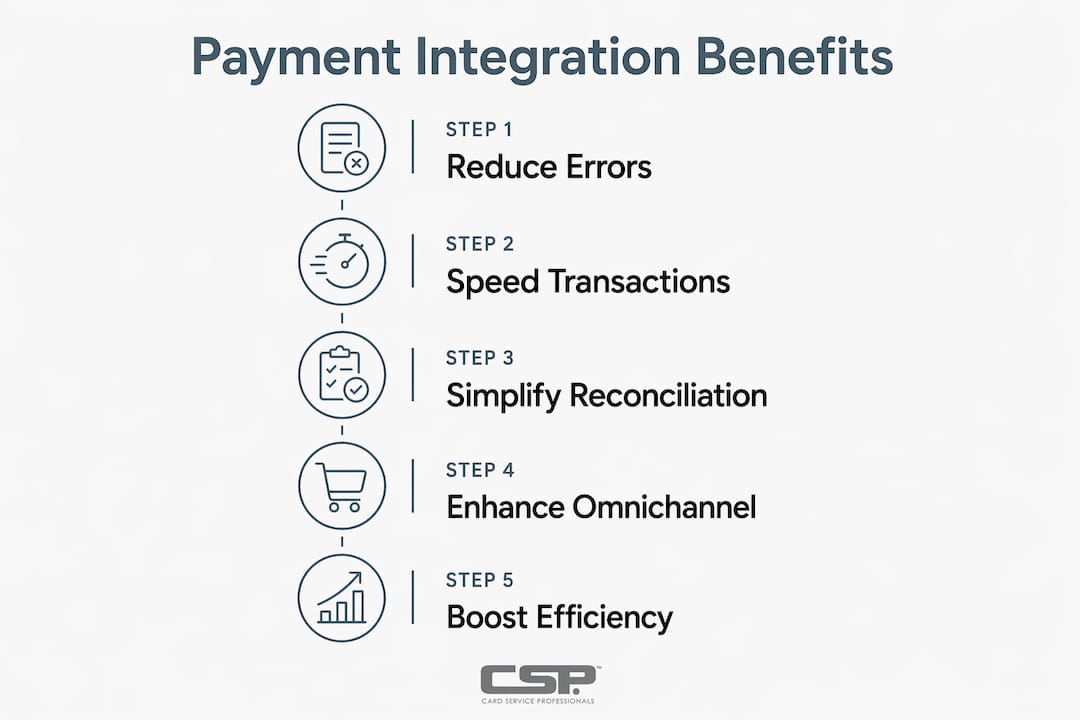
Integrated payment processing delivers measurable gains across accuracy, speed, and back-office efficiency. These are not abstract improvements. They show up in your daily operations within the first week of going live.

Accuracy comes first. Integrated payment systems reduce payment entry errors by about 30% for retailers. That reduction happens because the POS pushes the transaction amount directly to the terminal, removing the manual step where a cashier types in a dollar figure. Fewer errors mean fewer voids, fewer customer disputes, and less time reconciling at the end of the day.
Speed follows accuracy. Faster transactions reduce queue times during busy periods, which matters enormously for Kentucky retailers during peak shopping hours or seasonal rushes. A checkout that takes 15 seconds instead of 45 seconds keeps customers happy and lines moving.
Reconciliation becomes straightforward. Integrated systems make your POS the single source of truth for both sales and payment data. Daily settlement reports rarely match bank deposits exactly, so having transaction-level matching built into your system saves significant time and catches missed errors before they become chargebacks.
Pro Tip: Before you go live with any integrated system, run a full day of test transactions and compare your POS report against the gateway settlement report line by line. This one step reveals configuration gaps that would otherwise surface as reconciliation headaches weeks later.
Omnichannel merchants gain an additional advantage. When your in-store POS and your online checkout feed into the same payment platform, you get unified sales data across every channel. That unified view supports smarter inventory decisions and clearer revenue reporting without building custom spreadsheets.
What types of payment integration fit different retail businesses?
The right integration method depends on your transaction volume, your technical resources, and how much of the PCI DSS compliance burden you want to manage directly. Most small merchants benefit from direct integration with a single payment gateway rather than complex multi-processor setups.
The three most common approaches break down this way:
Hosted checkout redirects customers to a payment page managed by the gateway provider. Your PCI scope stays minimal because cardholder data never touches your servers. This works well for ecommerce merchants with lower transaction volumes who want fast setup and low maintenance.
Embedded payment fields place the card entry form directly on your checkout page using iframes or JavaScript libraries provided by the gateway. The customer never leaves your site, which improves the checkout experience. The gateway still handles tokenization, so your PCI scope remains manageable.
Direct POS-to-processor integration connects your physical terminal to your payment processor through a certified integration. This is the standard model for brick-and-mortar retailers in Kentucky and across the U.S. Your POS software communicates with the terminal via a local network or cloud API, and the processor handles routing and settlement. For a deeper look at the types of payment solutions available to U.S. retailers, the options range from entry-level countertop terminals to full enterprise POS platforms.
The table below compares the three approaches across the factors that matter most to small and mid-sized merchants.
| Integration type | PCI scope | Setup complexity | Best fit |
|---|---|---|---|
| Hosted checkout | Lowest | Low | Ecommerce, low volume |
| Embedded payment fields | Low to medium | Medium | Ecommerce, mid volume |
| Direct POS-to-processor | Medium | Low to medium | Brick-and-mortar retail |
Choosing the right approach depends on transaction volume, regulatory compliance scope, and business needs. Enterprise or high-volume merchants may need hybrid models, but most independent retailers in Kentucky fit cleanly into the direct POS-to-processor category.
How to implement payment integration without common pitfalls
A successful payment integration process requires more than plugging in a terminal. The merchants who run into problems almost always skip one of the following steps.
-
Validate PCI DSS compliance scope before you build. Know which Self-Assessment Questionnaire (SAQ) type applies to your integration method. Using a hosted checkout drops you to SAQ A, the simplest form. A direct API integration may require SAQ D, which carries significantly more requirements.
-
Verify webhook signatures on every event. Payment gateway webhooks are the only authoritative signals for confirming successful payments. Frontend redirects alone are unreliable. Your server must verify the cryptographic signature on every incoming webhook before acting on it.
-
Build idempotent event handlers. Duplicate webhook events are a normal part of how payment networks operate due to network retries. If your system processes the same event twice, you risk double charges or duplicate order fulfillment. Store a unique event ID for each webhook and reject any repeat.
-
Validate order totals on the backend. Never trust the amount sent from the frontend. Your server should calculate the order total independently and compare it against the payment amount before confirming fulfillment. This prevents pricing manipulation and catches integration bugs early.
-
Plan your failure paths. Every integration needs a clear process for declined payments, gateway timeouts, and partial authorizations. Merchants who skip this step discover the gaps during a busy Saturday afternoon, not during testing.
-
Test your chargeback and refund workflow. Integrated systems handle refunds programmatically through the gateway API. Confirm that your POS records the refund correctly and that the gateway processes it back to the original payment method.
Pro Tip: Many merchants assume the payment is final when the customer sees a success screen. The asynchronous webhook is the real confirmation. Build your fulfillment logic to wait for the webhook, not the browser redirect.
For a complete payment processing checklist covering these steps and more, Card Service Professionals has a resource built specifically for small business owners.
Key Takeaways
Payment integration connects your POS and payment gateway into one system, reducing errors, speeding up transactions, and making reconciliation accurate enough to catch chargebacks before they cost you money.
| Point | Details |
|---|---|
| Core definition | Payment integration links your POS directly to a payment gateway, removing manual data entry. |
| Error reduction | Integrated systems cut payment entry errors by about 30%, reducing voids and disputes. |
| Settlement timing | Authorization is instant; settlement takes T+1 to T+3 days, which affects cash flow planning. |
| Integration type | Most small retailers fit direct POS-to-processor integration, which keeps PCI scope manageable. |
| Webhook reliability | Always confirm payments via gateway webhooks, not frontend success screens. |
What I’ve learned watching Kentucky merchants go live with integrated payments
Most merchants I work with underestimate one thing: the gap between “the terminal works” and “the integration is correct.” A terminal that accepts cards is not the same as a system where your POS, gateway, and accounting software all agree on the same transaction record. I have seen stores run for months with a working terminal and a broken reconciliation process, and they only discovered it when a chargeback arrived that nobody could trace.
The merchants who get this right share one habit. They treat the payment integration process as a business systems project, not an IT task. They involve whoever manages their books from the start, not after go-live. That one change prevents most of the reconciliation problems I see.
Kentucky retailers face a specific challenge that merchants in larger metro markets sometimes overlook. Provider support quality varies significantly by region. A gateway that works well for a high-volume urban retailer may offer slower technical support for a mid-sized store in Lexington or Bowling Green. Choosing a provider with genuine local or regional support, or working with an independent agent who can advocate on your behalf, changes the experience when something goes wrong.
The other misconception I encounter regularly is that integrated payments are only for larger stores. The opposite is true. A small retailer with one register benefits more from integration than a large chain with a dedicated IT team. The small merchant has no one to manually reconcile errors at the end of the day. Integration removes that burden entirely.
— Jerry
Payment integration support from Card Service Professionals
Card Service Professionals works with small and mid-sized retail merchants across Kentucky and the U.S. as independent agents for several of the country’s leading merchant service providers. That independence means you get a comparison of real options, not a single-provider pitch.

Whether you need a direct POS-to-processor setup for a brick-and-mortar store, a cash discount program that reduces your processing costs, or guidance on PCI compliance scope, Card Service Professionals matches you with the right solution at competitive rates. The team handles the technical coordination so you can focus on running your store. Visit Card Service Professionals to review your options or go straight to the sign-up application to get started.
FAQ
What is payment integration in simple terms?
Payment integration is the connection between your POS system and your payment processor, so transaction amounts and approvals move automatically without manual entry. It removes the step where a cashier types in a dollar amount separately on the terminal.
How long does payment gateway integration take to set up?
Setup time varies by integration type. A hosted checkout can go live in a day or two, while a direct POS-to-processor integration for a brick-and-mortar store typically takes one to two weeks, including testing and PCI compliance verification.
What is PCI DSS and why does it matter for payment integration?
PCI DSS (Payment Card Industry Data Security Standard) is the security framework that governs how cardholder data is handled during transactions. Your integration method determines which PCI compliance level applies to your business, directly affecting your liability exposure.
What is the difference between a payment gateway and a payment processor?
A payment gateway is the technology that encrypts and transmits transaction data between your POS and the card networks. A payment processor is the financial institution that manages the actual movement of funds between the customer’s bank and your merchant account. Both are required components of any integrated payment system.
Do small retail stores in Kentucky need payment integration?
Any retail store accepting card payments benefits from integration. Integrated systems reduce errors, speed up checkouts, and simplify end-of-day reconciliation, advantages that matter more to a small merchant with limited staff than to a large chain with dedicated accounting resources.
Recommended
- Merchant Account Explained for U.S. Retail Merchants – Card Service Professionals
- Partial Payment Processing Explained for U.S. Retailers – Card Service Professionals
- Credit Card Processing Explained for U.S. Retailers – Card Service Professionals
- What Is Merchant Services? A Guide for U.S. Retailers – Card Service Professionals
