



Merchant services is the umbrella term for the financial tools, technology, and infrastructure that allow a business to accept and process electronic payments from customers. The term covers everything from the card reader on your counter to the payment gateway behind your online store. Providers like Adyen, Stripe, and Square bundle these tools into packages, but the underlying system is the same: a layered network connecting your business, your customer’s bank, and the card networks. Understanding how that system works gives you real leverage when comparing providers and negotiating rates.
What is merchant services and what does it include?

Merchant services are a collection of financial tools that enable businesses to accept, process, and settle electronic payments, including card swipes, taps, and online transactions. The term is broad by design. It covers hardware, software, financial accounts, and the relationships between banks and card networks that make a transaction complete.
The core components break down into five categories:
- POS hardware and software. Registers, terminals, and card readers capture payment data at the point of sale. POS software often handles sales tracking and can connect directly to inventory systems, making it more than just a payment tool.
- Payment gateways. A gateway captures and encrypts card data at the front end. Payment gateways route authorization requests through card networks to the customer’s issuing bank. Some providers bundle gateway and processor functions into a single API.
- Payment processors. The processor handles the back-end authorization and settlement lifecycle. It communicates between the gateway, the card network (Visa, Mastercard, American Express, Discover), and the acquiring bank.
- Merchant accounts. A merchant account is a specialized bank account that holds funds after a transaction is authorized and before they are deposited into your business checking account. Merchant service providers serve as intermediaries connecting merchants, customers, banks, and payment networks.
- Security and encryption. Every step in the payment flow uses encryption and tokenization to protect cardholder data and meet PCI DSS compliance standards.
Pro Tip: Ask any provider whether their gateway and processor are bundled or separate. Bundled solutions are simpler to manage, but separate components sometimes give you better pricing flexibility as your volume grows.
How do merchant services work in practice?
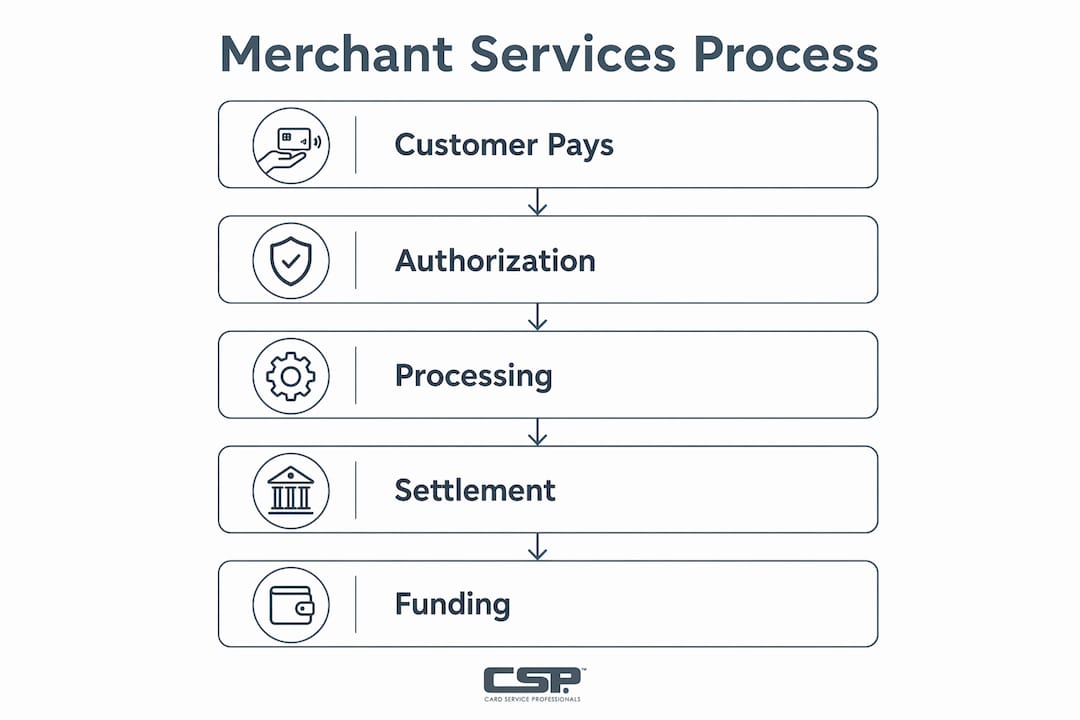
A card payment looks instant to your customer. Behind the counter, it moves through several distinct steps before money reaches your account.
- Card capture. Your customer taps, swipes, or inserts a card at your terminal or enters card details online. The terminal or gateway encrypts the data immediately.
- Authorization request. The encrypted data travels through your payment processor to the relevant card network, which forwards it to the customer’s issuing bank.
- Approval or decline. The issuing bank checks the account for available funds and fraud signals, then sends an approval or decline back through the same network path. This round trip typically takes two to three seconds.
- Batch settlement. At the end of your business day, your processor submits all approved transactions in a batch to the acquiring bank. Settlement typically occurs within 24–48 hours, though timing varies by provider.
- Funds deposit. The acquiring bank deposits the net amount (after fees) into your merchant account, which then transfers to your business checking account.
One detail most retailers miss: some providers use a blanket account model, holding funds before distribution rather than depositing directly into your merchant account. This affects how quickly you see your money and how visible your transaction funds are day to day.
The in-store and online flows follow the same logic. The main difference is that online transactions rely entirely on a payment gateway rather than physical hardware, and card-not-present transactions carry slightly higher fraud risk, which often means slightly higher processing fees.
What types of merchant services work best for small retailers?
Different types of merchant service solutions exist for businesses at every size and stage. Choosing the wrong type costs you money or limits how you can sell.
| Solution type | Best for | Key features | Typical cost structure |
|---|---|---|---|
| Standalone terminal | Brick-and-mortar with low volume | Accepts chip, swipe, tap | Monthly rental or purchase plus per-transaction fee |
| Mobile card reader | Pop-ups, markets, field sales | Connects to smartphone via Bluetooth | Low or no monthly fee; slightly higher per-transaction rate |
| Integrated POS system | Retail stores needing inventory and sales data | Combines hardware, software, and payment processing | Monthly software fee plus processing rate |
| Online payment gateway | E-commerce or phone orders | Card-not-present processing, fraud tools | Monthly gateway fee plus per-transaction fee |
| All-in-one provider | Businesses wanting one vendor | Bundles gateway, processor, and acquiring functions | Flat-rate or interchange-plus pricing |
Merchant service providers increasingly bundle gateway, processor, and acquiring bank functions into a single package. That simplicity is real, but bundled pricing can be harder to audit. Knowing what each layer costs separately gives you a stronger position when you negotiate.
Subscription and recurring billing services are a growing option for retailers who sell memberships, service plans, or auto-replenishment products. These tools automate charge cycles and reduce failed payment rates through automatic card updater features.
Pro Tip: If you sell both in-store and online, look for a provider that offers a unified merchant account for both channels. Splitting your volume across two providers usually means paying two sets of monthly fees and losing the volume discount you would earn with one.
What are the benefits and key considerations when choosing merchant services?
Merchant services provide faster checkout, expanded payment options, enhanced security, and improved cash flow for retail businesses. Each of those benefits has a direct impact on your bottom line and your customer experience.
Benefits worth knowing:
- Faster checkout reduces line wait times and increases the number of transactions you can complete per hour.
- Accepting credit, debit, contactless, and digital wallets like Apple Pay and Google Pay captures sales you would otherwise lose from customers who carry no cash.
- Built-in encryption and tokenization protect your business from data breaches and reduce your PCI compliance burden.
- Predictable settlement timing improves cash flow planning, especially for seasonal retailers.
Considerations before you sign:
- Merchant services may require monthly fees, transaction fees, and setup charges that vary widely by provider. Read every line of the fee schedule before signing.
- Contract length and early termination fees are common pitfalls. Some providers lock you in for two to three years with penalties for leaving early.
- Customer support quality matters more than most retailers expect. A payment outage during a busy Saturday afternoon is a serious problem. Confirm that your provider offers 24/7 phone support.
- Integration with your existing accounting software (QuickBooks, Xero) or e-commerce platform (Shopify, WooCommerce) saves hours of manual reconciliation each month.
- Compliance with PCI DSS is your legal responsibility as a merchant. A good provider makes compliance easier, but it does not eliminate your obligation.
For small retailers specifically, understanding payment processor roles before comparing providers prevents costly mismatches between what you need and what you are paying for.
Key Takeaways
Merchant services is the complete payment infrastructure connecting your business to your customers’ banks, and choosing the right setup directly determines your costs, speed, and security.
| Point | Details |
|---|---|
| Core definition | Merchant services covers POS hardware, payment gateways, processors, and merchant accounts working together. |
| Transaction lifecycle | Every card payment moves through authorization and settlement, with funds typically arriving within 24–48 hours. |
| Solution types vary | Standalone terminals, mobile readers, integrated POS, and online gateways each suit different retailer needs. |
| Fee structure matters | Monthly fees, transaction rates, and contract terms vary widely; read every line before signing. |
| Bundled vs. separate | All-in-one providers simplify management but can make fee auditing harder; know what each layer costs. |
What I have learned after years in merchant services
The most common mistake I see U.S. retailers make is choosing a merchant services provider based on the advertised rate alone. A 2.6% flat rate sounds clean until you realize it applies to every transaction, including debit cards that would cost you under 1% on an interchange-plus plan at your volume. The math changes fast once you process more than $10,000 a month.
The second mistake is ignoring the contract. I have seen retailers locked into three-year agreements with $500 early termination fees because they did not read past the first page. Reputable providers will walk you through every fee before you sign. If a sales rep rushes you past the contract details, that is a clear signal to slow down.
The third thing I would tell any retailer: the payment technology you choose today shapes what you can offer customers tomorrow. Contactless payments, digital wallets, and pay by phone options are no longer optional extras. Customers expect them. A provider that cannot support those channels will cost you sales within a year or two, not just convenience today.
Vetting a provider takes an afternoon. A bad contract can cost you thousands over three years. Spend the time.
— Jerry
How Card Service Professionals helps U.S. retailers get paid
Card Service Professionals works with several of the leading merchant service providers in the United States, which means you get competitive rates without being locked into a single company’s pricing model.

Whether you need a simple terminal for a single location or a full integrated payment solution for multiple channels, Card Service Professionals matches your business to the right fit. Cash discount programs, all electronic payment options, and current POS equipment are all on the table. The sign-up process is straightforward, and a real person walks you through your options before you commit to anything.
FAQ
What is the basic definition of merchant services?
Merchant services is the collection of financial tools and infrastructure that allows a business to accept, process, and settle electronic payments from customers. It includes POS hardware, payment gateways, payment processors, and merchant accounts.
How long does it take to receive funds after a card sale?
Settlement typically takes 24–48 hours after the transaction batch is submitted, though the exact timing depends on your provider and the type of transaction.
Do I need a merchant account to accept card payments?
Most traditional merchant service setups require a dedicated merchant account. All-in-one providers like Square or Stripe use aggregated accounts, which simplifies setup but can result in fund holds for some businesses.
What fees should I expect from a merchant services provider?
Fees typically include a monthly service fee, a per-transaction rate, and sometimes a setup charge. Some providers also charge for PCI compliance, statement fees, or early termination.
How do I avoid merchant services scams?
Reputable providers always clearly identify themselves and never pressure you to sign on the spot. Be cautious of unsolicited calls promising unusually low rates without a written fee schedule.
Recommended
- What Is a Payment Processor? A Guide for Retailers – Card Service Professionals
- Credit Card Processing Explained for U.S. Retailers – Card Service Professionals
- Types of Business Payment Solutions for U.S. Retailers – Card Service Professionals
- Pay by Phone Explained for U.S. Retail Merchants – Card Service Professionals
