



“High risk” describes any situation, entity, or activity carrying a greater-than-normal chance of negative outcomes, whether that’s financial loss, physical harm, or operational failure. The term cuts across medicine, business, insurance, and finance, and its meaning shifts meaningfully depending on context. What stays constant is the core idea: elevated probability of something going wrong, paired with consequences serious enough to require extra attention.
Here’s what the label typically signals, regardless of domain:
- Greater likelihood of harm or loss compared to a standard baseline
- Increased monitoring or oversight from professionals, regulators, or institutions
- Modified terms or conditions, such as higher fees, specialist care, or restricted access
- Not a verdict. Being labeled high risk means precautions are warranted, not that a bad outcome is guaranteed
What does “high risk” mean in medical and pregnancy contexts?
A high-risk pregnancy, as defined by the National Institutes of Health, is one where the mother, the fetus, or both face greater health risks than in a typical pregnancy. The classification triggers a more intensive care plan, not a prediction of failure.
Common factors that place a pregnancy in this category include:
- Maternal age below 17 or above 35
- Chronic conditions such as high blood pressure, diabetes, obesity, thyroid disease, or heart disorders
- Pregnancy-related complications including preeclampsia, gestational diabetes, or placenta previa
- Multiple gestation (twins, triplets, or more)
- Fetal growth restriction, defined as growth below the 10th percentile for gestational age
- History of preterm birth or prior pregnancy complications
Medical experts emphasize that the high-risk label exists to trigger proactive care, including more frequent ultrasounds, specialist consultations with maternal-fetal medicine physicians, genetic counseling, and advanced fetal monitoring. According to Cleveland Clinic, many people with high-risk pregnancies deliver healthy babies when they receive proper monitoring and care.
Pro Tip: If your pregnancy is classified as high risk, ask your provider specifically which specialists you’ll be referred to and how often monitoring will occur. The care plan varies widely based on your individual risk profile.
How does “high risk” apply to merchants and financial businesses?
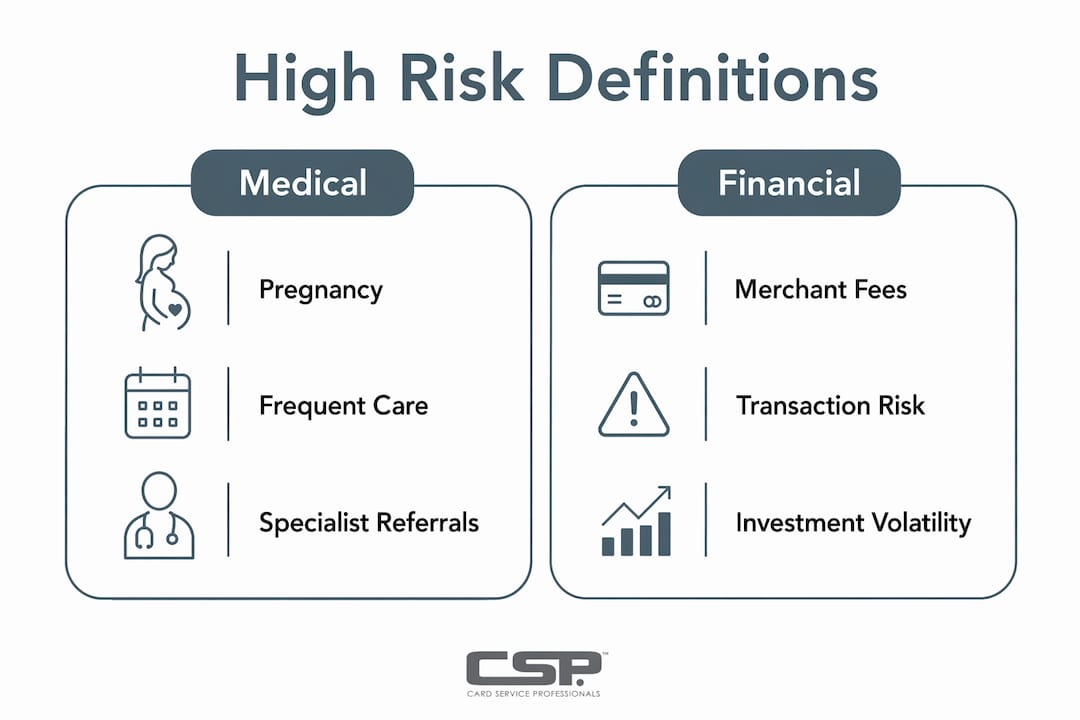
In payment processing, a high-risk merchant classification reflects a processor’s assessment of aggregate financial exposure, not a judgment of how a business is run. Plenty of legitimate, well-operated businesses carry this label simply because of the industry they’re in.
Factors that typically trigger the classification include:
- Chargeback-to-transaction ratio above 1%, the single most weighted factor
- Industry type, including adult entertainment, gambling, travel agencies, subscription services, and CBD products
- Card-not-present transactions, which carry higher fraud risk than in-person sales
- International operations, which add currency conversion complexity and cross-border fraud exposure
- Business age, since newer merchants without processing history are evaluated more conservatively
- Poor credit history or previous account terminations, especially placement on the MATCH list
The financial consequences are real. High-risk merchants pay 1–2 percentage points above standard transaction fees, face account reserves that hold a portion of revenue, and deal with longer settlement periods. Contracts are more restrictive, and account monitoring is closer. That said, high-risk accounts also unlock access to international markets and niche verticals that standard processors won’t touch.
For merchants navigating this classification, Card Service Professionals works with leading U.S. merchant service providers to find processing solutions that fit your actual business. You can learn more about high-risk merchant accounts and what the label means for your payment setup.

In investing, “high risk” follows similar logic: assets with greater price volatility and a higher chance of loss. Stocks in early-stage companies, cryptocurrency, and leveraged funds all fall into this category. A free portfolio risk calculator can help you evaluate where your current holdings sit on the risk spectrum.
What makes someone a high-risk driver for insurance purposes?
High-risk driver status in U.S. auto insurance is an underwriting classification, not a legal one. One insurer’s high-risk driver may qualify as standard risk at another carrier, so the label is more fluid than it sounds.
Driving history factors that typically trigger the classification:
- At-fault accidents within the past three to five years
- Traffic violations such as speeding tickets or reckless driving
- DUI or DWI convictions, which can affect status for up to 10 years
- Lapsed coverage or a gap in insurance history
- Multiple claims in a short period
Minor violations typically affect your status for 3–5 years; serious offenses like DUIs sit on your record longer. Drivers in this category can still get coverage through non-standard auto insurance policies, which fulfill legal driving requirements at higher premiums. Over time, as violations age off your record and you maintain a clean driving history, most insurers will reassess your risk tier and lower your rates accordingly.
How “high risk” works across insurance and pregnancy together

Both insurance underwriting and obstetric medicine use “high risk” the same way: as a care or coverage framework, not a punishment. In insurance, the label adjusts your premium and policy terms to reflect the statistical likelihood that you’ll file a claim. In pregnancy, it adjusts the level of medical surveillance to reflect the statistical likelihood of complications.
The practical overlap matters for pregnant people navigating both systems simultaneously. A high-risk pregnancy may affect health insurance costs or coverage requirements, particularly for specialized procedures like amniocentesis or extended fetal monitoring. Understanding that both uses of the term are functional tools, designed to match resources to need, removes much of the anxiety the label tends to create.
Key Takeaways
“High risk” is a functional classification used across medicine, business, and insurance to match resources, oversight, and costs to the actual probability of a negative outcome.
| Point | Details |
|---|---|
| Medical high risk triggers more care | A high-risk pregnancy classification leads to specialist referrals, more ultrasounds, and closer monitoring throughout. |
| Merchant classification affects fees | High-risk merchants typically pay 1–2 percentage points above standard transaction rates. |
| Chargeback ratio is the key threshold | A chargeback-to-transaction ratio above 1% is the primary trigger for high-risk merchant classification. |
| Driver status is insurer-specific | A driver labeled high risk by one insurer may qualify as standard risk at another carrier. |
| The label is temporary and manageable | In both insurance and business, high-risk status can be reduced over time through better performance and consistent record-keeping. |
If your business has been classified as high risk by a payment processor, Card Service Professionals can help you find competitive rates and the right processing solution. Start your application or explore our merchant services to see what’s available for your industry.

Recommended
- High Risk Merchant Account Explained for U.S. Retailers – Card Service Professionals
- Aggregator vs Merchant Account: A U.S. Retail Guide – Card Service Professionals
- Top 4 Payment Processing Agencies for americanbanker.com alternatives 2026 – Card Service Professionals
- Payment Processing Red Flags Merchants Must Know – Card Service Professionals
