



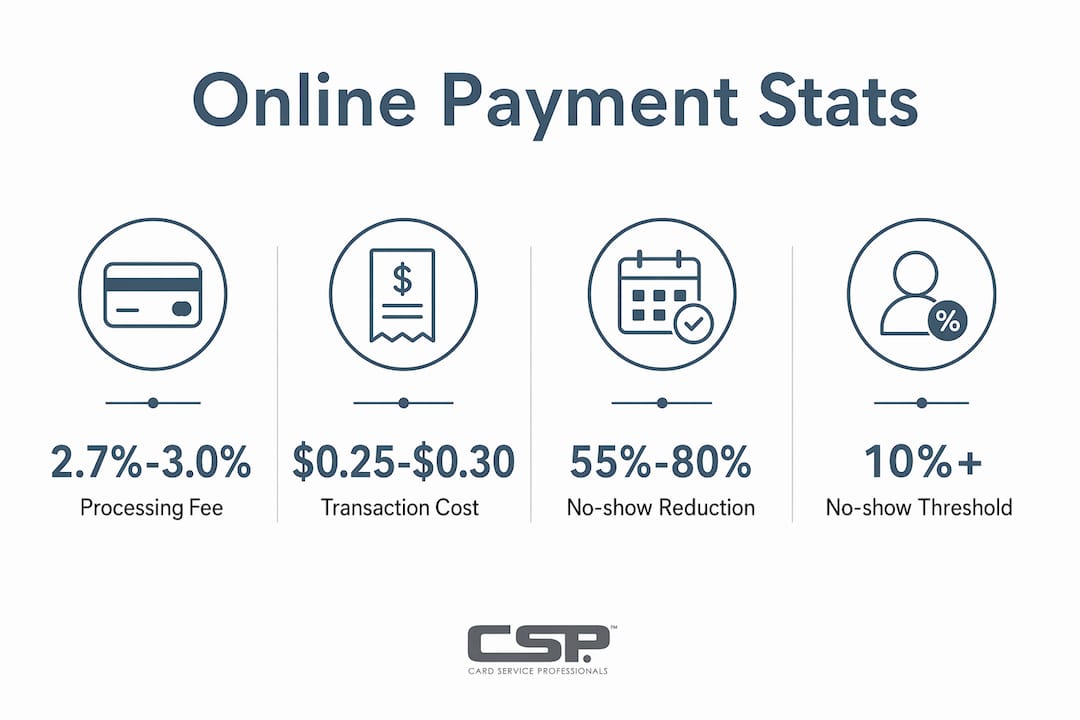
Online booking payment is the integrated method by which businesses collect payment from customers at the moment of online reservation or appointment booking. This process combines a payment gateway with a booking platform to secure funds before the service date, protecting both parties. The PCI Security Standards Council sets the compliance framework that governs how this payment data is stored and transmitted. Businesses that require payment at booking reduce no-shows by 55% to 80% compared to collecting payment at service time. That single metric explains why service businesses across the United States are moving fast to adopt these systems.
What is online booking payment and how does it work?
Online booking payment is the process of accepting and processing a customer’s payment during the reservation step, before the appointment or service takes place. The industry term for the underlying technology is a payment gateway, which acts as the secure digital connection between a customer’s card details and your business bank account. Understanding how these two pieces fit together is the foundation for choosing the right setup.
When a customer books online, the booking platform passes their card data to the payment gateway. The gateway encrypts that data, sends it to the card network (Visa, Mastercard, American Express, or Discover), and receives an approval or decline in seconds. The funds then move from the customer’s bank to your merchant account, typically settling within one to two business days.

The booking platform and the payment gateway must be integrated for this to work without manual steps. Most modern booking platforms connect directly to major payment gateways through APIs, so the customer never leaves your booking page to complete payment. That frictionless experience is what separates a professional online booking system from a basic contact form.
What payment models are used in online booking payment systems?
Service businesses typically use three core payment models when collecting money at booking: full prepayment, a deposit, or a card-on-file arrangement. Each model suits a different type of service and price point.
- Full prepayment: The customer pays 100% of the service fee at booking. This model works best for fixed-price services like haircuts, fitness classes, or photography sessions. It eliminates all collection risk and produces the strongest reduction in no-shows.
- Deposit (25%–50% upfront): The customer pays a portion at booking and the balance at service time. Deposits between 25% and 50% balance commitment with reduced booking friction. This model fits higher-ticket services like event planning, custom work, or multi-session packages where customers may hesitate to pay in full upfront.
- Card-on-file: The customer’s card is securely stored at booking but not charged until after the service. This model suits businesses where the final price varies, such as auto repair or consulting. It also supports late cancellation fees and no-show charges without an awkward conversation.
Choosing the wrong model costs money. A yoga studio charging $20 per class should use full prepayment. A wedding photographer charging $3,000 should use a deposit. A mobile mechanic with variable labor costs should use card-on-file.
Pro Tip: If your no-show rate exceeds 10%, switch to full prepayment or a deposit immediately. The reduction in lost revenue will far outweigh any small drop in new bookings.
How do processing fees and security requirements affect your business?
Online payment processing fees for U.S. service businesses typically run 2.7%–3.0% plus $0.25–$0.30 per transaction. On a $100 booking, that means roughly $3.00 in percentage fees plus $0.28 per transaction. Those costs add up quickly at volume, so comparing processor rates before committing to a platform matters.
Security compliance adds another layer of responsibility. The PCI Security Standards Council requires all businesses that accept card payments to meet PCI DSS (Payment Card Industry Data Security Standard) requirements. The good news is that hosted payment pages shift most of that compliance burden to the processor, reducing your annual requirement to a self-assessment questionnaire rather than a full audit.
Online payments carry higher fraud risk than in-person transactions because the card is not physically present. Card-not-present fraud is the primary chargeback risk for booking businesses. Using Address Verification Service (AVS) and CVV checks at the time of booking catches most fraudulent attempts before they become chargebacks.
Fund holds and reserve policies are a less-discussed risk. Some processors freeze funds for seasonal or high-ticket businesses without warning. Reading your merchant agreement before signing prevents this surprise.
| Cost or security factor | What it means for your business |
|---|---|
| Processing rate (2.7%–3.0%) | Built into your service pricing to protect margins |
| Per-transaction fee ($0.25–$0.30) | Matters most for low-ticket, high-volume bookings |
| PCI DSS compliance | Use hosted checkout pages to reduce your audit scope |
| AVS and CVV verification | Required to minimize chargebacks on card-not-present sales |
| Fund holds and reserves | Review processor terms before signing any merchant agreement |
Pro Tip: Ask your payment processor specifically whether they use hosted checkout pages. If they do, your PCI compliance scope drops significantly, saving you time and potential fines.
What operational benefits do integrated booking payment systems provide?
Integrated booking and payment software automates fund transfers and reconciles scheduling with payments inside one platform. That means no manual matching of invoices to appointments at the end of the day. Your accounting software pulls clean, categorized transaction records directly from the booking system.
The operational gains go beyond accounting. Here are the four most direct benefits businesses report after integrating payment into their booking flow:
- Fewer no-shows. Customers who have already paid are far more likely to show up or cancel in advance. That predictability lets you fill canceled slots instead of absorbing the loss.
- Cleaner client interactions. Collecting payment at booking removes the awkward checkout moment at the end of a service. Clients leave focused on the experience, not on pulling out a card.
- Faster cash flow. Prepaid bookings mean funds arrive before the service date. That forward cash position reduces reliance on credit lines for payroll and supplies.
- Higher customer satisfaction. Offering multiple payment methods, including Apple Pay, Google Pay, and major credit cards, removes friction for customers who prefer digital wallets. Businesses that ignore digital wallets risk losing those bookings entirely.
Beyond these four points, integrated systems reduce administrative overhead by automating payment collection, which directly cuts the staff time spent chasing invoices or processing manual payments. That time savings translates into lower payroll costs for the same booking volume.
How do businesses select and implement online booking payment solutions?
Selecting the right payment solution starts with matching the gateway’s capabilities to your booking volume, average ticket size, and customer base. The wrong gateway costs more per transaction or creates compliance headaches that slow your operation down.
- Evaluate fees against your average ticket. A 3.0% rate on a $50 service costs $1.50. On a $500 service, it costs $15. High-ticket businesses should negotiate interchange-plus pricing rather than flat-rate pricing.
- Confirm integration with your booking software. Not every gateway connects to every booking platform. Verify the integration exists before committing to either product.
- Check supported payment methods. Your gateway must accept Visa, Mastercard, American Express, Discover, and ideally Apple Pay and Google Pay. Missing any major method costs you bookings.
- Review the merchant agreement carefully. Look specifically for reserve requirements, fund hold policies, and chargeback fee structures. These terms vary widely between processors. A payment processing checklist helps you compare agreements side by side.
- Plan your customer communication. Customers unfamiliar with prepayment need a clear explanation of your refund and cancellation policy before they book. Post that policy on your booking page, in your confirmation email, and in any reminder messages.
- Train your staff. Your team needs to understand how refunds, partial charges, and chargebacks work inside the new system. A one-hour training session before launch prevents most post-launch errors.
Watch for payment processing red flags during onboarding, including processors who cannot explain their chargeback dispute process or who require long-term contracts with steep early termination fees. Working with an independent merchant services agent gives you access to multiple processors and competitive rate comparisons without being locked into one provider’s terms.
Key Takeaways
Requiring payment at the time of booking is the single most effective step a U.S. service business can take to reduce no-shows, protect cash flow, and remove friction from the client experience.
| Point | Details |
|---|---|
| No-show reduction | Collecting payment at booking cuts no-shows by 55%–80% compared to paying at service time. |
| Payment model selection | Match your model to your service: full prepayment for fixed-price, deposits for high-ticket, card-on-file for variable pricing. |
| Fee awareness | U.S. online processing rates run 2.7%–3.0% plus $0.25–$0.30 per transaction; build this into your pricing. |
| Security compliance | Use hosted checkout pages to reduce PCI DSS scope and deploy AVS and CVV checks to limit chargebacks. |
| Integration matters | Booking and payment software that share one platform automates reconciliation and eliminates manual data entry. |
What I’ve learned from watching businesses adopt online booking payments
The resistance I hear most often from service business owners is this: “My customers won’t want to pay before they’ve experienced the service.” After years of working with businesses across the United States, I can tell you that resistance is almost always wrong.
Customers who book online are already comfortable with digital transactions. They buy airline tickets, hotel rooms, and concert seats without hesitation, all fully prepaid. The hesitation is on the business owner’s side, not the customer’s. The moment a business owner sees their first week of prepaid bookings with zero no-shows, that resistance disappears.
The mistake I see most often is choosing a payment gateway based on brand recognition rather than fee structure and integration quality. A well-known name does not mean the best rate for your specific volume and ticket size. I have watched businesses overpay by a full percentage point simply because they never compared options. That difference compounds fast at scale.
The other mistake is skipping the cancellation policy conversation with customers. A clear, written refund policy posted before the customer pays prevents the vast majority of chargebacks. Chargebacks are expensive, time-consuming, and damaging to your merchant account standing. A two-sentence refund policy eliminates most of them before they start.
My honest recommendation: start with a deposit model if full prepayment feels like too big a change. A 25% deposit still cuts no-shows dramatically and gives you proof of concept before you move to full prepayment. Revisit your payment policy every six months and adjust based on your actual no-show and chargeback data.
— Jerry
How Card Service Professionals can help with your payment setup
Card Service Professionals works with U.S. service businesses as an independent agent for several of the country’s leading merchant service providers. That independence means you get rate comparisons across multiple processors, not a single provider’s pitch.
Whether you need a cash discount program to offset processing fees, a card-on-file solution for variable-price services, or a fully integrated booking payment setup, Card Service Professionals matches you with the right processor at competitive rates. The team handles the merchant agreement review, onboarding, and equipment setup so you can focus on running your business. Visit Card Service Professionals to get a rate comparison or speak directly with a payment processing expert about your specific booking setup.
FAQ
What is online booking payment?
Online booking payment is the process of collecting a customer’s payment at the time they make a reservation or appointment online, using a payment gateway integrated with a booking platform. It secures funds before the service date and reduces no-shows significantly.
What are the typical processing fees for online booking payments?
U.S. online payment processing fees typically run 2.7%–3.0% plus $0.25–$0.30 per transaction. High-ticket service businesses should ask processors about interchange-plus pricing to reduce costs at volume.
How does online booking payment reduce no-shows?
Requiring payment at booking reduces no-shows by 55%–80% compared to collecting payment at service time. Customers who have already paid are far more likely to attend or cancel with enough notice to fill the slot.
Is online booking payment secure?
Yes, when implemented correctly. Using a hosted checkout page reduces your PCI DSS compliance scope, while AVS and CVV verification tools reduce chargeback risk from card-not-present fraud.
What payment methods should my booking system accept?
Your booking payment system should accept Visa, Mastercard, American Express, Discover, Apple Pay, and Google Pay. Accepting digital wallets is now a competitive necessity, not an optional feature.
Recommended
- Accepting Payments for Service Businesses: 2026 Guide – Card Service Professionals
- Types of Business Payment Solutions for U.S. Retailers – Card Service Professionals
- Merchant Account Explained for U.S. Retail Merchants – Card Service Professionals
- Pay by Phone Explained for U.S. Retail Merchants – Card Service Professionals
