



If you run two or more stores and still reconcile payments location by location, you are leaving money, time, and data on the table. The right move is a centralized, platform-based payment processing architecture: one parent merchant relationship, location-aware sub-ledgers, and a single reconciliation layer that gives every department the same real-time picture. Request a site assessment from Card Service Professionals to get a concrete rollout estimate before you commit to any hardware or platform.
The operational case is not theoretical. Vontier’s Unified Payment Research found that 75% of retailers report fragmented payment architectures and 68% operate two or more payment systems across devices, leading to certification delays and reconciliation backlogs. PCI DSS compliance gets harder, not easier, when each location runs its own stack. Centralizing fixes that at the root.
Table of Contents
- What does centralized payment processing look like for multi-location retailers?
- What core features must your payment and POS system include?
- How does centralized payment processing improve operations and profitability?
- What should you budget for multi-location payment processing?
- What does a realistic rollout timeline look like?
- Which integrations actually move the needle for multi-location retailers?
- How do you evaluate and choose the right payment processing partner?
- How Card Service Professionals supports multi-location retailers
- Key Takeaways
- What most retailers get wrong about multi-location payment stacks
- Card Service Professionals: get a tailored assessment for your stores
- Useful sources for further verification
What does centralized payment processing look like for multi-location retailers?
The architecture is simpler than it sounds. POS terminals at each store capture transactions, tokenize card data, and push it to a central payment platform. That platform handles authorization, settlement, and fraud screening, then writes the result to a consolidated ledger with location-level tags. Finance sees one statement; store managers see their slice.
There are three common configurations, and the right one depends on your size and risk profile:
- Parent MID with location sub-accounts. One merchant ID at the top, with location descriptors that appear on cardholder statements. Reconciliation is centralized by default. Best for chains of 2–15 stores with similar risk profiles.
- Platform-based payfac with sub-merchant accounts. Each location gets its own sub-merchant record under a payment facilitator umbrella. Chargeback liability is isolated per location, which matters if one store has a higher dispute rate. Common for mid-market and franchise models.
- Hybrid approach for holding companies. Separate MIDs for legally distinct entities, orchestrated through a shared analytics and reporting layer. Multi-merchant strategy guidance recommends this for mixed-risk portfolios where underwriting leverage and chargeback isolation both matter.
The operational difference between per-location MIDs and a parent MID is real. Per-location MIDs give you chargeback isolation and cleaner underwriting per brand, but they multiply your certification overhead and reconciliation workload. A parent MID cuts that overhead sharply, though a single high-dispute location can affect the whole account. Most growing chains land on the parent MID model first, then migrate to a hybrid structure as they add brands or franchisees. You can read more about merchant account structures before you decide.
What core features must your payment and POS system include?

Not every feature a vendor demos is worth paying for. Here is how to sort them.
Must-have features (non-negotiable for multi-store ops):
- Real-time reconciliation with location-level tagging and a consolidated daily settlement report
- EMV chip and contactless acceptance, including Apple Pay and Google Pay, at every terminal
- Offline/edge processing that queues transactions locally and syncs when connectivity returns
- Tokenization with a single customer profile that travels across locations
- Role-based staff controls so a cashier at Store 3 cannot see Store 7’s sales data
Highly recommended (pay for these if the budget allows):
- API-first integration layer so your accounting, ERP, and e-commerce systems pull from the same ledger
- Centralized gift card and loyalty program tied to tokenized customer identifiers, which unified payments research shows drives measurable retention gains
- Multi-location inventory sync that updates in real time at point of sale
Nice-to-have (evaluate after the core is stable):
- Embedded finance features like BNPL or branded payment cards
- Real-time tip payouts to staff bank accounts, which centralized payment platforms increasingly support as an employee-retention lever
For mobile and pop-up selling between locations, accepting payments on the go requires the same tokenization and offline-mode standards as your fixed terminals.
Pro Tip: During vendor demos, ask for a live reconciliation trace and a sample daily settlement report from a multi-location merchant. If the vendor cannot produce one on the spot, their “one source of truth” claim is marketing copy, not a product feature.
How does centralized payment processing improve operations and profitability?
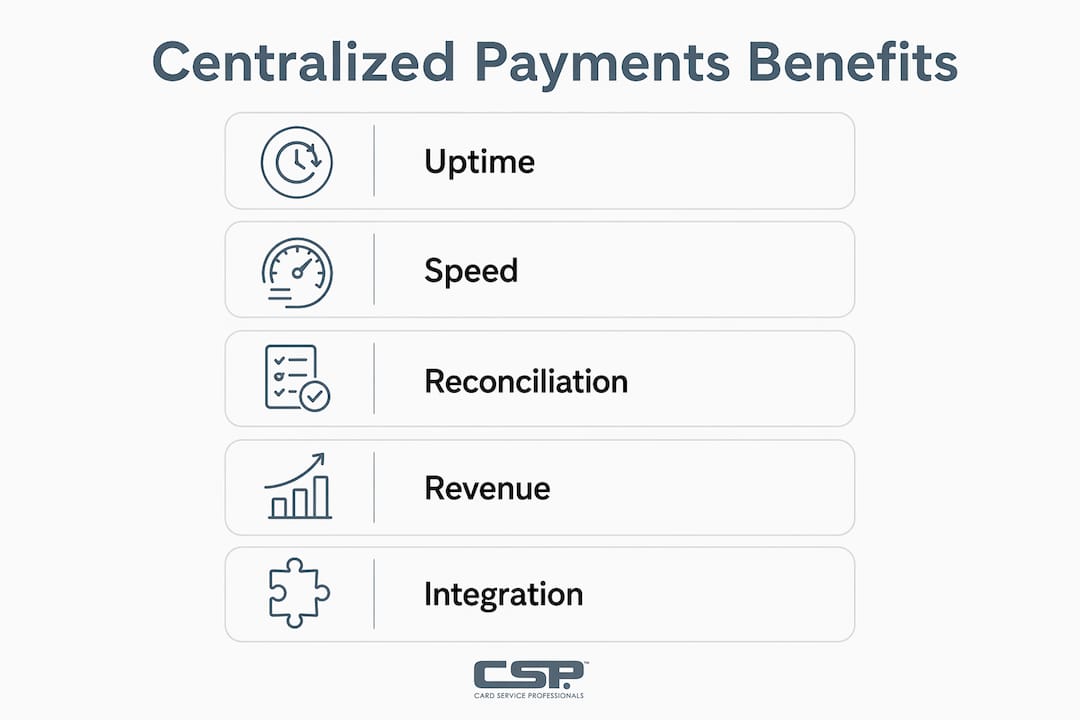
The gains show up in three places: uptime, speed, and downstream revenue.

On uptime, the numbers are sobering. Vontier’s survey found that 88% of retailers reported at least one payment system outage in the previous 12 months, with 36% experiencing three or more outages and 53% reporting a typical downtime of at least an hour. A centralized platform with a single vendor SLA and redundant failover cuts that exposure significantly compared to managing five separate vendor relationships.
On speed, retailers with unified payment systems were nearly twice as likely to have new features live within six months (47% vs. 26% for fragmented stacks). That gap compounds over time: every new payment method or loyalty feature you launch faster is a competitive advantage.
The downstream ROI levers are worth naming specifically:
- Higher authorization rates from a single, optimized routing layer versus multiple disconnected gateways
- Lower fraud losses because tokenization and centralized fraud screening apply consistently across all locations
- Faster settlements that improve cash flow, especially for chains with high daily volume
- Reduced PCI DSS certification overhead, since a centralized token vault shrinks your cardholder data environment to one scope instead of one per location
- Real-time employee tip payouts, which direct deposit research shows matter to younger retail workers as a retention factor
Reconciliation alone is worth the switch. When finance closes the books daily instead of weekly, discrepancies surface in hours, not at month-end.
What should you budget for multi-location payment processing?
Pricing models vary, and the gaps between them are wide enough to matter at scale.
Common pricing structures:
- Interchange-plus: The processor passes the actual interchange cost from Visa/Mastercard plus a fixed markup. Most transparent for high-volume chains.
- Flat-rate or tiered: A single blended rate regardless of card type. Simpler to forecast but almost always more expensive for merchants processing above roughly $30,000 per month.
- Subscription plus per-terminal fee: A monthly platform fee plus a small per-transaction cost. Works well when transaction volume is predictable.
- Per-location fees: Some platforms charge a monthly fee per active location on top of transaction costs. These add up fast for a 10-store chain.
Budget line items to plan for:
- Hardware: terminals, PIN pads, receipt printers, and any tablet-based POS hardware per location
- Per-terminal software licenses (monthly or annual)
- Integration and migration costs, including API development time if your ERP is not pre-integrated
- PCI scope reduction work: network segmentation, point-to-point encryption (P2PE) setup, and annual SAQ or QSA assessment fees
- Chargeback reserves, which some processors hold back for new merchant relationships
- Staff training, which is often underbudgeted for multi-location rollouts
A small chain (2–5 stores) typically faces higher one-time setup costs relative to ongoing fees, while a mid-market rollout (10–50 stores) shifts the cost weight toward integration, training, and per-location licensing. Use a payment processing cost audit to compare bids on a like-for-like basis before you sign anything.
Red flags in vendor quotes: non-transparent interchange pass-through, large monthly gateway fees buried in the fine print, per-location minimums that penalize seasonal closures, and elevated reserve requirements with no clear release schedule.
What does a realistic rollout timeline look like?
Most multi-location rollouts follow a four-phase structure. Compressing it to save time usually costs more in rework.
- Discovery and scoping (2–4 weeks). Map your current payment stack: how many terminals, which processors, what integrations exist, and where your PCI scope sits today. Identify the pilot store.
- Pilot (4–8 weeks). Stand up the new platform at one store. Run parallel processing for at least two weeks so you can compare settlement reports side by side. Validate offline mode, reconciliation accuracy, and staff training materials before touching another location.
- Phased rollout by region (2–6 weeks per phase). Group stores geographically or by volume tier. Migrate one group at a time, with a defined cutover window and a tested fallback process.
- Stabilization (30–90 days post-rollout). Monitor authorization rates, chargeback ratios, and reconciliation accuracy. Lock in SLA performance reviews with your provider.
Phased deployment checklist:
- Pilot store selection: choose a mid-volume location, not your highest-revenue store, so errors are contained
- Hardware staging: pre-configure and test terminals before shipping to stores
- Card vault migration: tokenize existing stored cards before cutover to avoid breaking recurring transactions
- Staff training: cover both the new POS workflow and the fallback process for outages
- SLA verification: confirm uptime guarantees and escalation paths in writing before go-live
Pro Tip: Schedule cutover windows on Tuesday or Wednesday mornings, not Friday afternoons. Weekend transaction volume is harder to reconcile if something goes wrong, and your support team is thinner.
Which integrations actually move the needle for multi-location retailers?
API-first payment platforms reduce reconciliation cycles from days to hours by letting your accounting, inventory, and CRM systems pull from the same ledger in real time. The integration priority question is really a sequencing question: what breaks first if it is not connected?
| System Type | Impact on Reconciliation | Implementation Time | Criticality |
|---|---|---|---|
| POS / sales ledger | Direct: every transaction flows here | Low (native) | Critical |
| Settlement / accounting (ERP) | High: eliminates manual journal entries | Medium | Critical |
| E-commerce gateway | High: unifies online and in-store customer profiles | Medium | High |
| CRM / loyalty platform | Medium: ties rewards to tokenized IDs | Medium | High |
| Payout / treasury system | Medium: enables real-time staff payouts | High | Optional |
The practical sequencing: get POS and accounting connected first. Until those two systems share the same ledger, your finance team is still doing manual reconciliation regardless of what the platform dashboard shows. E-commerce and loyalty come next, especially if you run any omnichannel promotions. Payout and embedded finance integrations are worth planning for but rarely block a launch.
For a deeper look at how API layers connect your retail stack, payment integration for U.S. retail merchants covers the architecture in practical terms.
How do you evaluate and choose the right payment processing partner?
The evaluation process matters as much as the feature list. Here is what to demand before you sign.
Questions to ask during vendor demos:
- Show me a live reconciliation trace from a multi-location merchant with at least five stores.
- What was your last major outage, how long did it last, and what was the root cause?
- How do you handle chargebacks across locations — is liability isolated per location or pooled?
- Can you provide references from retailers with a similar store count and transaction volume?
- What does your PCI scope reduction support actually include, and do you have a QSA relationship?
Trust signals worth demanding:
- PCI DSS Level 1 certification (or a clear explanation of their compliance scope)
- Published SLA with uptime guarantees and financial penalties for breaches
- Transparent interchange-plus reporting with line-item interchange costs visible per transaction
- Client case studies from multi-store retailers, not just single-location merchants
Red flags that should end the conversation:
- Opaque pricing with blended rates and no interchange pass-through visibility
- Refusal to show reconciliation samples or live reporting during the demo
- No clear chargeback reserve policy or an open-ended reserve hold period
- Black-box transaction routing with no explanation of how authorization decisions are made
For a broader list of warning signs, payment processing red flags covers the patterns that cost merchants the most.
Understanding your business payment solution options before entering vendor negotiations puts you in a much stronger position.
How Card Service Professionals supports multi-location retailers
Card Service Professionals works as an independent sales agent for several of the leading merchant service providers in the United States, which means the recommendation you get is matched to your actual store count, volume, and integration needs rather than to a single platform’s sales quota.
What the engagement typically covers:
- Site assessment: a review of your current payment stack, terminal inventory, and PCI scope before any proposal is made
- Merchant account strategy: guidance on parent MID vs. platform-based sub-merchant structures based on your risk profile and growth plan
- Hardware procurement: sourcing and pre-configuring terminals and POS equipment for each location
- Integration support: connecting your payment platform to accounting, ERP, and loyalty systems
- Ongoing support: SLA-backed service packages with defined escalation paths
Card Service Professionals also offers cash discount programs that can materially reduce net processing costs for high-volume locations, along with the full range of electronic payment options including EMV, contactless, and mobile wallets. The CSP Advantage page outlines the service model in more detail.
Retailers ready to move from evaluation to action can request a pilot program scoped to a single store, validate the reconciliation and reporting outputs, and then expand location by location with a defined timeline.
Key Takeaways
Centralized payment processing for multi-location retail requires a single reconciliation layer, PCI DSS-compliant tokenization, and a phased rollout starting with a one-store pilot before expanding across your chain.
| Point | Details |
|---|---|
| Centralize reconciliation first | A parent MID or platform sub-account structure eliminates per-location reconciliation backlogs from day one. |
| Demand live reconciliation proof | Ask every vendor for a live reconciliation trace during the demo — not a screenshot, a live trace. |
| Budget beyond transaction fees | Hardware, integration, PCI scope work, and training are real costs that flat-rate quotes routinely omit. |
| Pilot before you scale | A 4–8 week single-store pilot with parallel processing catches integration failures before they hit your whole chain. |
| Card Service Professionals | Offers site assessments, merchant account strategy, and hardware procurement for U.S. multi-location retailers. |
What most retailers get wrong about multi-location payment stacks
The conventional wisdom says the hard part of multi-location payment processing is choosing the right platform. It is not. The hard part is the data model underneath it.
Most retailers I see in the field have already picked a platform by the time they realize their accounting system maps transactions to a store number, their loyalty platform maps them to a customer email, and their payment processor maps them to a terminal ID. Three systems, three identifiers, zero automatic reconciliation. The platform is fine. The integration design is broken.
The fix is not expensive, but it requires a decision before implementation starts: pick one canonical identifier for each transaction (usually the tokenized card or the order ID) and make every downstream system reference it. That single architectural choice cuts reconciliation time more than any dashboard feature a vendor will demo for you.
The other thing worth saying plainly: the retailers who get the most out of centralized payments are the ones who stop treating it as a cost-reduction project and start treating it as an operational platform. Real-time tip payouts reduce turnover. Centralized loyalty data drives repeat visits. Unified fraud screening lowers losses. None of that shows up in a per-transaction rate comparison, but all of it shows up in the P&L. If your current vendor conversation is entirely about basis points, you are optimizing the wrong variable.
Card Service Professionals: get a tailored assessment for your stores
Running multiple locations means your payment processing costs, integration requirements, and rollout complexity are different from a single-store merchant. Card Service Professionals offers a no-obligation site assessment that maps your current stack, identifies PCI scope exposure, and produces a concrete proposal with transparent interchange-plus pricing and a phased rollout timeline.

The assessment covers your store count, average monthly volume, current terminal inventory, and integration requirements. From there, Card Service Professionals matches you with the right merchant service provider from their network, sources and pre-configures hardware, and supports the rollout through stabilization. Cash discount programs are available for locations where they fit the customer mix.
Request your assessment or visit Card Service Professionals to start the conversation. Most merchants receive a tailored proposal within three business days.
Useful sources for further verification
The claims in this article about PCI DSS compliance, payment fragmentation, and rollout timelines draw from the following primary and industry sources.
| Source | What It Covers | Relevance to Multi-Location Retailers |
|---|---|---|
| Vontier Unified Payment Research | Fragmentation rates, outage frequency, and feature launch timelines across retail | Quantifies the operational cost of fragmented stacks |
| PYMNTS: Payments Platformization | API-first platforms, omnichannel integration, embedded finance | Explains how platformization reduces reconciliation lag |
| PaymentsJournal: Centralizing Payments | Unified ledgers, employee payouts, loyalty use cases | Supports the case for treating payments as an operational platform |
| Forbes: Unified Payments and Loyalty | Loyalty program integration and tokenized customer identifiers | Backs loyalty and retention claims |
| Multi-flow: Multi-Merchant Strategy | Parent MID vs. sub-merchant vs. hybrid architectures | Guides merchant account structure decisions for holding companies. |
Recommended
- Accepting Payments on the Go: A Retail Merchant’s Guide – Card Service Professionals
- Mobile Card Reader for Retail Business: 2026 Guide – Card Service Professionals
- Partial Payment Processing Explained for U.S. Retailers – Card Service Professionals
- Payment Processing for Delivery Services: 2026 Guide – Card Service Professionals
