



Card brand fees are the fees paid to card networks like Visa, Mastercard, Discover, and American Express every time a customer swipes, dips, or taps a card at your register. Also called assessment fees or network fees, these charges fund the payment infrastructure, security systems, and brand operations that make card acceptance possible. They are separate from interchange fees and processor markups, and they are non-negotiable. Every U.S. retail merchant who accepts cards pays them, which makes understanding what is a card brand fee one of the most practical things you can do for your bottom line.
What is a card brand fee and how does it work?
Card brand fees are collected by your payment processor and passed directly to the card networks. Your processor does not keep this money. Visa, Mastercard, Discover, and American Express receive it to fund their global payment systems, fraud prevention programs, and network rules enforcement.
The fee is calculated as a small percentage of your total transaction volume. A $100 sale on a Visa card, for example, triggers a Visa assessment fee on top of the interchange fee paid to the card-issuing bank. These two charges are distinct, and confusing them is one of the most common mistakes merchants make when reading their processing statements.

Card brand fees fund the cost of running the payment network infrastructure, maintaining security, managing rules, and marketing the card brands globally. Without these fees, the networks that connect your point-of-sale terminal to your customer’s bank could not operate. Think of them as a toll for using the highway, not a fee for the car or the driver.
Pro Tip: Request an itemized statement from your processor that separates card brand fees from interchange and markup. If your processor bundles them together, that is a red flag worth investigating.
How card brand fee rates compare across networks
Assessment fees typically range from about 0.14% to 0.25% of the transaction value, varying by card network. Visa charges roughly 0.14% of transaction volume plus a fixed per-transaction fee. Mastercard charges around 0.13%–0.15%. These percentages are small on any single transaction, but they add up fast at scale.
| Card Network | Typical Assessment Fee | Per-Transaction Fee | Negotiable? |
|---|---|---|---|
| Visa | ~0.14% of volume | Yes, fixed amount | No |
| Mastercard | ~0.13%–0.15% of volume | Yes, fixed amount | No |
| Discover | ~0.13%–0.14% of volume | Varies | No |
| American Express | ~0.15%–0.25% of volume | Varies | No |
The rates above apply to standard consumer card transactions. Rewards cards, corporate cards, and cross-border transactions can trigger additional fees on top of the base assessment rate.
How do card brand fees differ from interchange and processor markups?
Three separate fee layers make up your total card processing cost. Merchants who understand each layer can audit their statements accurately and negotiate where negotiation is actually possible.
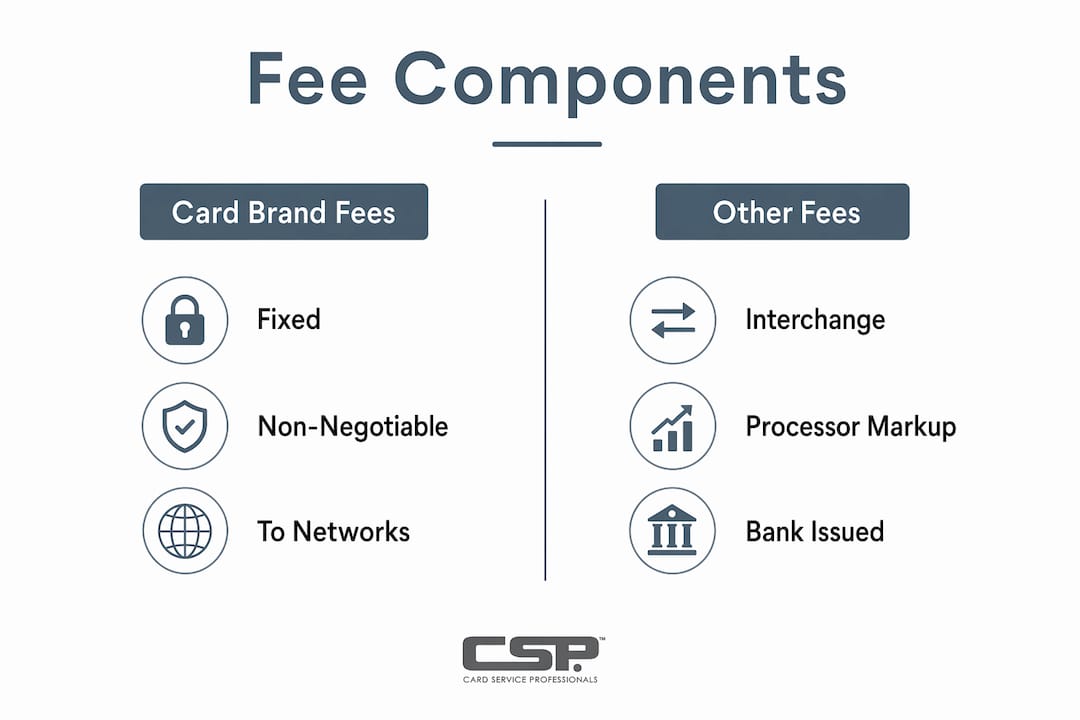
Interchange fees are paid to the bank that issued your customer’s card. These are the largest component of processing costs, ranging from about 1% to 3% depending on card type and transaction risk. A premium rewards card costs more to accept than a basic debit card. Interchange rates are set by the card networks but collected by issuing banks.
Card brand fees go directly to the card networks themselves. They are smaller than interchange but equally non-negotiable. No processor, no matter how large, can reduce or waive these fees.
Processor markups are the fees your acquiring bank or payment processor charges for their services. These cover transaction processing, customer support, equipment, and profit margin. Processor markups are the only layer where negotiation is possible.
| Fee Type | Who Receives It | Typical Range | Negotiable? |
|---|---|---|---|
| Interchange fee | Card-issuing bank | 1%–3% | No |
| Card brand fee | Card network (Visa, Mastercard, etc.) | 0.13%–0.25% | No |
| Processor markup | Acquiring bank or processor | Varies | Yes |
- Card brand fees are fixed by the card networks and apply equally to all processors.
- Interchange fees vary by card type, transaction method, and merchant category code.
- Processor markups are the only cost you can reduce through negotiation or switching providers.
- Bundled or tiered pricing models often hide card brand fees inside flat rates, making auditing harder.
Pro Tip: Interchange-plus pricing models pass through card brand fees at true cost and then add a fixed processor markup. This model gives you the clearest view of what each fee layer actually costs.
What types of card brand fees should merchants know?
Card brand fees are not a single charge. Several distinct fee categories fall under the card brand umbrella, and each one applies in different transaction scenarios.
Assessment fees are the base card brand fee. They apply as a percentage of your total card volume for a billing period. Every card network charges this fee on every transaction.
NABU fees (Network Access and Brand Usage fees) are charged by Mastercard on a per-transaction basis. They apply separately from the percentage-based assessment and show up as a fixed cent amount per transaction on your statement.
Cross-border fees apply when your customer’s card was issued in a different country than where the transaction occurs. Mastercard charges a cross-border fee of 0.60% for domestic currency transactions and 1.00% for non-USD transactions. If your store attracts international shoppers, these fees can be a meaningful cost.
Digital enablement fees apply to card-not-present transactions, such as online orders or phone sales. These fees reflect the higher fraud risk associated with transactions where the physical card is not present. They carry minimums and maximums per transaction depending on the network.
Understanding these fee types matters because they appear as separate line items on a detailed processor statement. A merchant who sees only a single “network fee” total is missing the breakdown needed to verify accuracy.
How can merchants audit and manage card brand fees?
Auditing your card brand fees starts with getting the right statement. A detailed, itemized statement separates card brand fees, interchange fees, and processor markups into distinct line items. If your current statement does not show this breakdown, ask your processor for one. If they refuse, that tells you something important about their transparency.
Once you have an itemized statement, compare the card brand fee rates against the published rates for each network. Visa and Mastercard publish their assessment rates publicly. If the rates on your statement are higher than the published rates, your processor may be marking up card brand fees and passing them through as network charges. This practice is not uncommon, and merchants can audit statements to catch it.
- Request a fully itemized monthly statement from your processor.
- Identify each card brand fee line item separately from interchange and markup.
- Compare card brand fee rates against published Visa, Mastercard, Discover, and American Express rates.
- Flag any discrepancy between published rates and what appears on your statement.
- Contact your processor for a written explanation of any fee that does not match published network rates.
- If markups on card brand fees are confirmed, negotiate their removal or switch to an interchange-plus pricing model.
CMSPI estimates that april 2026 network fee updates alone add approximately $3 billion in additional annual cost to U.S. merchants. That figure shows why ongoing statement review is not optional for merchants who want to protect their margins.
Pro Tip: Review your processing statements every month, not just when costs spike. Card networks update their fee schedules periodically, and processors do not always notify merchants proactively when payment processing red flags appear.
Key Takeaways
Card brand fees are fixed, non-negotiable charges paid to card networks like Visa and Mastercard on every transaction, and the only way to control their impact is through accurate auditing and transparent processor pricing.
| Point | Details |
|---|---|
| Card brand fees defined | Fees paid to card networks for using their payment infrastructure on every transaction. |
| Non-negotiable by nature | No processor can reduce card brand fees; only processor markups are negotiable. |
| Multiple fee types exist | Assessment, NABU, cross-border, and digital enablement fees each apply in different scenarios. |
| Audit statements monthly | Compare card brand fee rates on your statement against published network rates to catch markups. |
| Pricing model matters | Interchange-plus pricing gives the clearest view of card brand fees passed at true cost. |
What I’ve learned watching merchants read their first itemized statement
Most retail merchants I work with have never seen a truly itemized processing statement. They receive a single total, pay it, and move on. The first time they see card brand fees broken out as a separate line item, the reaction is almost always the same: “I didn’t know I was paying that.”
The confusion runs deeper than just card brand fees. Merchants routinely conflate interchange and network fees, assuming they are the same charge going to the same place. They are not. Interchange goes to your customer’s bank. Card brand fees go to Visa or Mastercard. These are different companies with different roles, and the distinction matters when you are trying to figure out where your money is going.
The part that frustrates me most is how easy it is for processors to obscure card brand fees inside bundled pricing. A flat-rate model that charges 2.9% per transaction looks simple, but it hides the fact that card brand fees are already baked in at whatever rate the processor decided to use, which may be higher than the published network rate. Merchants on flat-rate pricing have no way to verify whether they are paying the true card brand fee or a marked-up version of it.
My honest advice: get off flat-rate or tiered pricing if you process more than a few thousand dollars a month. Move to interchange-plus. It costs nothing to switch with the right processor, and it gives you the transparency you need to actually manage your costs. Working with a trusted payment partner who explains every fee layer is not a luxury. It is the baseline you deserve.
— Jerry
How Card Service Professionals helps merchants take control of processing costs
Understanding card brand fees is one thing. Having a processor relationship that actually reflects that understanding is another.

Card Service Professionals works with U.S. retail merchants as independent sales agents for several of the leading merchant service providers in the country. The focus is on transparent fee structures, interchange-plus pricing options, and clear statements that show exactly what you are paying and why. Whether you need a full processing cost review or want to explore cash discount programs that offset card brand fees entirely, Card Service Professionals has the expertise to match you with the right solution. Merchants who want a straightforward look at their current costs can apply for a merchant account and get a fee comparison with no obligation.
FAQ
What is a card brand fee in simple terms?
A card brand fee is a small percentage of each card transaction paid to the card network, such as Visa or Mastercard, for the use of their payment system. These fees are separate from interchange fees and processor markups.
Are card brand fees the same as interchange fees?
No. Interchange fees go to the bank that issued your customer’s card and typically range from 1% to 3%. Card brand fees go to the card network itself and are much smaller, generally between 0.13% and 0.25%.
Can merchants negotiate card brand fees?
Card brand fees are fixed and non-negotiable. The only fee layer merchants can negotiate is the processor markup added by their acquiring bank or payment processor.
What are NABU fees?
NABU stands for Network Access and Brand Usage. Mastercard charges this fee on a per-transaction basis, separate from the percentage-based assessment fee. It appears as a fixed cent amount per transaction on your statement.
How do I find card brand fees on my processing statement?
Request a fully itemized statement from your processor and look for line items labeled “assessment fee,” “network fee,” or the card brand name followed by a percentage. If your statement shows only a single bundled total, ask your processor to break out each fee category separately.
Recommended
- Credit Card Processing Explained for U.S. Retailers – Card Service Professionals
- Why Accept Credit Cards in Retail: A U.S. Owner’s Guide – Card Service Professionals
- What Is Merchant Services? A Guide for U.S. Retailers – Card Service Professionals
- Card Present vs Card Not Present: A Merchant’s Guide – Card Service Professionals
