



A retail payment processing cost audit is the systematic review of your merchant statements to identify unnecessary fees, hidden charges, and negotiable markup that inflate your true processing costs. Most retail merchants overpay without knowing it because they never look past the advertised rate. The industry standard measure is the effective rate, calculated as total processing fees divided by total sales volume. Typical retail effective rates range from 1.8% to 2.5%. Any rate above that range signals overpayment. Card Service Professionals works with merchants daily who discover they are paying well above this benchmark once they run the numbers.
What does a retail payment processing cost audit actually require?
Before you calculate anything, you need the right documents in front of you. A payment processing cost analysis built on incomplete records produces misleading results. Gather at least three months of merchant processing statements. One month is not enough because volume fluctuates, and some fees appear quarterly rather than monthly.
Pull your sales volume data for the same period. Your point-of-sale system or accounting software should export this quickly. You also need your current processing contract and fee schedule. Many merchants sign a contract and never read it again. The fee schedule is where processors list every charge they are authorized to collect.
Your audit document checklist:
- Three or more months of merchant statements
- Matching sales volume reports by month
- Your signed processing contract and fee schedule
- Official Visa and Mastercard interchange rate tables
- A spreadsheet application such as Microsoft Excel or Google Sheets
- A basic calculator for cross-checking totals
The Visa and Mastercard interchange tables are publicly available and free. Download the current versions directly from each card brand’s website. These tables are your reference point for every fee line on your statement. Without them, you cannot tell whether a fee is a legitimate pass-through or inflated markup.
| Document | Where to get it |
|---|---|
| Merchant statements | Your processor’s online portal or paper mail |
| Sales volume data | POS system or accounting software export |
| Processing contract | Original signed copy or request from processor |
| Interchange tables | Visa.com and Mastercard.com public rate guides |
| Fee schedule | Attached to your processing contract |
How to calculate your effective payment processing rate accurately
The effective rate is the only number that tells you what you actually pay. Advertised rates are almost always misleading because they exclude monthly fees, statement fees, and other charges that accumulate quietly. Most merchants confuse advertised rates with their true effective rate. That confusion is exactly where processors profit.
The formula is straightforward:
- Add up every fee on your statement for the month. Include interchange fees, assessment fees, monthly minimums, statement fees, batch fees, PCI fees, and any other line item.
- Divide that total by your gross sales volume for the same month.
- Multiply the result by 100 to get your percentage.
- Repeat for each of your three statement months.
- Average the three results for a reliable baseline.
Here is a concrete example. If your total processing fees for the month are $234.71 and your total sales volume is $7,521.22, your effective rate is 3.12%. That number is significantly above the 1.8%–2.5% retail benchmark, which means you are almost certainly overpaying on markup or carrying avoidable fees.
The most common mistake merchants make is leaving out ancillary fees. Monthly minimum shortfall charges, PCI non-compliance fees, and statement fees are real costs. They belong in your total fee calculation. Skipping them understates your effective rate and makes your situation look better than it is.

Pro Tip: Run the effective rate calculation separately for each card type if your statement breaks out Visa, Mastercard, and Amex individually. A high effective rate on one card brand often points to a specific fee or downgrade issue rather than a systemic problem.
Which hidden fees should you look for in your statements?
A standard merchant statement audit focuses on four key fee categories that can represent 10%–25% of your monthly invoice. Knowing which fees are fixed and which are negotiable is the most valuable insight an audit produces.
Non-negotiable fees (set by card brands):
- Interchange fees: set by Visa, Mastercard, and Discover for each card type and transaction method
- Network assessment fees: a small percentage charged by the card brand, not the processor
- Card brand fees: dues and assessments that pass through unchanged
Negotiable fees (set by your processor):
- Processor markup: the spread above interchange that is your processor’s actual revenue
- Monthly statement fees: typically $5–$15 per month with no real cost justification
- Batch settlement fees: charged per daily batch close, often $0.10–$0.30 per batch
- Monthly minimum shortfall fees: the monthly minimum shortfall is often 100% negotiable and can be eliminated entirely
- PCI non-compliance fees: PCI non-compliance fees cost $20–$99 per month and are completely avoidable
The PCI non-compliance fee deserves special attention. Processors charge it when you have not completed your annual PCI DSS self-assessment questionnaire. The questionnaire takes about 30 minutes to complete. Paying $20–$99 every month because you skipped a 30-minute task is one of the most expensive oversights in retail payment expenses.
Some processors also inflate pass-through interchange fees by adding basis points on top of the published rate. They label these fees as interchange on your statement, making them look non-negotiable. They are not. Cross-referencing your statement against official interchange tables exposes this practice immediately.
Pro Tip: Look for any fee labeled “regulatory,” “compliance,” or “network access” that does not match a specific line item in the Visa or Mastercard interchange tables. These are often processor-invented fees with no card brand basis.
Step-by-step process to conduct a retail payment processing cost audit
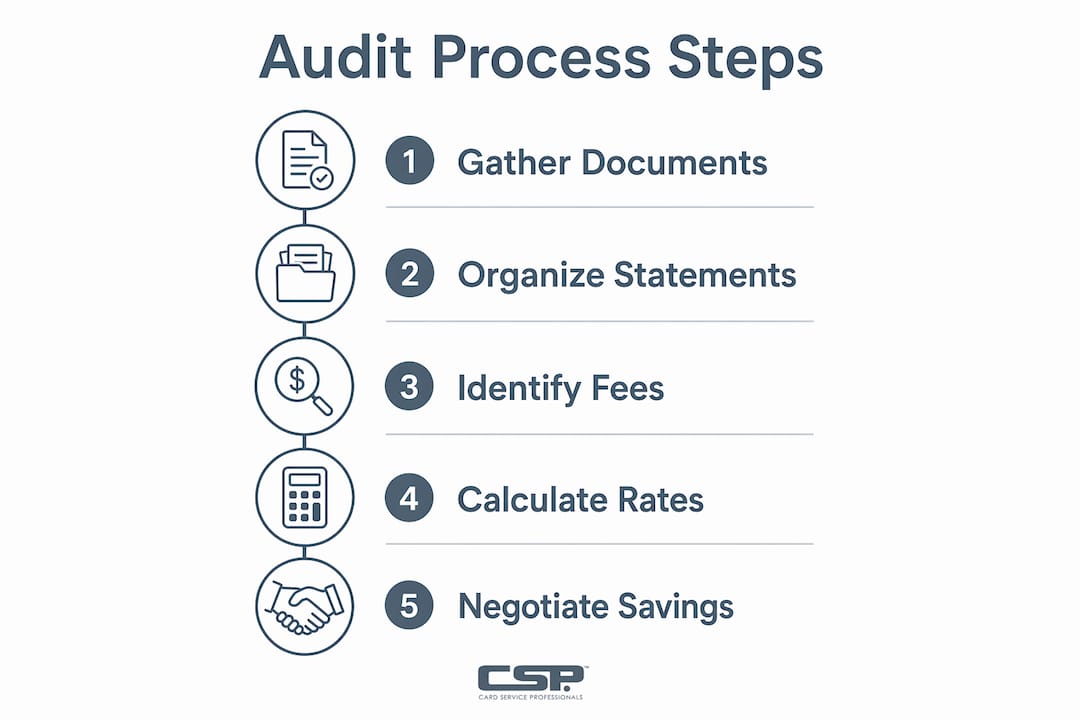
A structured process produces results you can act on. Reviewing statements without a clear sequence leads to missed fees and inaccurate conclusions. A thorough audit covering three months of statements takes about 60 minutes when you follow a consistent method.
- Organize your statements by month. Label each statement clearly and note the total fees charged and total volume processed on a summary spreadsheet.
- Separate interchange and assessment fees from processor markup. Interchange fees will match published card brand rates. Any fee above those rates is markup or a processor-added charge.
- List every recurring fee that is not interchange or assessment. Statement fees, batch fees, monthly minimums, PCI fees, and any labeled “service” or “access” fees go on this list.
- Calculate your effective rate for each month using the formula above. Record all three results.
- Cross-reference suspicious line items against official Visa and Mastercard interchange tables. Flag any fee that does not have a direct match.
- Summarize your findings in a single document: effective rate, total negotiable fees per month, and specific line items that appear inflated or unjustified.
| Audit stage | What you are looking for |
|---|---|
| Statement organization | Total fees, total volume, fee line count |
| Fee separation | Interchange vs. markup vs. junk fees |
| Recurring fee list | Statement, batch, PCI, minimum shortfall |
| Effective rate calculation | Benchmark comparison: 1.8%–2.5% target |
| Interchange cross-reference | Inflated pass-through fees |
| Summary document | Negotiation leverage points |
The summary document is your negotiation tool. When you approach your processor or a new provider, specific numbers carry far more weight than general complaints. Knowing that you pay $47 per month in PCI non-compliance fees and $18 in statement fees gives you a concrete starting point for reducing retail payment expenses.
Common pitfalls and how to verify audit accuracy
Audit errors lead to bad negotiations. The most common mistake is misclassifying a downgrade fee as a standard interchange charge. Downgrades happen when a transaction does not qualify for the best interchange rate, often because of card type, entry method, or missing data. They appear as separate line items and can significantly raise your effective rate.
A second common error is ignoring contract terms during the audit. Your contract may include a rate floor that prevents negotiation below a certain markup level. Knowing that floor before you negotiate saves time and sets realistic expectations. Reviewing your payment processing contract terms alongside your statements is not optional.
Cross-reference every processor line item against official Visa and Mastercard interchange tables to detect hidden inflated markup fees masked as pass-through charges.
Merchants also make the mistake of focusing too much on interchange fees. About 85% of processing costs are fixed interchange and network fees that no one can change. The remaining 15% is processor markup and junk fees. That 15% is where your audit effort pays off. Spending hours analyzing interchange rates produces no savings. Spending 20 minutes identifying junk fees and inflated markup can save hundreds of dollars per month.
Validate your audit by pulling three individual transaction records and tracing each fee back to its statement line item. If the math does not reconcile, your statement may contain errors or undisclosed charges worth escalating.
Key takeaways
A retail payment processing cost audit delivers real savings only when merchants focus on the 15% of fees that are negotiable rather than the fixed interchange costs that cannot be changed.
| Point | Details |
|---|---|
| Know your effective rate | Divide total fees by total sales volume to find your true processing cost percentage. |
| Target negotiable fees | Processor markup, statement fees, batch fees, and PCI non-compliance fees are all negotiable. |
| Use three months of data | One month of statements is not enough; three months reveals patterns and recurring junk fees. |
| Cross-reference interchange tables | Compare statement line items against Visa and Mastercard tables to catch inflated pass-throughs. |
| Complete your PCI questionnaire | Filing the annual self-assessment eliminates $20–$99 per month in avoidable non-compliance fees. |
What I have learned after years of reviewing merchant statements
The merchants who benefit most from a payment processing audit are not the ones with the highest volume. They are the ones who have never looked at their statements closely. A $30,000-per-month retailer paying a 3.2% effective rate loses more to unnecessary fees than a $200,000-per-month retailer paying 2.1%.
The part that surprises most merchants is how little of their bill is actually negotiable. Only about 15% of processing costs sit in the negotiable markup category. That sounds discouraging until you realize that 15% on a $30,000 monthly volume is $450 per month, or $5,400 per year. That is real money for a small retailer.
I also think merchants underestimate what regular audits do beyond cost savings. When you audit annually, you build a clear picture of how your fees change over time. Processors sometimes raise markup quietly between contract renewals. An annual audit catches those increases before they compound. Fee transparency also puts you in a stronger position when you shop for better terms, because you walk into that conversation with data.
My honest recommendation: if your effective rate is above 2.5% and you have not reviewed your statements in the past 12 months, start the audit this week. The 60-minute investment has a direct financial return. If the process feels unclear or your statements are unusually complex, bring in an expert rather than guessing. A wrong conclusion from a flawed audit can lead you to negotiate the wrong fees and miss the real savings.
— Jerry
How Card Service Professionals can reduce your processing costs
Identifying overcharges on a merchant statement is one thing. Knowing how to act on those findings is another. Card Service Professionals specializes in reviewing merchant accounts, identifying inflated markup, and connecting retailers with competitive processing rates through leading U.S. merchant service providers.

Card Service Professionals offers credit card processing expertise built specifically for U.S. retail merchants, including cash discount programs that can eliminate processing costs entirely for qualifying businesses. If your audit reveals fees above the 1.8%–2.5% benchmark, the next step is a professional review. Visit Card Service Professionals to request a statement review or explore your options. The sign-up process is straightforward, and most merchants see a clear cost comparison before making any commitment.
FAQ
What is a retail payment processing cost audit?
A retail payment processing cost audit is a structured review of your merchant statements to calculate your effective rate, identify hidden fees, and find negotiable charges. The process typically takes about 60 minutes when reviewing three months of statements.
What is a good effective rate for retail merchants?
Typical retail effective rates range from 1.8% to 2.5% of total sales volume. Rates above 2.5% indicate potential overpayment on processor markup or avoidable fees.
Which fees are negotiable during a payment processing audit?
Processor markup, monthly statement fees, batch fees, and monthly minimum shortfall fees are all negotiable. PCI non-compliance fees are avoidable entirely by completing the annual self-assessment questionnaire.
How often should retailers conduct a payment processing audit?
Retailers should audit their processing costs at least once per year. Annual audits catch quiet rate increases between contract renewals and keep fee transparency current.
What is the most common mistake in a payment processing audit?
The most common mistake is focusing on interchange fees, which are fixed and non-negotiable. Effective audits focus on the roughly 15% of costs that represent processor markup and junk fees, where real savings are possible.
Recommended
- Credit Card Processing Explained for U.S. Retailers – Card Service Professionals
- Why Small Retailers Need Card Processing in 2026 – Card Service Professionals
- Payment Processing Red Flags Merchants Must Know – Card Service Professionals
- What Is a Payment Processor? A Guide for Retailers – Card Service Professionals
