


A cash discount program is a pricing strategy that offers customers a lower price when they pay with cash instead of a credit or debit card. For dry cleaners, this means passing card processing fees to card-paying customers while rewarding cash payers with the base price. Credit card fees typically run around 4% per transaction. That cost adds up fast in a low-margin business like dry cleaning. A properly structured cash discount program lets you protect your margins, give price-sensitive customers a real incentive, and stay fully compliant with Visa and Mastercard rules.
How does a cash discount program work for dry cleaners?
A cash discount program sets two prices at the point of sale: a standard price for card payments and a lower price for cash payments. The difference reflects the card processing cost merchants would otherwise absorb, which averages around 4%. That means a $25 dry cleaning order has a cash price of roughly $24. The customer sees both prices and chooses how to pay.
Here is how the process works step by step:
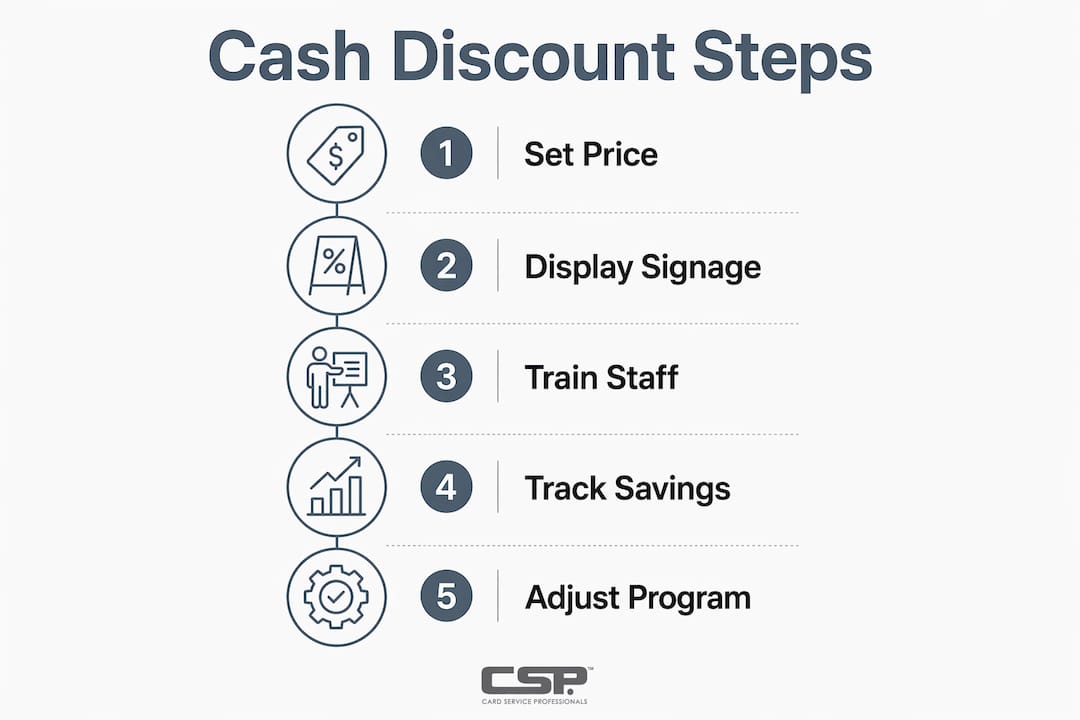
- Set your standard price. This is the price that covers your costs plus the card processing fee. Card-paying customers pay this amount.
- Calculate the cash price. Subtract the processing fee percentage from the standard price. At 4%, a $50 order becomes $48 for cash payers.
- Display both prices clearly. Visa rules require prominent signage near the payment area so customers know the difference before they pay.
- Apply the discount at checkout. Your point-of-sale system records the cash price when the customer pays with cash. Card transactions process at the standard price.
- Print compliant receipts. The receipt must reflect the actual amount charged and meet card network disclosure requirements.
You can structure the discount as a percentage off (4% for cash) or as a fixed dollar amount ($1 off orders over $20). Fixed amounts work well for dry cleaners with predictable ticket sizes, since customers find round numbers easier to understand.
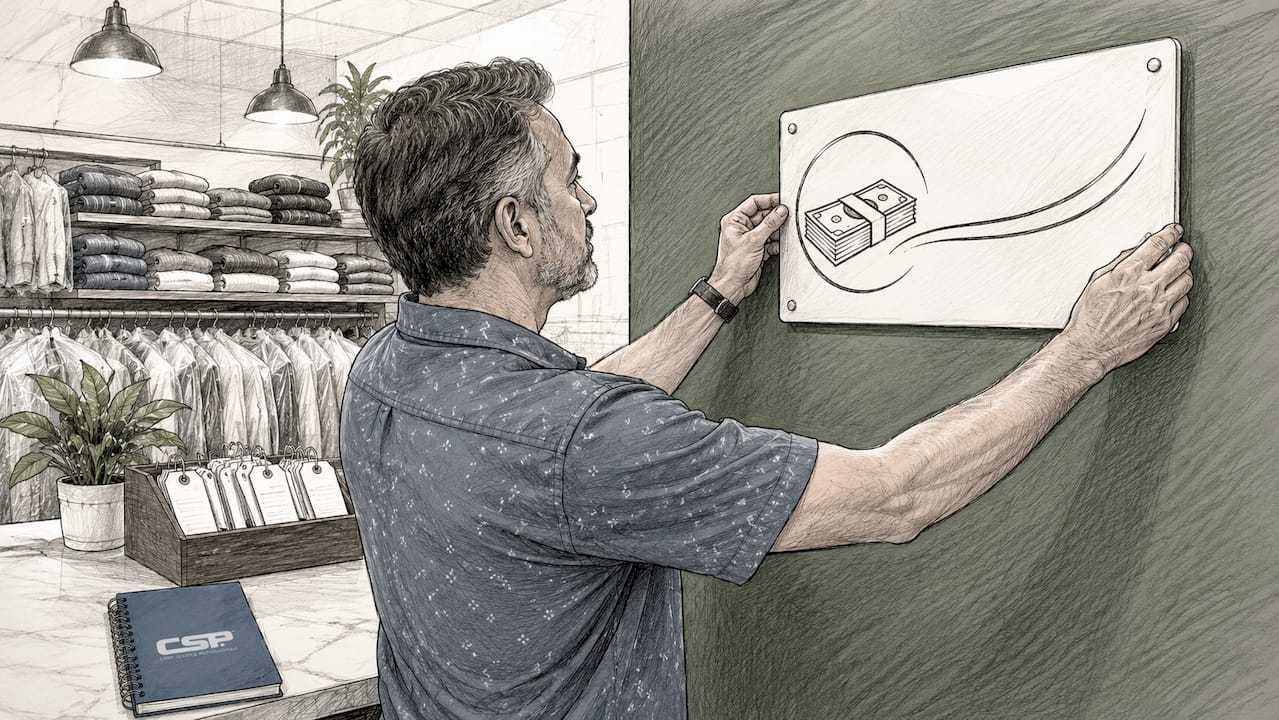
Pro Tip: Post your cash discount pricing on a small sign at the counter and near your price list. Customers who see the savings before they hand over their garments are far more likely to pull out cash.
The financial impact is direct. A dry cleaner processing $15,000 per month in card transactions at a 4% fee pays $600 monthly in processing costs. Shifting even half of those transactions to cash cuts that expense by $300 per month, or $3,600 per year.
What are the legal and compliance requirements for cash discounting?
Cash discounting and surcharging are not the same thing, and the distinction matters legally. A cash discount lowers the price for cash payers. A surcharge adds a fee on top of the listed price for card payers. Card networks allow cash discounting. They restrict or prohibit surcharging in many situations. Getting this wrong exposes your business to card network violations and potential fines.
Key compliance requirements include:
- Signage at the point of sale. Visa mandates that merchants display clear, visible notices near payment areas disclosing the pricing difference between cash and card transactions.
- Receipt formatting. Visa’s transaction receipt rules require specific content and delivery standards. The receipt must reflect the correct amount charged and indicate the payment method used.
- No hidden fees. The card price must be presented as the standard price, not as a surcharge added after the fact. Customers must see both prices before completing the transaction.
- State law compliance. Some states have additional rules about payment fee disclosures. Check your state’s consumer protection statutes before launching your program.
- Credit card minimums. Under the Dodd-Frank Act, merchants can set a minimum purchase amount up to $10 for credit card transactions, but this is separate from cash discounting and subject to state law.
Pro Tip: Treat receipt formatting as a core compliance requirement, not an afterthought. A receipt that fails to meet Visa’s disclosure standards can trigger a violation even if your signage is perfect.
The most common mistake dry cleaners make is framing the program as a “credit card surcharge” in their signage or staff scripts. That language triggers card network rules against surcharging. Always frame it as a discount for cash, not a penalty for cards.
What do customers think about cash discounts at dry cleaners?
Most customers respond positively to cash discounts when the offer is clear and the savings feel real. A cash payment discount gives price-sensitive customers a concrete reason to change their payment behavior. For a dry cleaner with regular weekly customers, even a small discount builds loyalty over time.
The customers most likely to take advantage of the offer are those who already carry cash, retirees on fixed incomes, and customers who are actively watching their spending. These groups tend to be consistent, repeat visitors. Rewarding them with lower prices on dry cleaning reinforces their loyalty without requiring a formal laundry loyalty program or punch card system.
Some customers will push back, especially those who prefer credit card rewards points. The best response is a simple, honest explanation: the cash price reflects the actual cost of the service, and card payments carry a processing fee that gets built into the standard price. Most customers accept this once they understand it. Confusion almost always comes from unclear signage or staff who cannot explain the program confidently.
The business impact goes beyond the fee savings. Encouraging cash payments improves cash flow, reduces payment processing complexity, and can lower your monthly reconciliation time. Dry cleaners with tight margins benefit most, since every percentage point recovered from processing fees flows directly to the bottom line.
How to implement a cash discount program at your dry cleaning business
Getting the program right from day one prevents compliance problems and customer complaints. Follow these steps to launch cleanly.
- Audit your current processing costs. Pull three months of merchant statements and calculate your effective rate. If you are paying above 3%, a cash discount program will generate meaningful savings.
- Choose a compatible payment system. Not all point-of-sale terminals handle dual pricing automatically. Work with a payment processor that supports cash discounting natively so the system applies the correct price without manual calculation.
- Update your price list and signage. Reprint your service menu to show both the cash price and the standard price. Place a disclosure sign at the counter, near the register, and at any self-service kiosk.
- Train your staff. Staff training is the single most important factor in customer acceptance. Every employee needs a clear, two-sentence explanation of how the program works and why it benefits the customer.
- Communicate the launch to your regulars. Send a text or email to your customer list explaining the new pricing. Frame it as a discount offer for dry cleaning customers who pay with cash, not as a policy change.
- Monitor results for 90 days. Track the percentage of cash versus card transactions each week. Watch for customer complaints and adjust your signage or staff scripts if confusion persists.
Pro Tip: Run a soft launch for two weeks before making the program permanent. Tell customers it is a trial discount and ask for feedback. This approach reduces resistance and gives you real data on customer response before you commit fully.
Avoid the mistake of launching without testing your POS configuration. A system that applies the discount inconsistently or prints non-compliant receipts creates more problems than it solves. Test every transaction type, including split payments and returns, before going live.
Key takeaways
A cash discount program for dry cleaners reduces net processing fees by rewarding cash payers with a lower price, requires strict Visa signage and receipt compliance, and delivers the strongest results when staff are trained to explain the offer clearly.
| Point | Details |
|---|---|
| Core mechanic | Set a standard price for cards and a lower cash price reflecting the ~4% processing fee. |
| Compliance is non-negotiable | Visa requires clear signage and properly formatted receipts before and at the point of sale. |
| Cash vs. surcharge distinction | Frame the program as a discount for cash, never as a fee added to card transactions. |
| Staff training drives acceptance | Employees need a simple, confident explanation to prevent customer confusion and complaints. |
| Monitor and adjust | Track cash-to-card ratios weekly for the first 90 days and refine signage or scripts as needed. |
What I have learned from watching dry cleaners adopt cash discounting
The dry cleaners who get the most out of cash discount programs are the ones who treat it as a customer communication project, not just a payment processing change. The mechanics are straightforward. The compliance requirements are manageable. What trips people up is the conversation at the counter.
I have seen well-run shops lose customer goodwill in the first week because the staff could not explain the pricing difference without sounding apologetic or defensive. The fix is simple: train your team to lead with the benefit. “You save 4% when you pay with cash” lands completely differently than “we charge more for cards.” Same policy, completely different customer reaction.
The other thing worth knowing is that cash discounting works best as part of a broader approach to payment processing costs. It is not a silver bullet. Dry cleaners who also review their interchange categories, negotiate their monthly fees, and use modern POS equipment tend to see the biggest overall improvement in margins. Cash discounting is one lever, and it is a good one, but it works best alongside smart payment management overall.
My honest advice: start with a 90-day pilot. Set a clear goal, such as moving 20% of transactions to cash, and measure against it. If you hit the goal, the program pays for itself. If you fall short, you will know exactly where the friction is and can fix it before making the program permanent.
— Jerry
Card Service Professionals can set up your cash discount program
Dry cleaners ready to reduce processing costs have a clear path forward with Card Service Professionals. As independent sales agents for several of the leading merchant service providers in the U.S., Card Service Professionals sets up compliant cash discount programs with the right POS equipment, proper dual-pricing configuration, and the disclosure materials Visa requires.
Card Service Professionals also offers competitive rates across all electronic payment options, so you are not locked into a single payment type. Whether you want to launch a cash discount structure, upgrade your terminal, or review your current processing costs, the sign-up process is straightforward. Reach out to Card Service Professionals to get a no-obligation review of your current merchant account and see exactly how much a cash discount program could save your dry cleaning business each month.
FAQ
What is a cash discount program for dry cleaners?
A cash discount program offers customers a lower price when they pay with cash instead of a credit or debit card. The discount reflects the card processing fee, which averages around 4%, that the merchant would otherwise absorb.
Is a cash discount program legal for dry cleaners?
Cash discounting is legal and permitted under Visa and Mastercard rules when implemented with proper signage and receipt disclosures. It differs from surcharging, which adds a fee to card transactions and faces stricter restrictions.
How much can a dry cleaner save with a cash discount program?
Savings depend on your monthly card volume and effective processing rate. A dry cleaner processing $15,000 per month in card transactions at 4% pays $600 in fees. Shifting half of those transactions to cash cuts that cost by $300 per month.
What signage does a dry cleaner need for a cash discount program?
Visa requires merchants to display clear, prominent notices near the payment area disclosing the price difference between cash and card payments. Signage must be visible before the customer completes the transaction.
Can a dry cleaner use a cash discount program alongside a loyalty program?
Yes. A cash discount program and a laundry loyalty program serve different customer motivations and can run simultaneously. The cash discount rewards immediate payment behavior, while a loyalty program rewards repeat visits over time.
Recommended
- Blog – Card Service Professionals
- Sign Up Application – Card Service Professionals
- Card Service Professionals – Credit Card Processing Experts
- Why Accept Credit Cards in Retail: A U.S. Owner’s Guide – Card Service Professionals
