



Zero-fee processing is a pricing model that shifts most credit-card acceptance costs from the merchant to the cardholder through compliant surcharging or cash-discount pricing. The fees don’t disappear. They move.
That distinction matters for every decision you’ll make about whether to implement one of these programs. Legally, both approaches work in the U.S. when structured correctly. Practically, you should expect to recover most of your credit-card acceptance costs, not 100%.
Two program types cover nearly all zero-fee payment options on the market:
- Surcharge program: A line-item fee added at checkout when a customer pays by credit card. Best for merchants whose customers are accustomed to transparent fee disclosures and who process mostly credit (not debit) transactions.
- Cash-discount program: The card price is the posted price; cash or ACH customers receive a discount. Best for merchants in states that restrict surcharging, or those who prefer to frame the difference as a reward rather than a penalty.
Table of Contents
- What zero-fee processing actually means (and what it doesn’t)
- How zero-fee programs work at the point of sale
- U.S. compliance rules you need to know before you launch
- Common myths about zero-fee processing (and what’s actually true)
- Which businesses benefit most — and which should be cautious
- Technical requirements and implementation checklist
- Worked savings example: a $30,000-per-month merchant
- Operational risks and how to protect the customer experience
- Pre-launch checklist: steps to take before you flip the switch
- Key Takeaways
- The part most processors won’t tell you upfront
- Card Service Professionals can help you get this right
- Useful sources and further reading
What zero-fee processing actually means (and what it doesn’t)
The industry uses several names interchangeably: no-fee processing, zero-cost processing, no-fee merchant programs. They all describe the same mechanics. The merchant’s net cost of accepting credit cards drops to near zero because the program passes that cost to the cardholder, either as an explicit surcharge or as the difference between a cash price and a card price.
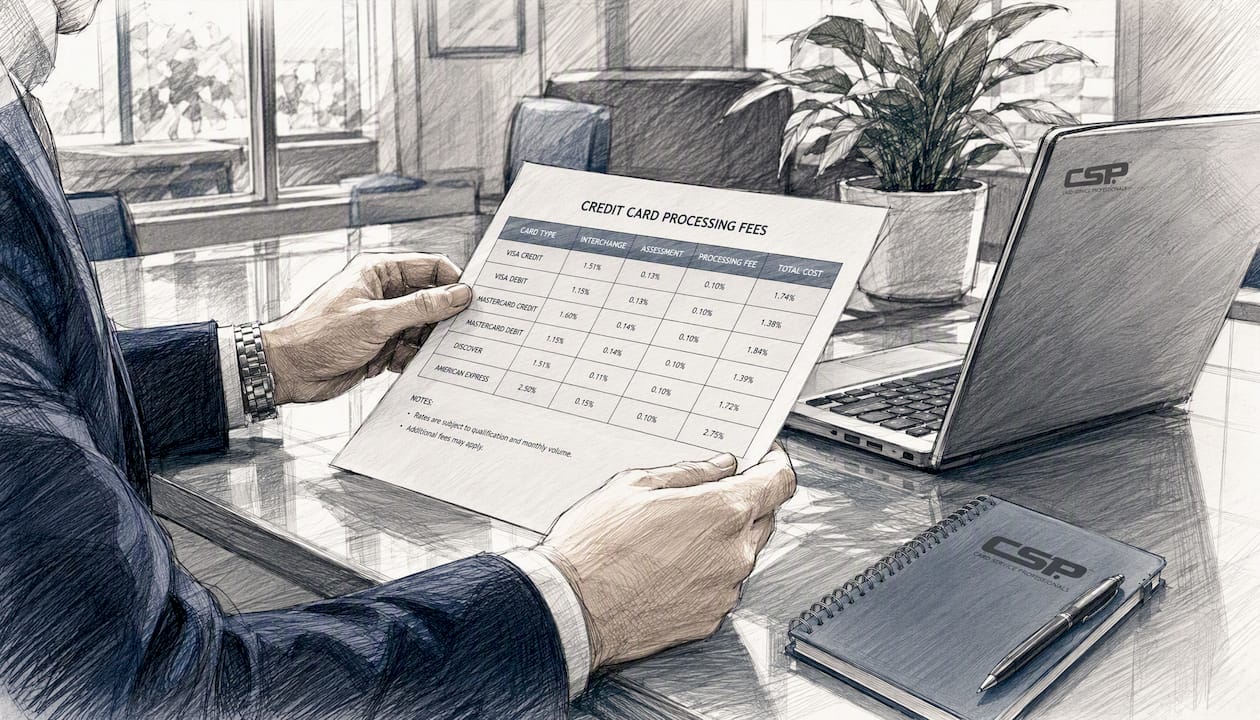
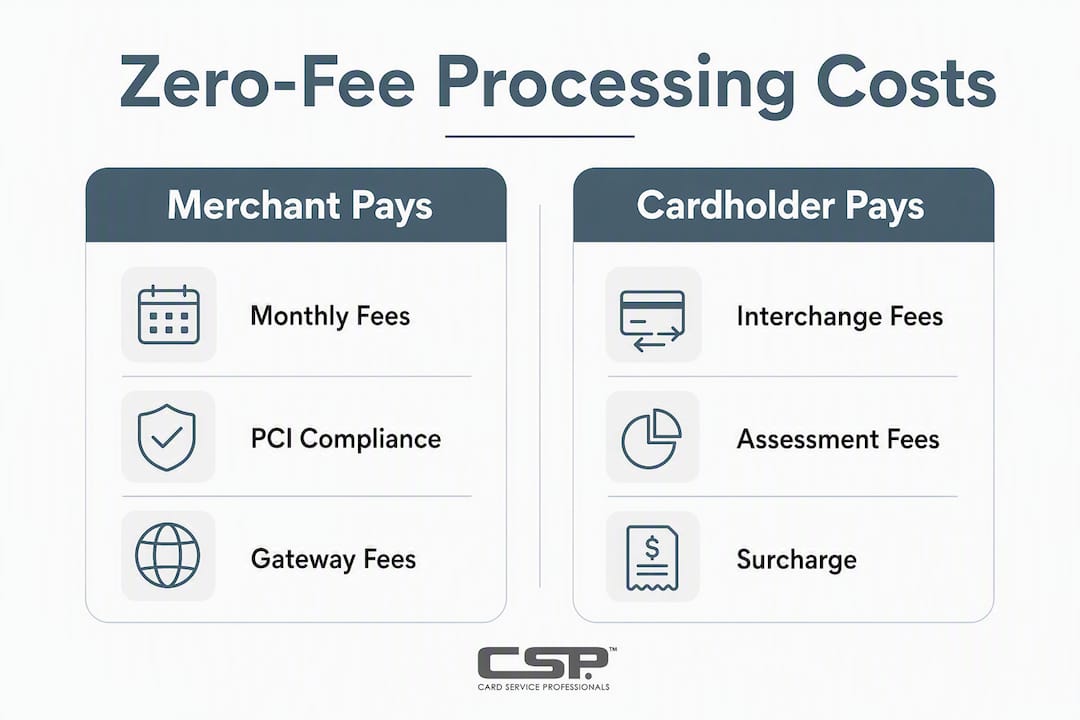
What it is not is a complete elimination of all payment-related expenses. Understanding what a processing fee actually includes helps clarify why. Interchange, assessments, and processor markup are the three layers of every card transaction. A zero-fee program recovers the processor markup and often the assessment layer on credit cards. It does not eliminate debit card fees, PCI compliance fees, gateway fees, or flat monthly statement fees. Those remain the merchant’s responsibility.
| Cost component | Who pays under zero-fee program |
|---|---|
| Credit card interchange + assessment | Recovered via surcharge or card price differential |
| Processor markup on credit cards | Recovered via surcharge or card price differential |
| Debit card fees | Merchant pays (debit cannot be surcharged) |
| Monthly gateway / PCI / statement fees | Merchant pays |
| Terminal / POS equipment fees | Merchant pays |
How zero-fee programs work at the point of sale
Surcharge program workflow
- Customer selects items; total appears on screen.
- Customer chooses to pay by credit card.
- POS or terminal automatically calculates and adds the surcharge (capped at the lesser of your actual acceptance cost or 3% per Visa’s network rules).
- Customer sees the surcharge as a separate line item before approving the transaction.
- Receipt shows the base price and the surcharge as distinct amounts.
- At month-end, the surcharge revenue collected offsets the processing fees on your statement.
Cash-discount program workflow
- All posted prices (shelf tags, menus, website) reflect the card price.
- At checkout, customers paying with cash or ACH receive a discount applied to the total.
- Receipt shows the card price, the discount amount, and the net cash total.
- The merchant keeps the full card price when a card is used; the discount is only applied when the customer pays with a non-card tender.
| Dimension | Surcharge program | Cash-discount program |
|---|---|---|
| How cost is passed | Explicit fee added at checkout | Implicit: card price is the base; cash gets a discount |
| Display mechanics | Surcharge shown as line item on receipt | Discount shown on receipt; card price is posted price |
| Legal complexity | State restrictions apply; 30-day network notice required | Legal in all 50 states when structured correctly |
| Debit card treatment | Cannot be surcharged (federal law) | Debit typically pays card price; no surcharge issue |
| Network cap | Lesser of cost or 3% | No network cap |
| Typical recovery | A high proportion of credit-card costs | A high proportion of credit-card costs |
Pro Tip: Always post the card price on shelf tags and menus, then apply the cash discount at the register. If you post the lower cash price and add a fee for cards, card networks will classify it as a disguised surcharge, which triggers compliance audits.

U.S. compliance rules you need to know before you launch
Compliance is where most merchants stumble, and the rules come from two directions: card networks and state law.
Visa and Mastercard network requirements
Visa requires merchants to notify Visa and their acquirer at least 30 days before starting to surcharge. Disclosure must appear at three points: the point of entry (door signage or website landing page), the point of sale (terminal screen), and the receipt as a separate line item. The surcharge cannot exceed the lesser of your actual cost of acceptance or 3%. Mastercard follows essentially the same framework.
Debit and prepaid cards cannot be surcharged under federal law, regardless of what the network rules say. This is a hard stop.
State-level restrictions
Not every state allows surcharging. Some states have restrictions or caps that are below the federal network ceiling. Several other states have passed or are considering similar limits. The NCSL tracks credit and debit card surcharge statutes by state and is the most reliable place to check current law for your location.
Cash-discount programs sidestep most of these restrictions. Because you’re offering a discount rather than adding a fee, cash discounting is legal in all 50 states when the program is genuinely structured as a discount and not a disguised surcharge.
Compliance checklist
- Point-of-entry signage (physical and digital) disclosing the surcharge or cash-discount policy
- Point-of-sale terminal display showing the fee or discount before the customer approves
- Receipt line item clearly labeled as “surcharge” or “cash discount”
- 30-day advance written notice to your acquirer and to Visa/Mastercard (surcharge programs only)
- Tender exclusions configured in POS: debit and prepaid cards must not trigger a surcharge
- State law review completed before launch
The NFIB’s merchant guide on surcharging and cash-discount laws is a practical small-business reference that covers disclosure requirements, caps, and tax considerations in plain language.
Compliance note: This article is general information, not legal or financial advice. Confirm current state law and network rules with your acquirer or a qualified professional before launching any program.
Common myths about zero-fee processing (and what’s actually true)
Myth: Zero-fee processing eliminates all your fees.
Reality: Debit card fees, monthly gateway fees, PCI compliance fees, and terminal costs remain the merchant’s responsibility. Merchants should expect an 80–95% reduction on credit-card acceptance costs, not a complete elimination.
Myth: Processors make nothing on zero-fee programs.
Reality: The fee shifts to the cardholder, but the processor still collects interchange assessments and markup. The merchant’s net cost drops; the processor’s revenue doesn’t disappear.
Myth: Cash-discount programs are just surcharging with a different name.
Reality: The legal and structural difference is meaningful. Surcharging adds a fee to the card price. Cash discounting reduces the price for non-card tenders. The compliance requirements, state restrictions, and network caps are different for each.
Myth: Any business can implement this and save 100%.
Reality: Merchants with high debit card volume will see proportionally lower recovery because debit transactions cannot be included in a surcharge program. A business where 60% of card transactions are debit will recover far less than one where 90% are credit.
“Zero-fee models don’t erase costs — they convert an opaque expense into a transparent line item. For a business with $30,000 in monthly card volume, a compliant program can recover most credit-card fees and materially boost margins.” — Shopappy industry analysis
Which businesses benefit most — and which should be cautious
Good fits for zero-fee programs
- Low-debit-volume retailers: Boutiques, specialty shops, and service businesses where most card transactions are credit cards. The higher the credit-card share, the more you recover.
- High-ticket service businesses: Auto repair shops, contractors, medical and dental practices, salons. A $1,200 repair bill with a 2.9% processing cost is $34.80 per transaction. At scale, that adds up fast.
- Thin-margin businesses: Restaurants and food service operations where a 2–3% processing fee can represent a significant share of net profit.
- B2B merchants: Businesses invoicing other businesses, where card surcharges are standard practice and customers are less price-sensitive about a disclosed fee.
Businesses that should think carefully
- High-debit-usage merchants: Grocery stores, convenience stores, and quick-service restaurants often see 50–70% of card transactions on debit cards. The recoverable portion shrinks accordingly.
- Price-sensitive retail: Discount retailers and commodity businesses where even a small visible surcharge can push customers to competitors.
- Frequent split-tender transactions: If customers regularly split payments between cash and card, the POS configuration and receipt management become complicated quickly.
A dry cleaner processing $15,000 monthly in credit cards at a blended 2.8% rate pays roughly $420 per month in acceptance costs. Under a compliant cash-discount program, nearly all of that is recovered. A convenience store with the same volume but 65% debit transactions might recover only $147 of the same cost.
Technical requirements and implementation checklist
What your POS or terminal must support
- Dual-pricing or surcharge calculation built into the software (not a manual add-on)
- Automatic tender-type detection to exclude debit and prepaid from surcharges
- Receipt printing with a separate line item for the surcharge or discount
- Signage templates or screen prompts that display the fee before transaction approval
- E-commerce cart integration if you sell online (the surcharge or card-price differential must appear before checkout completion)
Implementation steps
- Audit your current fees. Pull three months of statements and identify your blended credit-card acceptance rate. This becomes your surcharge ceiling.
- Choose your program type. Surcharge or cash discount, based on your state, customer mix, and POS capabilities.
- Confirm POS/gateway compatibility. Not every terminal supports compliant dual pricing out of the box. Verify with your provider before committing.
- Register with your acquirer and networks (surcharge programs only). Submit written notice at least 30 days before go-live.
- Produce compliant signage. Visa provides sample signage and receipt language you can adapt.
- Train your staff. Every person at the register needs to explain the program clearly and handle objections without escalating.
- Run test transactions. Verify the surcharge or discount calculates correctly, appears on the receipt, and excludes debit cards.
- Reconcile the first 30 days. Compare surcharge revenue collected against processing fees charged to confirm the program is performing as modeled.
A typical rollout takes 2–6 weeks from decision to go-live, with most of that time consumed by the 30-day notice period and signage production.
Pro Tip: Submit your 30-day acquirer notice the same day you order signage. The two timelines run in parallel, so you’re not waiting an extra month after signage arrives.
Ongoing obligations include monitoring interchange rate changes (networks adjust them periodically), reconciling surcharge revenue against processor fees monthly, and updating website disclosures if your card-price policy changes.
Worked savings example: a $30,000-per-month merchant
A practical illustration helps more than a general claim. Take a retail merchant processing $30,000 monthly in card volume with a blended credit-card acceptance rate of 2.8% and a debit card share of 25%.
| Item | Amount |
|---|---|
| Total monthly card volume | $30,000 |
| Residual monthly fees (PCI, gateway, statement) | $50–$80 |
| Net merchant cost after program | $126–$165 |
The recovery range reflects a realistic reduction on credit-card acceptance costs. Debit fees and fixed monthly costs remain. This merchant goes from paying roughly $705 per month to paying $126–$165. That’s a real number, not a marketing claim.
Compliance checklist for this scenario
- Surcharge set at 2.8% (actual cost), not rounded up to 3%
- Debit transactions excluded from surcharge calculation in POS
- Signage posted at store entrance and at terminal
- Receipt shows “Credit Card Surcharge: $X” as a separate line
- Acquirer notified 30 days prior; written confirmation on file
- State law confirmed: not in a restricted state
Before you run any projection, do a payment processing cost audit to establish your actual blended rate. Modeling against an estimated rate instead of your real one is the most common reason merchants are disappointed with their first-month results.
Operational risks and how to protect the customer experience
Zero-fee programs introduce friction that standard card acceptance doesn’t. Managing that friction is the difference between a smooth rollout and a customer-service headache.
Operational risks
- Debit misclassification: Some cards run as credit on the network but are actually debit. If your POS doesn’t detect tender type correctly, you may apply a surcharge to a debit transaction, which is a compliance violation. Test this before launch.
- Reconciliation mismatches: Surcharge revenue collected and processing fees charged don’t always align perfectly in the first month. Build a simple spreadsheet to track both.
- Signage gaps: Missing point-of-entry signage is the most common audit trigger. Check every customer-facing touchpoint, including your website checkout page.
- POS configuration errors: A surcharge set above your actual cost of acceptance violates network rules. Verify the percentage in your terminal settings against your actual blended rate.
Customer experience risks
- Visible surcharges increase cart abandonment in e-commerce, particularly for first-time buyers who weren’t expecting the fee.
- In-store, customers occasionally dispute the charge at the register. Staff who can’t explain the program clearly make the situation worse.
- Negative online reviews mentioning “hidden fees” can follow a poorly communicated rollout.
Mitigation tactics
- Post clear signage at every customer touchpoint before launch, not after.
- Give staff a two-sentence script: “We offer a cash discount for customers paying with cash or ACH. Card transactions include a small processing fee that covers our acceptance costs.”
- Offer ACH or check as a zero-fee payment option for customers who object.
- Set the surcharge at your actual cost, not the maximum allowed. A 2.8% surcharge on a $50 purchase is $1.40. Framed correctly, most customers accept it.
- Review common payment processing mistakes before go-live to avoid the pitfalls that catch most merchants off guard.
Pre-launch checklist: steps to take before you flip the switch
- Choose surcharge or cash discount — Confirm your state allows surcharging; if not, cash discount is your path.
Pro Tip: Coordinate your 30-day notice submission with your acquirer rep, not just a form submission. An acquirer who knows your go-live date can flag configuration issues before they become compliance problems.
Key Takeaways
Zero-fee processing shifts credit-card acceptance costs to the cardholder through surcharging or cash-discount pricing, recovering 80–95% of those costs for most merchants, not 100%.
| Point | Details |
|---|---|
| Two program types | Surcharge adds a fee at checkout; cash discount posts the card price and discounts cash payments. |
| Realistic savings range | Merchants typically recover 80–95% of credit-card acceptance costs; debit and fixed fees remain. |
| Compliance is non-negotiable | Surcharge programs require 30-day notice to acquirer and networks, three-point disclosure, and state law review. |
| Debit cards cannot be surcharged | Federal law prohibits surcharging debit or prepaid cards; high-debit merchants recover proportionally less. |
| Card Service Professionals | Offers fee audits, cash-discount program setup, POS configuration, and compliance training for U.S. merchants. |
The part most processors won’t tell you upfront
The marketing around zero-fee processing often implies a clean, complete solution. In practice, the merchants who benefit most are the ones who go in with clear numbers, not optimistic assumptions.
The 80–95% recovery figure is real, but it’s an average across credit-card transactions. If your business runs 60% debit, your actual recovery is closer to a much lower proportion of total card acceptance costs. That’s still meaningful money. It’s just not the “zero” the headline promises.
The other thing worth saying plainly: cash-discount programs are often the better choice for small businesses, not because they recover more money, but because they’re simpler to stay compliant with. No 30-day notice, no state-by-state legal review, no network cap to monitor. You post the card price, you discount cash. The compliance burden is lower, and the customer experience is easier to explain.
What I’d tell any merchant considering this: start with a real fee audit before you commit to a program type. Your blended rate, your debit card percentage, and your state’s surcharging rules together determine which program fits and what you’ll actually save. Guessing at those numbers and then being disappointed with month-one results is the most avoidable outcome in this whole process.
Card Service Professionals can help you get this right
Most merchants spend more time researching zero-fee programs than it takes to actually implement one correctly. The real cost is getting the setup wrong: a surcharge applied to a debit card, a missing disclosure that triggers a network audit, or a POS configuration that doesn’t match your actual acceptance rate.
Card Service Professionals works with U.S. small and medium businesses as independent agents for leading merchant service providers. The process starts with a fee audit that shows your actual blended rate, your debit card percentage, and what a compliant program would realistically recover for your specific volume. From there, the team handles POS configuration, signage, acquirer coordination, and staff training so the rollout doesn’t fall on you to manage alone.
If you’re ready to find out what a zero-fee program would actually save your business, start with a free rate review or visit Card Service Professionals to learn more about available programs.
Useful sources and further reading
Before launching any zero-fee program, review these primary sources directly. Laws and network rules change, and what a blog post summarized last year may not reflect current requirements.
- Visa Surcharging FAQ for Merchants — Visa’s official guidance on 30-day notice requirements, disclosure locations, receipt language, and sample compliant signage. The primary source for surcharge program compliance.
- NCSL Credit and Debit Card Surcharge Statutes — State-by-state tracker of surcharging laws. Check this before deciding between a surcharge and cash-discount program.
- NFIB Surcharging and Cash Discount Guide — Plain-language small-business reference covering disclosure requirements, caps, and tax considerations.
- LegalClarity: Is a Cash Discount Program Legal? — Explains the legal distinction between cash discounting and surcharging, and why cash discounts are legal in all 50 states when structured correctly.
- Merchant Insiders: Is Zero-Fee Credit Card Processing Legit? — Covers realistic savings expectations, residual costs, and the debit card limitation that most zero-fee marketing glosses over.
Check your state’s current surcharging law directly with the NCSL tracker or your state attorney general’s office before launch. Network rules and state statutes both change, and your acquirer should confirm current requirements as part of your onboarding process.
Recommended
- What Is a Processing Fee? A Guide for U.S. Merchants – Card Service Professionals
- Credit Card Processing Explained for U.S. Retailers – Card Service Professionals
- Top 10 Payment Processing Mistakes Small Businesses Make – Card Service Professionals
- Why Small Retailers Need Card Processing in 2026 – Card Service Professionals
