



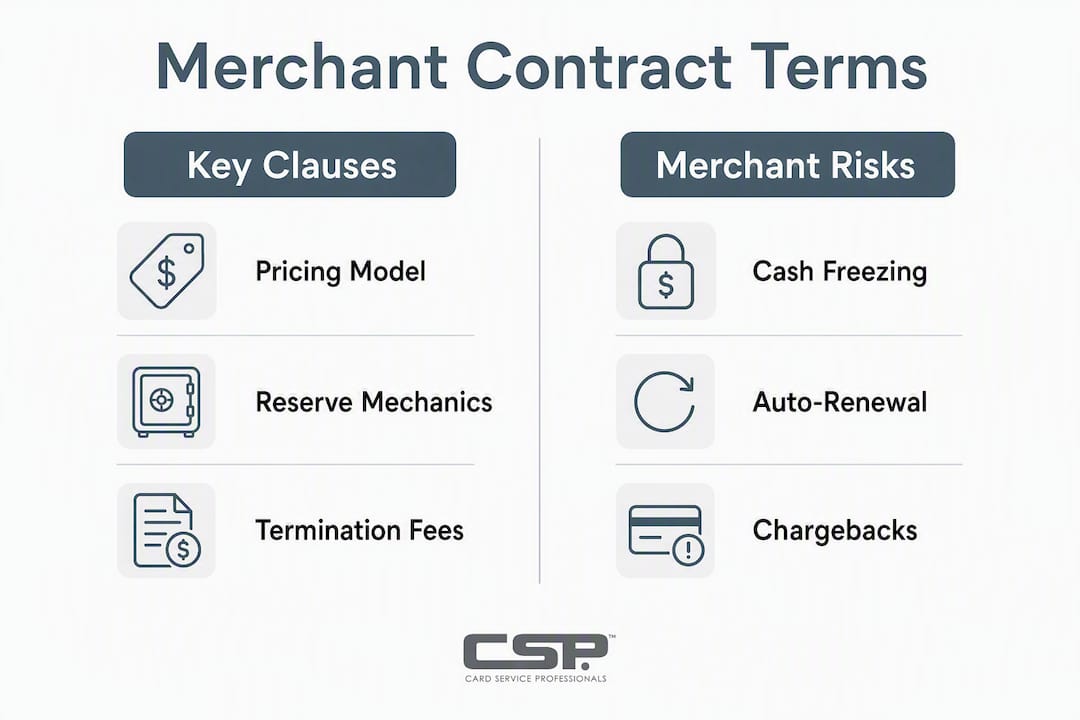
The five contract terms that most directly affect your processing cost and cash flow are: the pricing model (interchange-plus vs. tiered/blended), the processor markup, reserve mechanics (cap and release schedule), early termination and for-cause suspension clauses, and funding/settlement timing. Fix these first. Everything else is secondary.
- Pricing model: Tiered and blended pricing hide the processor’s margin inside rate buckets. Moving to interchange-plus (IC+) or IC++ gives you line-item visibility. Switching to IC++ pricing typically saves 0.25%–0.50% on effective rate for a mid-sized account, returning money to your pocket each month.
- Processor markup: Even on IC++ contracts, the markup percentage and per-transaction cent fee vary widely. A 0.10% difference on $200K monthly volume is $200/month. Know the number before you sign.
- Reserve mechanics: A rolling reserve without a written cap and release date is an indefinite, interest-free loan from you to the processor. Demand a reasonable cap percentage and a written release trigger.
- Early termination / for-cause suspension: ETFs range from $295 to $50,000. For-cause clauses can freeze your funds immediately, regardless of any stated notice period, catching merchants unprepared. Both need to be negotiated before you sign.
- Funding/settlement timing: T+1 funding vs. T+2 or T+3 is a real cash-flow difference. On $50K weekly volume, one extra day in transit is $50K sitting idle.
Pro Tip: Before you sign anything, ask for an IC++ quote and a written reserve-release schedule. If the processor won’t provide both in writing, that tells you something important.
Table of Contents
- What do the key clauses in a merchant contract actually mean?
- How do you calculate your true effective processing cost?
- Negotiation checklist: scripts and steps that actually work
- Which contract clauses can freeze your cash or trap you?
- When should you bring in a payments expert or attorney?
- Key Takeaways
- What the contract fine print actually costs you
- Card Service Professionals can audit your contract and rates
- Useful sources and further reading
What do the key clauses in a merchant contract actually mean?
A merchant processing agreement is a legally binding contract between your business and an acquiring bank. Even when an ISO or independent agent sells you the account, the acquiring bank is the legal counterparty, and the agreement pulls in Visa and Mastercard operating rules by reference. That matters because it means network rules govern your contract whether or not they are spelled out in the document you signed.

Pricing model: why the headline rate lies
Tiered pricing groups transactions into “qualified,” “mid-qualified,” and “non-qualified” buckets. The processor decides which bucket each transaction falls into, and the non-qualified rate can be double the advertised rate. Blended pricing is simpler but equally opaque. Interchange-plus pricing separates the actual interchange cost (set by Visa/Mastercard, non-negotiable) from the processor’s markup, so you can see exactly what you are paying for each component. IC++ adds a separate line for network assessments, which typically run 0.13%–0.15% per transaction. Some processors mark up that assessment line. Demand language that reads: “Assessments billed at network-published rates with no processor markup.”
Reserve mechanics: the working capital trap
Reserves are funds the processor withholds as a security deposit against chargebacks. Standard terms often set reserves at 5–10% with hold periods of 90–180 days. A $50K monthly merchant at 10% over 180 days can have roughly $30K held at any given time. A rolling reserve without a written cap or release date effectively becomes an indefinite hold. Your contract must specify the cap percentage, the release trigger (e.g., 180 days of clean processing history), and the release timeline.
Early termination fees and auto-renewal
ETFs can vary widely, from modest flat fees to substantial amounts calculated by complex formulas on multi-year contracts. Auto-renewal clauses often renew contracts for successive terms unless you provide written notice within a narrow window before renewal. Miss that window and you are locked in for another full term, ETF and all. Always mark the renewal notice deadline on your calendar the day you sign.
Account suspension and for-cause clauses
Processors can include “for cause” clauses that grant the right to immediately suspend accounts and freeze funds, effectively nullifying any planned exit timeline — even when the contract states a written notice period.
This is the clause that blindsides merchants most often. MCC (merchant category code) reclassification is a related risk: if the processor decides your business fits a higher-risk category, they can reclassify you, change your rates, and potentially suspend your account. Ask specifically about MCC reclassification rights and token/vault portability before signing, especially if you store card data for recurring billing.
Recurring and admin fees
| Fee Type | What to Watch For | Negotiation Target |
|---|---|---|
| Monthly minimum | Charged when processing volume falls below a threshold | Remove or lower the threshold |
| PCI non-compliance fees are typically charged monthly if you haven’t completed your SAQ; negotiating a waiver period and support is advisable. | ||
| Gateway fee | Separate monthly charge for payment gateway access | Bundle or cap |
| Chargeback fee | — per dispute, plus representment fees | Floor at —; cap representment |
| Statement fee | —/month, often buried | Strike entirely |
PCI DSS and security obligations
Your contract will require PCI DSS compliance and specify who bears liability in a breach. The indemnification clause typically reads: the merchant indemnifies the acquiring bank for losses caused by the merchant’s failure to comply with PCI DSS. Read that clause carefully. If your processor handles tokenization or vault storage, confirm in writing that their systems are in scope for their own PCI audit, not yours.
Dispute resolution and chargeback policy
The Fair Credit Billing Act requires merchants to respond to disputes within 30 days. Your contract will specify chargeback thresholds (typically 1% of transactions), response timelines, and who bears network fines for excess chargebacks. Arbitration clauses can expose you to significant costs if a dispute escalates. Check whether the contract requires binding arbitration and whether it caps your exposure for network-assessed fines.
How do you calculate your true effective processing cost?
Your effective rate is total processing fees divided by total card volume for the month. That single number tells you more than any headline rate.
Worked example: Assume $100,000 in monthly card volume. Your statement shows $1,450 in total fees. Your effective rate is 1.45%. Now break it down: interchange costs $950 (0.95%), network assessments cost $130 (0.13%), processor markup costs $250 (0.25%), and monthly/admin fees add $120. If your contract promised IC++ at 0.25% markup plus $0.10 per transaction (assume 800 transactions = $80), your expected markup is $330, not $250. That $80 gap needs an explanation from your processor.
Pro Tip: Recompute your effective rate from the first statement under any new contract and confirm it matches the contract within roughly 0.05%. If it doesn’t, call your processor before the second billing cycle.
| Statement Field | What to Verify |
|---|---|
| Interchange pass-through | Line-item interchange matches card type/network |
| Assessment line | No processor markup added above network rate |
| Processor markup | Matches contracted percentage + per-transaction fee |
| Monthly/admin fees | Only fees explicitly listed in the contract |
| Reserve deductions | Match contracted percentage; confirm release credits |
| Chargeback fees | Per-dispute fee matches contract floor |
Two checks to run in the first 60 days: first, confirm the effective rate matches the contract within ~0.05%; second, verify that any struck line items (PCI non-compliance fees, monthly minimums, ETFs) are absent from billing.
Negotiation checklist: scripts and steps that actually work
Negotiate in this sequence: pricing model first, then markup, then reserve cap and release, then ETF, then assessments, then funding window, then monthly minimum, then PCI fee, then chargeback floor. Smaller items move more easily once the big levers are settled.
- Get two written IC++ quotes — one from your current processor and one from an alternate. A written competing quote is the single strongest lever. Most processors will match or beat a concrete offer.
- Open with the pricing model. Say: “I’d like to move this account to IC++ pricing. Here is a written quote from another processor at [X]% markup plus [Y] cents. Can you match it?”
- Ask for assessment pass-through language. Say: “I need the contract to state that assessments are billed at network-published rates with no processor markup.”
- Demand a capped reserve with a release date. Say: “I need the reserve capped at [X]% of monthly volume with a written release trigger at 180 days of clean processing history.”
- Strike or cap the ETF. Say: “I’d like to remove the ETF entirely, or cap it at $[X] with a 30-day written notice option in lieu of the fee.”
- Confirm T+1 funding in writing. Ask for the funding cutoff time and the settlement timeline in the contract, not just verbally.
The three non-negotiables: if a processor refuses to move to IC++, refuses to cap the reserve with a written release path, or refuses to strike the ETF entirely, walk. These are not minor points — they are the terms that determine whether the contract works for you or against you.
Check the questions to ask before signing for a complete pre-signing checklist.
Which contract clauses can freeze your cash or trap you?
- Immediate suspension language: “For cause” clauses that allow fund freezes without meaningful notice, regardless of the stated notice period.
- Uncapped rolling reserves: No written cap percentage, no release trigger, no release timeline. This is an indefinite hold on your working capital.
- Broad auto-renewal with short cancellation windows: 30-day or shorter notice windows, especially on multi-year terms, make it easy to miss the exit.
- Hidden assessment markup: A processor billing assessments above the 0.13%–0.15% network rate without disclosure.
- Vague acceptable use policies: Language that permits retroactive termination or MCC reclassification at the processor’s discretion.
- Token and data portability limits: Clauses that restrict your ability to export tokenized card data make switching processors expensive and PCI-intensive.
A rolling reserve without a cap or release path is not a security deposit. It is an indefinite, interest-free loan from you to the processor — and the contract gives them every right to keep it.
For a deeper look at warning signs, the payment processing red flags guide covers additional clause language to watch for.
When should you bring in a payments expert or attorney?
Self-negotiation works well for straightforward renewals on accounts under $1M monthly volume with no reserve history and a standard fee structure. Bring in a specialist when:
- Monthly volume exceeds $1M, where even a 0.05% rate difference is material.
- You have a reserve history, repeated suspension risk, or a contract with multiple bundled fees.
- The contract includes complex liability or indemnification language you cannot parse.
- You are signing a multi-location or multi-entity agreement with cross-default provisions.
A payments consultant like Card Service Professionals will run a cost audit, pull competing IC++ quotes, recommend contract redlines, and verify implementation on the first two statements. An attorney handles legal redlines: liability caps, arbitration exposure, indemnification scope, and enforceable exit remedies.
Pro Tip: Bring these documents to your first consultation: the last 12 months of statements, your current contract and most recent renewal notice, chargeback logs, and your SAQ or PCI evidence. That package lets a consultant identify every fee and clause worth negotiating in one session.
Key Takeaways
Switching to IC++ pricing and negotiating a capped reserve with a written release schedule are the two contract changes that most directly reduce your effective processing cost and protect your working capital.
| Point | Details |
|---|---|
| Switch to IC++ pricing | Moving from tiered/blended to IC++ typically saves 0.25%–0.50% on effective rate for a mid-sized account. |
| Cap and release your reserve | Demand a written reserve cap (5–10%) and a release trigger; uncapped reserves become indefinite working capital holds. |
| Strike or cap the ETF | ETFs range from $295 to $50,000; remove them entirely or replace with a 30-day written notice option. |
| Verify the first two statements | Recompute your effective rate within ~0.05% of contract terms and confirm struck fees are absent from billing. |
| Card Service Professionals | Card Service Professionals offers cost audits, IC++ quotes, and contract review for U.S. retail merchants before you sign. |
What the contract fine print actually costs you
Most merchants sign whatever the processor sends and never look at the contract again until something goes wrong. That is the wrong approach, and the processors know it. The real cost of a poorly negotiated merchant agreement is not the headline rate. It is the reserve sitting idle for 180 days, the ETF that makes switching feel impossible, and the for-cause clause that lets the processor freeze your funds on a Friday afternoon with no recourse until Monday. These are not edge cases. They are standard contract terms that processors include precisely because most merchants do not push back.
The pricing model is where to start because it changes the information you have. Once you are on IC++, you can see the processor’s margin on every transaction. That visibility is what makes every other negotiation lever work. Without it, you are negotiating blind.
Card Service Professionals works as an independent sales agent representing multiple U.S. acquiring partners. The business model is commission-based: compensation comes from successfully onboarding merchants onto better processing agreements, not from hourly fees. That means the first conversation is a cost audit, not a sales pitch. The nine negotiation levers covered in this article are the same ones applied in every merchant engagement.
Card Service Professionals can audit your contract and rates
If you have read this far and are not sure whether your current contract has any of these problems, a cost audit is the right first step. Card Service Professionals reviews your last 12 months of statements, identifies every fee and clause worth renegotiating, and provides competing IC++ quotes from multiple U.S. acquiring partners. The audit covers pricing model, processor markup, reserve structure, ETF exposure, and recurring fees — the full list of levers from this article.

Bring your current contract, your last two statements, and your chargeback log to the first call. Card Service Professionals will tell you exactly where you are overpaying and what contract language to demand. To get started, visit Card Service Professionals or go directly to the sign-up application if you are ready to move to a better processing agreement now.
Useful sources and further reading
- Payment Processor Negotiation Playbook: 9 Levers That Actually Move the Number — the source for IC++ savings ranges, assessment rates, reserve mechanics, and ETF data cited in this article.
- PSP Contract Red Flags — PaymentBrief — covers for-cause suspension clauses and reserve hold practices in detail.
- Merchant Agreement: Fees, Chargebacks, and Contract Terms — LegalClarity — plain-language overview of the legal counterparty structure and standard contract sections.
- Merchant Agreements: A Complete Guide — Quantopia — covers PCI DSS obligations, card network rules, and fee structure definitions.
- Payment Processing Agreement: Key Components — Sirion — standard contract element checklist useful for verifying your own agreement’s structure.
- Visa and Mastercard operating regulations (available on each network’s public website) — the primary source for interchange rates, assessment fees, and acceptable use rules your contract references by default.
Save copies of your contract and the first two statements after any pricing change. If a dispute arises later, those documents are your evidence.
This article is general information, not legal or financial advice. Confirm current rules and contract terms with a qualified payments attorney or your acquiring bank for your specific situation.
Recommended
- Types of Merchant Processing Contracts: 2026 Retail Guide – Card Service Professionals
- Merchant Account Explained for U.S. Retail Merchants – Card Service Professionals
- What Is Merchant Services? A Guide for U.S. Retailers – Card Service Professionals
- Aggregator vs Merchant Account: A U.S. Retail Guide – Card Service Professionals
