



What Visa and Mastercard network fees actually cost you
Every card transaction you accept carries three layers of fees: interchange, assessment, and your processor’s markup. Interchange runs the majority share of your total processing cost, assessment fees add another 0.13%–0.15% of volume, and the processor markup is the only slice you can actually negotiate. Understanding where each dollar goes is the first step toward controlling what you pay.
Here is how a typical transaction breaks down:
- Interchange fees: Paid by your acquiring bank to the card-issuing bank. Rates run 1.4%–3.3% depending on card type and transaction method. Non-negotiable.
- Assessment fees: Paid to Visa or Mastercard for network infrastructure. Typically 0.13%–0.15% of volume, plus small per-transaction passthrough fees. Also non-negotiable.
- Acquirer markup: Your processor’s cut. This is the only component open to negotiation.
Neither Visa nor Mastercard pockets the interchange. The networks earn revenue through assessment fees and fixed monthly charges like Visa’s Fixed Acquirer Network Fee (FANF) and Mastercard’s Merchant Location Fee.
How interchange fees work and why they hit your margin hard
Interchange is the largest single cost in card acceptance, and it flows from your acquiring bank to the bank that issued your customer’s card. Visa and Mastercard set these rates, not your processor, and they publish updated schedules annually.
The rate you pay depends on several factors:
- Card type: A basic debit card costs far less than a premium travel rewards card.
- Transaction method: Card-present (swiped or tapped) transactions carry lower rates than card-not-present (online or keyed) transactions.
- Merchant Category Code (MCC): Grocery stores and utilities often qualify for reduced rates. Restaurants and retail fall into standard tiers.
- Transaction size: Some categories carry a fixed cents-per-transaction component on top of the percentage.
Rewards cards carry higher interchange because those points and miles have to be funded somehow. U.S. interchange rates remain among the highest globally precisely because the rewards ecosystem depends on that revenue. A merchant processing a $100 purchase on a premium Visa Infinite card could pay close to $3.30 in interchange alone, versus under $1.50 on a standard debit card.
What assessment fees cover and how Visa and Mastercard calculate them
Assessment fees are the networks’ operating revenue. They are smaller than interchange but unavoidable, and they stack on top of it. Base rates vary slightly by card type and network, with merchants paying the same percentage regardless of size.

Beyond the base percentage, both networks layer on fixed per-transaction fees for authorization, clearing, and settlement, typically $0.01–$0.04 per transaction. These add up fast at volume. Visa also charges its FANF monthly, a fixed fee per location ranging from approximately $1 to $25 depending on merchant category and processing volume. Mastercard’s equivalent is the Merchant Location Fee, structured similarly. Card-not-present merchants pay FANF as a percentage of monthly volume rather than a flat dollar amount.
Compliance fees add another layer. Visa and Mastercard charge compliance fees per declined transaction after repeated failed attempts, and chargebacks trigger additional network-level fees on top of processor charges.
How Visa and Mastercard set and update their fee schedules
Both networks publish updated fee schedules annually, typically taking effect in April and October. The adjustments reflect transaction volume trends, fraud and credit risk data, card type mix, and merchant category performance across the network.
Processors receive advance notice of rate changes and are required to pass them through to merchants. If you are on an interchange-plus pricing model, you will see these changes reflected as line-item adjustments on your statement. If you are on flat-rate pricing, the change gets absorbed into the bundle and you may never notice it directly.
Regulatory pressure has shaped fee levels in some markets. The European Union capped interchange at 0.3% for consumer credit cards and 0.2% for debit cards under its 2015 Interchange Fee Regulation. U.S. merchants operate under no equivalent federal cap for credit cards, though the Durbin Amendment limits debit interchange for large issuers.
Where to find current official Visa and Mastercard fee information
Both networks publish their interchange and assessment schedules publicly, though the documents are dense.
- Visa: Visit usa.visa.com and search for “Visa USA Interchange Reimbursement Fees.” The PDF is updated twice yearly.
- Mastercard: Visit mastercardcenter.org for the Mastercard Interchange Rate document, also updated biannually.
Your processor statement is the other key source. On an interchange-plus plan, assessments appear as separate line items, often labeled “V Assessment” or “MC Assessment” under a section called “Network Fees” or “Pass-Through Charges.” You can verify the math by multiplying your monthly volume for each network by the published rate.
Pro Tip: If your statement shows assessment charges that do not match the published network rates, your processor may be marking up pass-through fees. Some processors do this while still calling their model “interchange-plus.” A line-by-line comparison against the network’s published schedule is the only way to catch it.
Merchants on flat-rate pricing never see assessments broken out. The processor bundles interchange, assessments, and markup into a single rate, which simplifies the statement but makes cost auditing impossible. Switching to interchange-plus is the clearest path to auditing your processing costs accurately.
Common misconceptions about Visa and Mastercard fees
A few misunderstandings cost merchants real money.
- “My processor controls interchange rates.” They do not. Interchange and assessment fees are published by the networks and passed through unaltered. Only the processor’s markup is negotiable.
- “Visa and Mastercard collect interchange.” They do not. Interchange goes to the issuing bank. The networks collect assessment fees and fixed charges.
- “Bigger merchants pay lower network fees.” Volume can unlock lower interchange tiers in some categories, but base assessment percentages are identical for every merchant on the network.
- “I can surcharge to recover all my fees.” Card network rules cap surcharges at 3% as of 2026, and surcharging applies only to credit cards, not PIN-debit transactions. Several states, including Massachusetts and Connecticut, prohibit surcharging entirely under state surcharge statutes. Violating network rules risks fines and account termination.
- “Switching networks saves money on fees.” Visa and Mastercard compete on technology and merchant incentives, not on lowering assessment rates. Your customers’ card preferences drive which network you process on, not your cost optimization.
How to reduce what you actually pay in processing fees
You cannot negotiate interchange or assessment fees. You can control everything around them.
Request interchange-plus pricing. This model separates interchange, assessments, and markup into distinct line items. You see exactly what each component costs, which makes it possible to verify accuracy and compare processor markups directly. Flat-rate pricing hides all of this.
Qualify transactions correctly. Interchange rates drop when transactions meet specific data requirements. Submitting complete Level 2 or Level 3 data (purchase order numbers, tax amounts, line-item detail) on B2B transactions can move them into lower interchange tiers. Many merchants leave this on the table.
Reduce card-not-present volume where possible. Online and keyed transactions carry higher interchange than card-present ones. If your business model allows it, encouraging brezstično plačevanje v poslovalnici lowers your average rate.
Implement a cash discount program. Rather than surcharging card users, a cash discount program offers a reduced price to customers who pay with cash. This approach sidesteps surcharge restrictions in states that prohibit them and can effectively offset processing costs. Card Service Professionals offers cash discount programs built specifically for U.S. merchants.
Negotiate the processor markup aggressively. This is the only fee layer that moves. Get quotes from multiple processors, compare markups on an interchange-plus basis, and revisit your contract annually.
How Visa and Mastercard fee structures differ
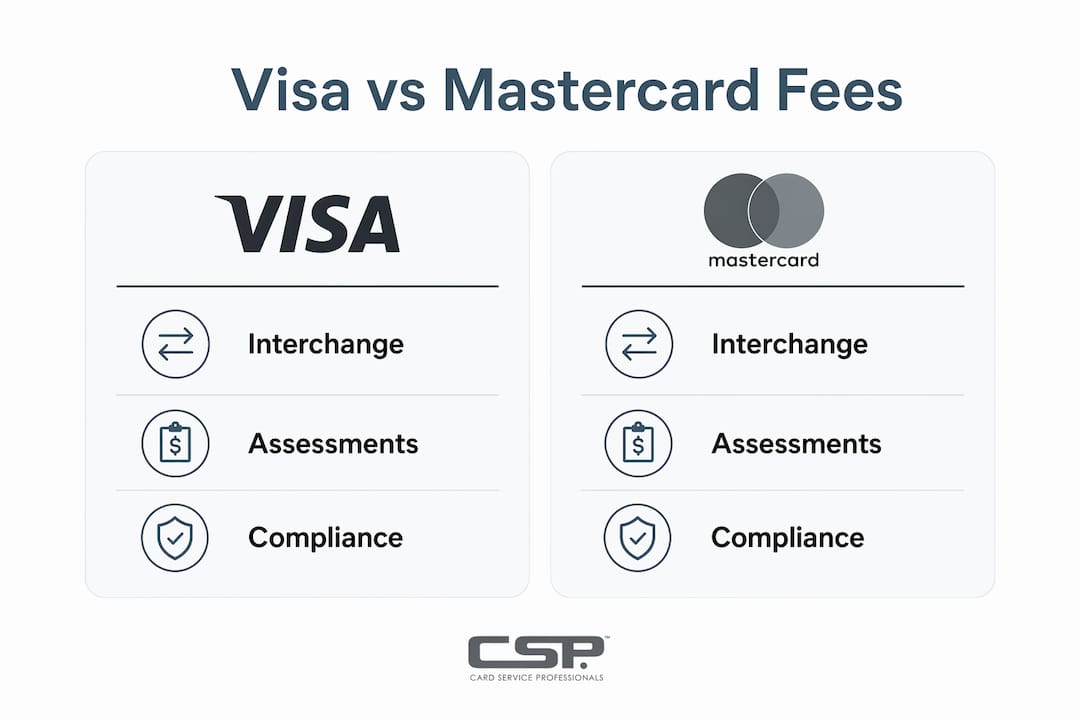
The two networks are close in structure but not identical. Visa and Mastercard have similar assessment fee structures with small differences in base rates, per-transaction fees, fixed monthly charges, compliance fees, and chargeback fee schedules. Some specific fee amounts differ between the two networks.
For most small to mid-sized merchants, the practical difference between Visa and Mastercard processing costs is small. The bigger variable is card type, not network brand.
How your transaction volume and business type shape your rates
Merchant Category Code assignment affects interchange more than almost any other single factor. A grocery store, a gas station, and a hotel all process Visa and Mastercard transactions, but they land in different interchange tiers because the networks price risk and reward by category.
High-volume merchants in certain categories can qualify for custom interchange programs, but this typically requires processing at a scale that most small businesses do not reach. What does scale affect for smaller merchants? Primarily the FANF calculation. A single-location retailer processing under $200 per month in Visa volume may be exempt from FANF entirely. As volume grows, the fee tier increases.
Business type also determines which interchange categories your transactions qualify for. A B2B supplier that collects purchase order data at the point of sale can access commercial card interchange rates that are lower than standard retail rates. A restaurant that settles transactions more than 24 hours after authorization may be downgraded to a higher-cost interchange category. Understanding how your card processing setup interacts with these rules is where real cost control happens.
Key Takeaways
Interchange fees, not assessment fees, drive the majority of what merchants pay to accept Visa and Mastercard, and only the processor’s markup is open to negotiation.
| Point | Details |
|---|---|
| Interchange dominates costs | Interchange runs the majority share of total processing costs, at rates of 1.4%–3.3% depending on card type and transaction method. |
| Assessment fees are fixed | Visa and Mastercard charge a small base assessment percentage of volume plus per-transaction passthrough fees. |
| Only markup is negotiable | Interchange and assessment fees are set by the networks and passed through unchanged; only the processor’s markup can be reduced. |
| Interchange-plus pricing reveals true costs | Flat-rate pricing bundles all fees invisibly; interchange-plus separates each component so merchants can audit and compare accurately. |
| Surcharge rules are strict | Network caps limit surcharges to 3% on credit cards only, and several states prohibit surcharging altogether. |
Card Service Professionals works with U.S. merchants every day to cut through exactly this complexity. As independent agents for leading merchant service providers, the team at Card Service Professionals helps businesses find competitive processing rates, including cash discount programs that offset card costs without triggering surcharge rules. If your current statement is a black box, that is worth fixing.

Recommended
- What Is a Card Brand Fee? A Guide for U.S. Retailers – Card Service Professionals
- Credit Card Processing Explained for U.S. Retailers – Card Service Professionals
- Merchant Account Explained for U.S. Retail Merchants – Card Service Professionals
- Retail Payment Processing Cost Audit Guide for Merchants – Card Service Professionals
