



What is a credit card surcharge and how do you calculate it?
A credit card surcharge is an additional fee merchants add to a transaction when a customer pays by credit card, specifically to recover the cost of card processing. The industry term is “checkout fee,” and it appears as a separate line item on the receipt rather than being baked into the product price. Calculating it is straightforward: multiply the transaction amount by your surcharge percentage.
For a purchase at a typical surcharge rate, calculate the surcharge amount by multiplying the transaction total by the rate to find the additional fee, then add that fee to the transaction total to find the amount charged to the customer.
Visa caps US merchant surcharges at 3% or the merchant discount rate (MDR), whichever is lower. Mastercard allows up to 4% in some cases, though 3% is the practical standard for most US merchants. Neither network permits surcharges to exceed your actual processing cost, so a flat percentage set without checking your real MDR puts you at risk.
Key surcharge facts at a glance:
- Only credit card transactions qualify. Debit and prepaid cards are off-limits.
- The fee cannot be a profit center. It must reflect your actual processing cost.
- Disclosure at entry, point of sale, and on the receipt is mandatory.
- Registration with your acquirer is required at least 30 days before you start.
Pro Tip: Before setting your surcharge percentage, pull your monthly processor statement and find your effective rate for each card brand. That number, not the network cap, is your legal ceiling.
Why merchants apply a credit card surcharge
Processing fees eat directly into margin, and surcharging shifts that cost back to the customer who generates it. For a retail merchant running on thin margins, recovering even 2–3% per credit card transaction can meaningfully protect profitability without raising sticker prices across the board.
The benefits go beyond simple cost recovery:
- Transparent pricing: Customers who pay cash or debit see no added cost, which rewards lower-cost payment behavior.
- Margin protection: You stop subsidizing rewards card users with fees funded by all customers.
- Pricing stability: Base prices stay consistent without periodic increases to absorb rising processing costs.
- Flexibility: You can apply surcharges at the brand level (all Visa credit cards) or at the product level (specific Visa card types), giving you control over where you recover costs.
The flip side is customer perception. Some shoppers react negatively to seeing a fee at checkout, particularly if competitors absorb the cost. Weighing that reaction against your actual processing expense is the real decision merchants face.
Key rules and legal requirements for surcharging in the US
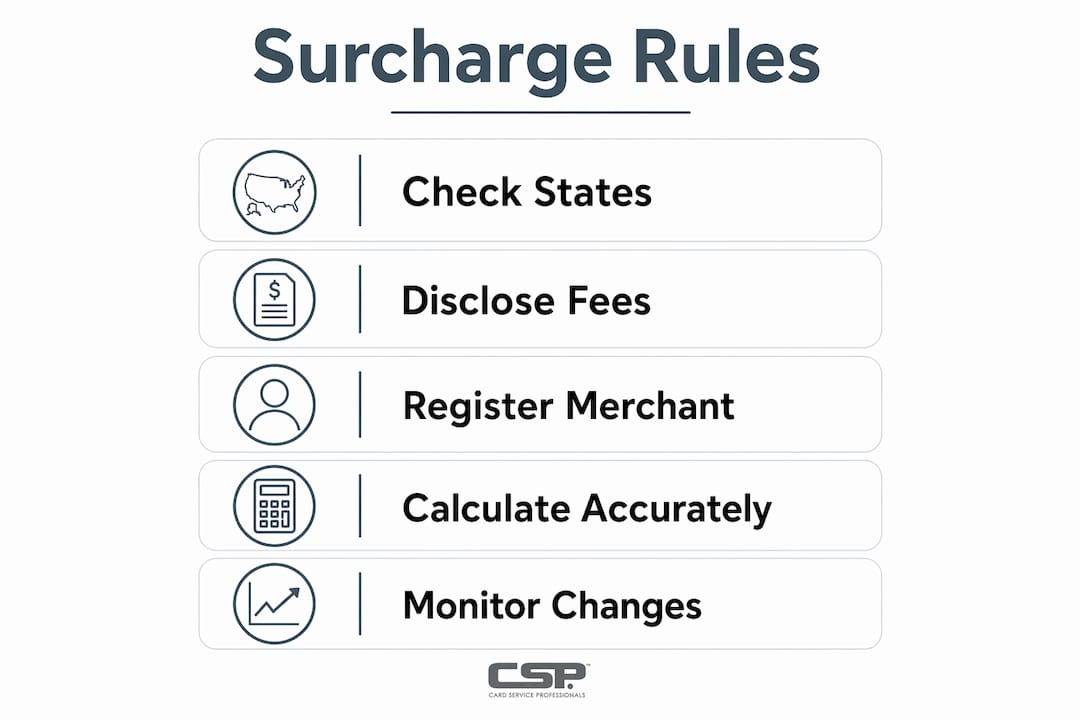
Compliance is where most merchants stumble. The rules come from two sources: card network mandates and state law. When they conflict, the stricter rule wins.
Network requirements (Visa and Mastercard):
- Register with your acquirer at least 30 days before your first surcharge transaction. Registration goes through your acquiring bank or processor, not directly with the card networks.
- Post clear disclosures at the business entrance, at the point of sale, and on every receipt as a separate line item.
- Cap the surcharge at your MDR or the network maximum (3% for Visa, up to 4% for Mastercard), whichever is lower.
- Never surcharge debit or prepaid cards. This ban is absolute under both network rules and federal law.
State-level restrictions:
Several states restrict or ban credit card surcharging entirely. As of 2026, states with prohibitions or restrictions include California, Colorado, Connecticut, Florida, Kansas, Maine, Massachusetts, New York, Oklahoma, and Texas. Connecticut’s statute is among the broadest, covering all payment methods. Maine and Massachusetts prohibit surcharges on both credit and debit cards.
New York permits surcharging but requires merchants to post the total price including the surcharge alongside the cash price. Simply posting a sign that says “4% surcharge on credit cards” does not comply there.
Pro Tip: If you sell online to customers across multiple states, you need per-transaction legality checks, not just a per-location policy. A customer in Massachusetts checking out on your website is subject to Massachusetts law regardless of where your store is located.
How to calculate surcharge amounts accurately
There are two calculation methods, and choosing the wrong one for your goal produces either a shortfall or a compliance problem.

Method 1: Simple percentage surcharge
Multiply the transaction amount by your surcharge rate. Use this when you want to add a disclosed fee on top of the listed price.
- Identify your surcharge rate (must not exceed your MDR or the network cap).
- Multiply: transaction amount × surcharge rate = surcharge fee.
- Add the surcharge fee to the transaction total.
- Display the surcharge as a separate line item on the receipt.
Method 2: Reverse-fee calculation (net target)
Use this when you need to net a specific dollar amount after processing fees are deducted. The formula is:
(Target net amount + fixed fee) ÷ (1 − percentage fee) − target net amount = surcharge
Worked example: to net $100 after a 2.9% + $0.30 processing fee, the estimated surcharge is about $3.30, making the gross charge about $103.30.
| Scenario | Target net | Processing fee | Estimated surcharge |
|---|---|---|---|
| Online card payment | $100 | 2.9% + $0.30 | $3.30 |
| Invoice payment | — | 2.9% + $0.30 | — |
| Simple 3% surcharge | — | 2.9% + $0.30 | — |
| High-ticket invoice | $1,000 | 2.9% + $0.30 | — |
| Low-ticket purchase | — | 2.9% + $0.30 | — |
Common calculation errors to avoid:
- Setting a flat rate without verifying it against your actual MDR for each card brand.
- Forgetting that the surcharge itself is processed as part of the card transaction, so reverse math must cover the fee on the gross amount, not just the net.
- Applying a fixed-fee component incorrectly by treating it as a percentage.
Pro Tip: Your credit card processing fees vary by card type. A Visa Signature card costs more to process than a standard Visa. If you set one flat surcharge rate, base it on your highest card-type MDR to stay within the “must not exceed actual cost” rule.
Surcharge vs. cash discount vs. convenience fee: what’s the difference?
These three fee types are frequently mislabeled, and mislabeling any of them can trigger compliance violations regardless of what you call it on the receipt.
| Fee type | Definition | Legal in all 50 states? | Requires network registration? | Applies to debit? |
|---|---|---|---|---|
| Credit card surcharge | Added fee on credit card transactions to recover processing costs | No (banned in several states) | Yes, 30 days in advance | No |
| Cash discount | Reduced price for customers paying cash; higher posted price is the standard | Yes | No | N/A |
| Convenience fee | Charge for using a non-standard payment channel (e.g., paying online when in-person is the norm) | Generally yes, with conditions | Varies by network | Sometimes |
A cash discount program posts a higher base price and reduces it for cash payers. Gas stations have used this model for decades. It does not trigger surcharge caps or registration requirements, and it is legal even in states that ban surcharging. The catch: the higher price must be the posted price. If you list a lower price and add a fee at the register for card users, that is a surcharge regardless of what you call it.
A convenience fee applies when a merchant offers an alternate payment channel that is not their standard method. A utility company that normally accepts checks by mail but lets customers pay online with a card can charge a convenience fee for that channel. It is not a surcharge for the payment method itself.
Pros and cons of applying a credit card surcharge
Pros:
- Recovers processing costs directly from the transactions that generate them.
- Keeps base prices stable without periodic increases to absorb fee changes.
- Encourages customers to use lower-cost payment methods like cash or debit.
- Creates pricing transparency: customers see exactly what card acceptance costs.
Cons:
- Customers in states where surcharging is banned cannot be surcharged, creating inconsistency for multi-location or online businesses.
- Some customers react negatively to checkout fees, particularly in competitive retail categories where nearby merchants absorb the cost.
- Compliance burden is real: registration, signage, receipt formatting, and ongoing monitoring of state law changes all require attention.
- Misconfigured terminals can accidentally surcharge debit cards, which violates both network rules and federal law.
The right call depends on your margins, your customer base, and your state. A high-volume merchant in a surcharge-friendly state with thin margins has a strong case. A boutique retailer in Massachusetts has no legal option to surcharge at all.
Best practices for surcharge disclosure and compliance
Disclosure is not optional, and the requirements are specific. Getting signage wrong is one of the most common reasons merchants face fines.
Required disclosure locations and content:
- Point of entry: A sign at the store entrance stating that credit card surcharges apply. Font size and clarity requirements are specified in Visa’s signage guidelines.
- Point of sale: A second notice at the register or checkout page before the customer commits to payment.
- Receipt: The surcharge must appear as a separate, labeled line item. It cannot be folded into the subtotal.
Step-by-step compliance checklist:
- Confirm surcharging is legal in every state where you operate or sell online.
- Calculate your MDR for each card brand from your processor statement.
- Set your surcharge rate at or below the lowest MDR across the card brands you accept.
- Notify your acquiring bank in writing at least 30 days before your start date.
- Order and install compliant signage at all entry points and registers.
- Configure your POS system to apply the surcharge only to credit card transactions and to print it as a separate line item.
- Train staff to explain the surcharge clearly and to identify debit vs. credit cards at checkout.
- Review your MDR and surcharge rate whenever you switch processors or renegotiate rates.
Sample compliant disclosure language for in-store signage: “We apply a [X]% surcharge to credit card transactions. This surcharge does not exceed our cost of card acceptance. Debit card and cash transactions are not subject to this fee.”
Common misconceptions and compliance pitfalls
The most expensive mistakes in surcharging are not deliberate. They come from misunderstanding the rules or assuming your processor handles compliance automatically.
Misconception 1: “My processor registers me automatically.”
Registration must be done by the merchant through the acquiring bank, not by the processor on your behalf. Assuming otherwise leaves you unregistered and exposed.
Misconception 2: “I can call it a cash discount and skip the registration.”
Only a genuinely structured cash discount program avoids registration requirements. If the fee appears only at checkout for card users and was not reflected in the posted price, it is a surcharge under network rules, full stop.
Misconception 3: “The 3% cap applies to everyone.”
Merchant discount rates vary, so a flat surcharge percentage risks noncompliance. If your effective rate on Visa credit cards is 2.4%, your surcharge ceiling is 2.4%, not 3%.
Common compliance failures include surcharging debit cards due to misconfigured terminals, exceeding network fee caps, and failing to register surcharging programs in advance. All are fixable with proper training, but the fines for getting caught start at $1,000 and can escalate to loss of card-acceptance privileges.
Pro Tip: Run a test transaction on your own terminal with a debit card after configuring surcharging. If a fee appears, your terminal is misconfigured. Fix it before a customer or auditor finds it.
How to handle disputes and chargebacks related to surcharges
Surcharge-related chargebacks usually fall into two categories: the customer was not informed of the fee before the transaction, or the fee exceeded the legal cap. Both are preventable.
When a customer disputes a surcharge, the first thing your acquirer will ask for is evidence of disclosure. That means your signage photos, your receipt showing the surcharge as a separate line item, and your registration confirmation. Without those, the chargeback is difficult to fight. Keep dated photos of your in-store signage and a copy of your acquirer registration confirmation on file.
If a customer claims the surcharge was not disclosed, review your POS configuration and signage. A legitimate dispute is a signal that your disclosure process has a gap. Correct it immediately and document the correction, because repeat disputes on the same issue suggest a systemic problem that auditors notice.
For chargebacks where the customer claims the surcharge exceeded the legal cap, pull your processor statement and verify your effective MDR at the time of the transaction. If the surcharge was within your MDR and the network cap, you have a defensible case. If it was not, refund the excess and recalibrate your rate.
How to implement surcharge fees in your retail store
Getting surcharging live requires more than flipping a switch in your POS system. The sequence matters.
- Audit your processing costs. Pull your last three months of processor statements and calculate your effective rate per card brand. This is your legal ceiling, not the network cap.
- Check state law for every location. Use your store addresses and, for online sales, consider where your customers are located.
- Set your surcharge rate. Choose a rate at or below your lowest MDR across all card brands you accept.
- Notify your acquirer in writing. Submit the required notification at least 30 days before your planned start date. Keep a copy.
- Update your POS system. Configure surcharges to apply only to credit card transactions. Debit and prepaid must be excluded. Verify the surcharge prints as a separate line item on every receipt.
- Install compliant signage. Place notices at every store entrance and at each register. Follow Visa’s font size and content specifications.
- Train your staff. Every person at the register needs to know how to explain the surcharge, how to identify debit versus credit cards, and what to do if a customer objects.
- Go live and monitor. Review your first week of transactions to confirm the surcharge is applying correctly and not hitting debit cards.
For merchants managing card brand fees across multiple card types, this audit step often reveals that your effective rate varies more than expected between card brands, which affects where you set your rate.
How to communicate surcharges to customers clearly
The goal is zero surprises at checkout. A customer who sees the surcharge for the first time on their receipt is a customer who may dispute it.
Strategies that work:
- Post the surcharge percentage prominently at the entrance, not just near the register. Customers who see it before they shop have time to decide.
- Train staff to mention the surcharge when a customer presents a credit card: “Just so you know, we apply a [X]% fee for credit card payments. Debit cards and cash have no fee.”
- On your website or online checkout, display the surcharge before the payment step, not after the customer enters card details.
Sample receipt disclosure language:
Credit card surcharge: $3.00 (3% of transaction total)
This fee reflects our cost of card acceptance and does not exceed that cost.
For online merchants, a checkout page notice works well: “A [X]% surcharge applies to credit card payments. Pay by debit card or ACH to avoid this fee.” Giving customers an alternative payment method at the same time reduces friction and complaint rates.
Which cards can you surcharge and what are the rate caps?
Surcharging applies only to credit cards. Debit card surcharges are banned under Visa and Mastercard network rules and federal law, covering both PIN-based and signature-based debit transactions. Prepaid cards are also excluded.
For credit cards, the network caps are:
- Visa: 3% or your MDR for that card brand, whichever is lower.
- Mastercard: Up to 4% in some cases, though 3% is the standard for US merchants. The MDR cap still applies.
You can apply surcharges at the brand level (all Visa credit cards) or at the product level (specific Visa card types such as Visa Signature or Visa Traditional Rewards), but not both simultaneously for the same brand. If you surcharge Visa, you must surcharge it on the same terms as any equal or higher-cost competing network that also imposes surcharge limits.
American Express has its own rules separate from Visa and Mastercard, so confirm current requirements directly with your acquirer before surcharging Amex transactions. Discover similarly maintains its own rulebook.
The MDR-as-ceiling rule is the one that catches merchants off guard. Your effective rate on premium rewards cards is typically higher than on standard cards, but your surcharge still cannot exceed your MDR for that specific card type. Understanding your merchant account fee structure by card type is the only way to set a compliant rate with confidence.
Ready to implement surcharging with confidence?
Card Service Professionals works with small business owners and retail merchants across the US to set up compliant, cost-effective payment processing programs, including surcharge programs and cash discount alternatives. If you’re unsure whether surcharging fits your business or need help calculating your MDR before setting a rate, the team at Card Service Professionals can walk you through it.
Ready to get started? Submit your application and a Card Service Professionals agent will review your current processing costs and help you determine the right approach for your locations and customer base.
Key Takeaways
Surcharging credit card transactions is legal in most US states, but compliance requires accurate calculation, advance registration, and proper disclosure at every customer touchpoint.
| Point | Details |
|---|---|
| Network rate caps | Visa caps surcharges at 3%, Mastercard allows up to 4% in some cases, but 3% is the standard for US merchants, and your actual MDR is always the binding ceiling. |
| Debit cards are excluded | Federal law and network rules ban surcharges on debit and prepaid cards, with no exceptions. |
| 30-day registration required | Notify your acquiring bank in writing at least 30 days before your first surcharge transaction. |
| Reverse-fee math for net targets | To net $100 after a 2.9% + $0.30 fee, the surcharge is about $3.30 and the gross charge is about $103.30. |
| State law overrides network rules | States including California, Colorado, Connecticut, Maine, and Massachusetts ban or restrict surcharging outright. |
Recommended
- What Is a Card Brand Fee? A Guide for U.S. Retailers – Card Service Professionals
- Credit Card Processing Explained for U.S. Retailers – Card Service Professionals
- Small Business Payment Processing Checklist for 2026 – Card Service Professionals
- Retail Payment Processing Cost Audit Guide for Merchants – Card Service Professionals
