



Card present (CP) is defined as any transaction where the physical payment card is used at a terminal in the merchant’s presence, while card not present (CNP) describes any payment made remotely without the physical card. This distinction drives nearly every difference in fraud risk, processing fees, and merchant liability that U.S. retail merchants face daily. Fraud loss rates continue to rise across both transaction types, which means understanding the gap between them is no longer optional. Getting this right protects your margins and your customers.
What is card present vs card not present, and why does it matter?
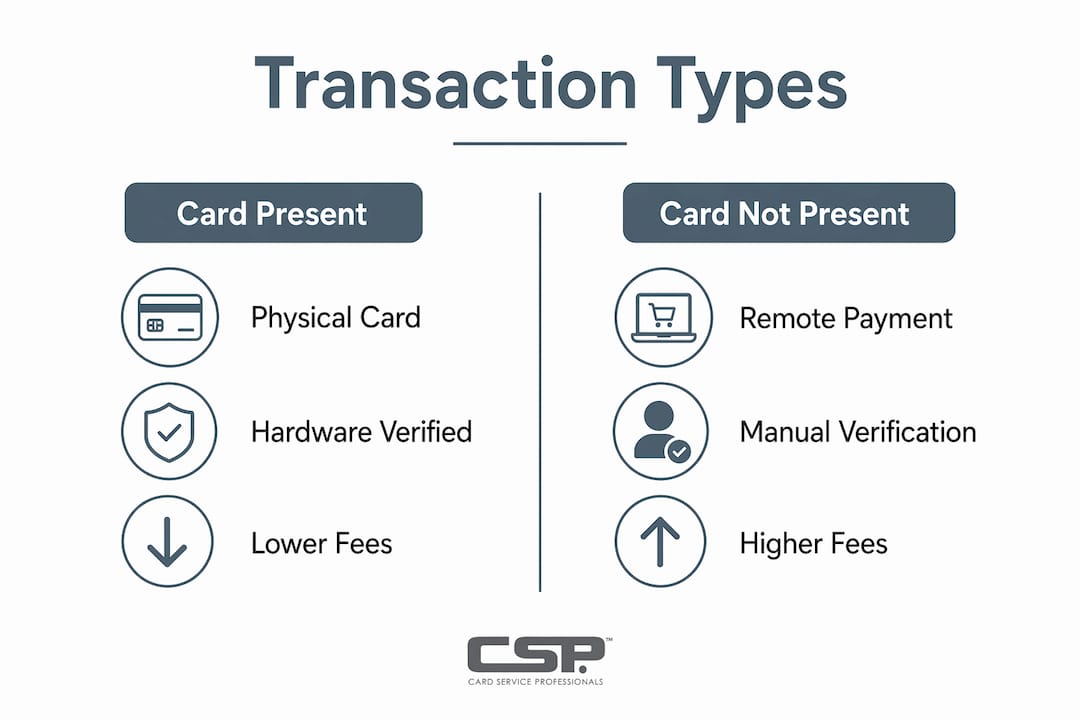
Card present transactions happen at a physical point of sale. The customer hands over a card, taps a device, or inserts a chip. The terminal reads the card data directly. Card not present transactions cover online checkout, mobile app purchases, telephone orders, and mail orders. The merchant never physically handles the card.
The core difference is verification. In a CP environment, the terminal authenticates the card through hardware. In a CNP environment, the merchant relies entirely on data the customer provides, such as a card number, expiration date, and CVV code. That gap in verification is why CNP fraud rates for non-prepaid debit cards have risen steadily through 2023, while CP fraud on dual-message networks has actually declined.

The financial stakes are real. CNP transactions carry higher interchange fees from card networks, higher chargeback rates, and a heavier burden of proof when disputes arise. Merchants who do not understand these differences often absorb losses that were entirely preventable.
How do card present transactions work, and what are their fraud risks?
Card present payments rely on three main card authentication types at the terminal level.
- EMV chip: The chip generates a unique cryptographic code for each transaction. That code cannot be reused, which makes counterfeit card fraud nearly impossible at the point of sale.
- NFC/contactless tap: Near-field communication lets customers tap a card or mobile wallet like Apple Pay or Google Pay. The same EMV cryptography applies, so the security level matches chip-and-PIN.
- Magnetic stripe swipe: The oldest method, and the weakest. Stripe data is static and can be cloned. Most U.S. merchants have moved away from swipe as the primary method, though it remains a fallback.
EMV chip and PIN authentication creates a hardware-verified audit trail that makes chargeback disputes significantly harder for customers to win. That audit trail shifts liability away from the merchant and toward the card issuer when fraud occurs. This is the single biggest financial benefit of accepting payments in person.
Processing fees for CP transactions are also lower. Card networks price interchange based on risk, and in-person payments carry less risk. Approvals happen faster because the terminal communicates directly with the network without the extra verification layers required online.
Pro Tip: If your business has a physical location, always prioritize chip-and-PIN or contactless payments over magnetic stripe swipes. The liability protection alone justifies upgrading your terminal hardware.
What security measures do card not present transactions require?
CNP transactions are the primary target for payment fraud in the United States. The reason is simple: a fraudster only needs stolen card data, not the physical card. That data is widely available through data breaches and phishing attacks.
Effective CNP security requires layered defenses, not a single tool. The industry standard stack includes:
- CVV verification: Requires the three or four digit security code printed on the card. This code is not stored in most data breaches, so it adds a meaningful filter.
- Address Verification Service (AVS): Compares the billing address the customer enters against the address on file with the card issuer. Mismatches flag potential fraud.
- Tokenization: Tokenization replaces sensitive card data with a unique token that has no value outside your payment system. Intercepted tokens are useless to fraudsters.
- 3D Secure 2.0: An authentication protocol that sends a real-time risk signal to the card issuer during checkout. High-risk transactions trigger additional verification steps, such as a one-time passcode.
- Multi-factor authentication (MFA): MFA and cryptographic authentication offset the absence of physical card verification by requiring customers to prove identity through a second channel.
CNP fees are higher because card networks price that elevated risk into interchange. Chargebacks are also more frequent and harder to dispute. The burden of proof in CNP fraud disputes heavily favors card issuers over merchants, which means losing a chargeback is the default outcome without strong transaction evidence.
Pro Tip: Review your payment gateway settings at least quarterly. Fraud patterns shift constantly, and a CVV rule that worked last year may miss new attack vectors today. Treat your fraud filters as a living system, not a one-time setup.
Merchants who accept telephone or mail orders face the same CNP risk profile as e-commerce merchants. The card is not present regardless of how the order arrives.
How do fraud rates and merchant liabilities compare?
The fraud picture between CP and CNP is not static. Federal Reserve data shows that card-present fraud on single-message networks rose even as dual-message network CP fraud declined, while CNP fraud continued its upward trend through 2023. That split matters because it shows EMV adoption has not eliminated CP fraud entirely, it has just shifted where it concentrates.
“CNP fraud continues to rise despite widespread EMV adoption at the point of sale. Fraudsters have followed the path of least resistance: away from chip-protected terminals and toward remote channels where physical card verification is impossible.”
The liability difference is the most consequential factor for merchants. In a CP transaction with an EMV chip, the card issuer bears liability for counterfeit fraud. If a merchant still uses a magnetic stripe terminal and a chip card is swiped instead of dipped, liability shifts to the merchant. This is the EMV liability shift rule, and it has been in effect in the United States since 2015.
| Transaction type | Fraud risk level | Chargeback exposure | Liability default |
|---|---|---|---|
| Card present, EMV chip | Low | Low | Card issuer |
| Card present, magnetic stripe | Medium | Medium | Merchant |
| Card not present, layered security | Medium | High | Merchant |
| Card not present, minimal security | High | Very high | Merchant |
CNP chargebacks are harder to fight because merchants cannot produce a signed receipt or a chip-verified transaction record. The burden of proof falls on the merchant to demonstrate the legitimate cardholder authorized the purchase. Without 3D Secure 2.0 authentication data or AVS match records, that case is difficult to make.
How can U.S. retail merchants optimize their payment processing strategy?
The right strategy treats CP and CNP as two distinct risk environments, each requiring its own approach.
- Default to card present where possible. CP as the default payment mode reduces fraud, lowers interchange fees, and simplifies dispute resolution. If your business model allows in-person transactions, prioritize them.
- Upgrade all terminals to EMV chip and contactless. Magnetic stripe terminals expose you to the EMV liability shift. Modern terminals that accept chip and NFC payments protect you and your customers.
- Layer CNP security tools. CVV alone is not enough. Combine AVS, tokenization, 3D Secure 2.0, and MFA for any remote transaction channel. Each layer catches fraud that the previous one misses.
- Comply with PCI DSS at all times. PCI DSS standards enforce encryption, secure data transmission, and restricted access to cardholder data. Compliance applies to every merchant, regardless of transaction volume or type.
- Monitor fraud patterns continuously. Effective CNP fraud management requires ongoing adaptation, not periodic compliance checks. Review gateway rules, chargeback reports, and fraud alerts on a regular schedule.
- Train your staff. Employees who handle telephone or mail orders need to know how to collect and verify card data correctly. A single poorly handled CNP transaction can result in a chargeback that costs more than the sale was worth.
Reviewing your payment processing costs regularly also reveals where CNP fees are eating into margins. Many merchants discover they are paying higher rates than necessary simply because their transaction mix has shifted without a corresponding rate review.
You can also review common payment processing red flags to catch problems before they become chargebacks.
Key Takeaways
Card present transactions carry lower fraud risk and merchant liability than card not present transactions, making CP the preferred default for any merchant who can accept payments in person.
| Point | Details |
|---|---|
| CP transactions use hardware authentication | EMV chip and NFC create a verified audit trail that protects merchants from most chargeback disputes. |
| CNP fraud risk is rising | Federal Reserve data confirms CNP fraud rates for non-prepaid debit cards increased steadily through 2023. |
| Layered security is required for CNP | CVV, AVS, tokenization, 3D Secure 2.0, and MFA together reduce CNP fraud exposure significantly. |
| Liability shifts with terminal type | Merchants using magnetic stripe terminals instead of EMV chip bear fraud liability under the 2015 EMV liability shift rule. |
| PCI DSS compliance is non-negotiable | All U.S. merchants must meet PCI DSS standards for encryption and cardholder data protection regardless of transaction type. |
What I’ve learned from watching merchants get this wrong
Most merchants I talk to understand that online payments carry more risk than in-store payments. What surprises them is how much that risk difference costs in real dollars once chargebacks and elevated interchange fees compound over a year. The merchants who feel it most are the ones who added an e-commerce channel without adjusting their fraud tools or reviewing their processing rates.
The other pattern I see constantly is treating security as a setup task rather than an ongoing responsibility. A merchant installs 3D Secure 2.0, checks the box, and moves on. Six months later, fraud patterns have shifted and their gateway rules are catching maybe half of what they should. Continuous fraud detection updates are not optional in a CNP environment. The threat evolves faster than most merchants realize.
My honest advice: if your business runs both in-person and online channels, audit them separately. Your CP setup and your CNP setup have different risk profiles, different fee structures, and different compliance requirements. Treating them as one system is where most merchants leave money on the table and open themselves to avoidable losses.
— Jerry
How Card Service Professionals supports your payment setup
Understanding the difference between card present and card not present transactions is the first step. Building a payment setup that handles both correctly is where most merchants need a partner.

Card Service Professionals works with U.S. retail merchants as independent sales agents for several of the leading merchant service providers in the country. The team helps merchants audit their current processing costs, identify where CNP fees are inflating margins, and set up the right mix of payment solutions for their transaction volume and risk profile. Whether you need a terminal upgrade, a cash discount program, or a full review of your fraud tools, Card Service Professionals offers competitive rates and hands-on guidance tailored to your business.
FAQ
What is the main difference between card present and card not present?
Card present transactions use the physical card at a terminal, enabling hardware authentication through EMV chip or NFC. Card not present transactions happen remotely, relying on card data alone without physical verification.
Why are card not present fees higher than card present fees?
Card networks price interchange based on fraud risk. CNP transactions carry higher fraud and chargeback rates, so networks charge merchants more to offset that elevated risk.
Does EMV chip technology protect merchants from all chargebacks?
EMV chip protects merchants from counterfeit card fraud chargebacks in card present transactions. It does not apply to CNP transactions, where merchants remain liable for most disputed charges.
What is 3D Secure 2.0 and do I need it?
3D Secure 2.0 is an authentication protocol that sends real-time risk data to the card issuer during online checkout. Any merchant accepting CNP payments online should use it to reduce fraud liability and chargeback exposure.
How often should merchants review their CNP fraud settings?
Fraud patterns shift constantly, so merchants should review gateway rules, AVS settings, and chargeback reports at least quarterly. Treating CNP fraud prevention as an ongoing process rather than a one-time setup significantly reduces loss exposure.
Recommended
- Declined Card Explained: A Merchant’s Guide to Codes – Card Service Professionals
- What Is Merchant Services? A Guide for U.S. Retailers – Card Service Professionals
- Why Accept Credit Cards in Retail: A U.S. Owner’s Guide – Card Service Professionals
- Accepting Payments on the Go: A Retail Merchant’s Guide – Card Service Professionals
