



Accepting payments for service businesses means enabling your company to receive money from customers securely through card processors, ACH transfers, and mobile payment tools. The right payment setup directly affects your revenue. Customers spend 12–18% more when paying by card compared to cash or check. That gap is real money left on the table if you only accept one or two payment methods. Processors like Square, Stripe, and ACH networks give service businesses the flexibility to collect payments in person, online, and on the go.
What are the main payment methods for service businesses?
Credit and debit card processing is the foundation of payment acceptance for most U.S. service businesses. Processors like Square and Stripe handle card transactions with minimal setup. Both connect to your existing devices and deposit funds within one to two business days.
ACH transfers and direct debit are the low-cost alternative to card payments. ACH fees run around 1%, compared to the standard card rate of 2.9% plus $0.60 per transaction. For service businesses billing large recurring amounts, like HVAC contracts or landscaping retainers, ACH can save hundreds of dollars per month.

Mobile payments like Tap to Pay let you accept contactless payments using just a smartphone. A plumber, personal trainer, or cleaning crew can collect payment on the spot without carrying a card reader. Setup takes minutes, and no additional hardware is required.
Payment links and digital invoices round out the picture. Sending payment links gives customers a direct way to pay from any device, which speeds up collection and reduces follow-up calls. Platforms like Stripe and Square both support payment link generation natively.
- Credit and debit cards: Accepted everywhere, higher fees, instant authorization
- ACH and direct debit: Lower fees, best for recurring or large invoices, 1–3 day settlement
- Tap to Pay and mobile wallets: Fast, contactless, no hardware needed
- Payment links and invoices: Flexible, works for remote clients, reduces late payments
Pro Tip: If your average invoice exceeds $500, offer ACH as a payment option at checkout. The fee savings add up fast, and most clients are comfortable with it for larger bills.
How do payment processing fees and pricing models differ?
Fee structures vary widely, and the wrong model can cost a growing service business thousands per year. The two main models are flat-rate pricing and interchange-plus pricing.
Flat-rate pricing charges a single fixed rate on every transaction, typically 2.9% plus $0.60 per card swipe. Square and Stripe both use this model. It is easy to predict costs, which makes it popular with newer businesses. The downside is that flat-rate pricing does not distinguish between a low-cost debit card and a premium rewards card, so you pay the same rate regardless.
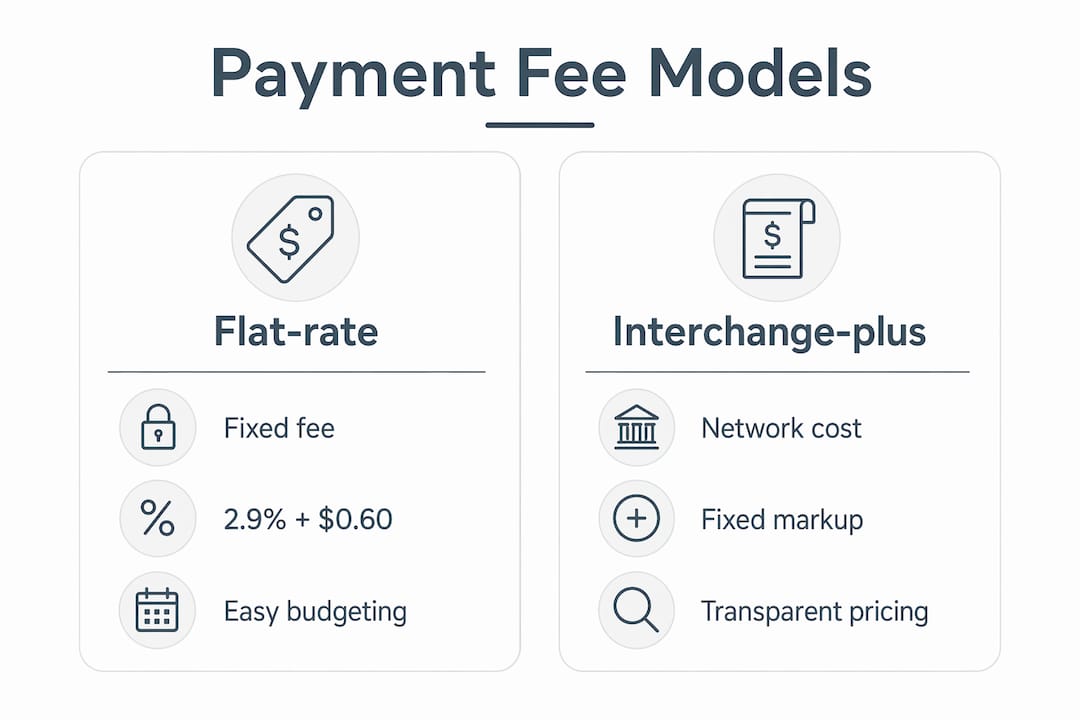
Interchange-plus pricing charges the actual card network cost plus a fixed markup. This model is more transparent and typically cheaper for businesses processing higher monthly volumes. A business running $30,000 per month in card volume will almost always pay less under interchange-plus than flat-rate.
| Pricing model | Best for | Typical cost | Transparency |
|---|---|---|---|
| Flat-rate | Low volume, new businesses | 2.9% + $0.60 per transaction | Low |
| Interchange-plus | Mid to high volume | Varies, usually lower overall | High |
| ACH/direct debit | Large or recurring invoices | Around 1% per transaction | High |
Pro Tip: Ask your processor for a monthly statement review. Hidden fees like batch fees, monthly minimums, and PCI non-compliance charges often appear in the fine print. Reviewing your statement quarterly catches these before they compound.
Understanding ecommerce payment processing fees in detail helps you compare processors on equal footing. Never compare processors using only the headline rate.
What are the key security and compliance requirements?
PCI DSS (Payment Card Industry Data Security Standard) compliance is not optional. Every business that accepts card payments must meet PCI standards, regardless of size. Non-compliance exposes you to fines and liability if a breach occurs.
Storing customer card numbers manually immediately violates PCI compliance. This includes writing card numbers in a spreadsheet, saving them in email, or keeping paper receipts with full card data. The risk is not theoretical. A single breach can result in fines, chargebacks, and loss of your ability to process cards.
Annual PCI Self-Assessment Questionnaires (SAQs) are required even when you use a hosted payment gateway. Non-compliance fees typically run $19–$100 per month, depending on your processor. Completing the SAQ takes less than an hour for most small service businesses using hosted solutions.
Businesses must never store credit card data outside secure, hosted gateways. Hosted solutions like Stripe and Square handle encryption and tokenization on their end, keeping your business out of direct contact with raw card data.
Key security practices every service business should follow:
- Use a hosted payment gateway so card data never touches your servers
- Complete your annual SAQ through your processor’s compliance portal
- Enable two-factor authentication on your payment processor account
- Review payment data security practices regularly to stay current on threats
- Never email or text card numbers, even at a customer’s request
How to choose the right payment solution for your business
Choosing the right payment setup starts with knowing your transaction volume, your payment channels, and your customers’ preferences. A one-size-fits-all approach rarely works for service businesses.
-
Calculate your monthly card volume. If you process under $10,000 per month, flat-rate pricing from Square or Stripe is simple and cost-effective. Above $20,000 per month, interchange-plus pricing from a dedicated merchant services provider will likely save you money.
-
Identify your payment channels. Do you collect payments in person, over the phone, or online? A mobile reader covers in-person jobs. A payment gateway like Stripe handles online invoices. Many service businesses need both.
-
Evaluate contract terms carefully. Month-to-month agreements give you flexibility. Long-term contracts with early termination fees lock you in. Read the full agreement before signing, and ask specifically about monthly minimums and PCI fees.
-
Add payment links for remote clients. Payment links increase flexibility and reduce the time between invoice and payment. Clients can pay from any device without logging into a portal.
-
Consider a cash discount program. Some processors, including those Cardserviceprofessionals works with, offer cash discount programs that pass the processing fee to card-paying customers. This can effectively eliminate your card processing costs while still accepting all major cards.
The CSP Advantage explains how working with a dedicated merchant services agent differs from signing up directly with a processor. Agents negotiate rates and provide ongoing support that self-service platforms do not offer.
Key Takeaways
Accepting card payments, ACH transfers, and mobile payments is the baseline for any competitive U.S. service business, and choosing the right pricing model and staying PCI compliant determines how much of that revenue you actually keep.
| Point | Details |
|---|---|
| Card payments increase revenue | Customers spend 12–18% more when paying by card versus cash or check. |
| ACH cuts costs on large invoices | ACH fees run around 1%, far below the standard 2.9% + $0.60 card rate. |
| Interchange-plus saves money at volume | Mid to high-volume businesses pay less under interchange-plus than flat-rate pricing. |
| PCI compliance is mandatory | Annual SAQ completion is required, and non-compliance fees run $19–$100 per month. |
| Payment links speed up collections | Sending payment links reduces follow-up and gets invoices paid faster. |
What I’ve learned after years of watching service businesses get this wrong
Most service businesses set up payments once and never revisit the decision. That is the single most expensive mistake I see. A landscaping company signs up with a flat-rate processor at startup, grows to $50,000 per month in card volume, and is still paying flat-rate three years later. The savings from switching to interchange-plus at that volume are not marginal. They are material.
The second mistake is ignoring PCI compliance until something goes wrong. I have seen small businesses get hit with months of non-compliance fees they did not even know were accumulating. Your processor charges these quietly in your monthly statement. Most business owners never look closely enough to catch it.
The third mistake is treating payment processing as a commodity. Not all processors are equal. The headline rate is not the total cost. Batch fees, statement fees, monthly minimums, and chargeback fees all add up. Working with a merchant services agent who reviews your full cost picture is worth far more than the time it takes to shop on rate alone.
My recommendation is to review your processing statement every quarter. Know your effective rate (total fees divided by total volume). If it is above 2.5% and you are doing meaningful volume, you are likely overpaying. The market is competitive, and better terms are available if you ask.
— Jerry
How Cardserviceprofessionals can help you accept payments
Cardserviceprofessionals works with some of the leading merchant service providers in the world to give U.S. service businesses competitive rates, transparent pricing, and full access to every electronic payment option available.
Whether you need a mobile reader for field work, an online gateway for invoicing, or a cash discount program to reduce processing costs, Cardserviceprofessionals has a solution built for service businesses. The application process is straightforward, and you get a dedicated agent who reviews your full cost picture, not just the headline rate. Visit Cardserviceprofessionals to see available solutions, or go directly to the sign-up application to get started today.
FAQ
What is the standard credit card processing fee for service businesses?
Standard card processing fees average 2.9% plus $0.60 per transaction for flat-rate pricing. ACH transfers typically cost around 1%, making them a cheaper option for large or recurring invoices.
Do I need to be PCI compliant if I use Square or Stripe?
Yes. Using a hosted processor like Square or Stripe reduces your compliance scope, but you still must complete an annual PCI Self-Assessment Questionnaire. Skipping it results in monthly non-compliance fees from your processor.
What is interchange-plus pricing and when does it make sense?
Interchange-plus pricing charges the actual card network cost plus a fixed markup. It makes sense for service businesses processing more than $20,000 per month in card volume, where the savings over flat-rate pricing become significant.
Can I accept payments without a card reader?
Yes. Payment links and Tap to Pay on a smartphone let you collect card payments without any hardware. Both Square and Stripe support these options natively.
What is a cash discount program?
A cash discount program passes the card processing fee to customers who pay by card, while offering a discount to customers who pay with cash. It effectively eliminates processing costs for the business while remaining compliant with card network rules.
Recommended
- Card Service Professionals – Credit Card Processing Experts
- Sign Up Application – Card Service Professionals
- Terms & Conditions – Card Service Professionals
- Blog – Card Service Professionals
